//

Industry Insights392 articles · Page 26 of 33
Industry Insights
AI market news translated into workflow decisions, risk boundaries, and practical next steps for small businesses.
Industry Insights articles, page 26
Industry Insights·
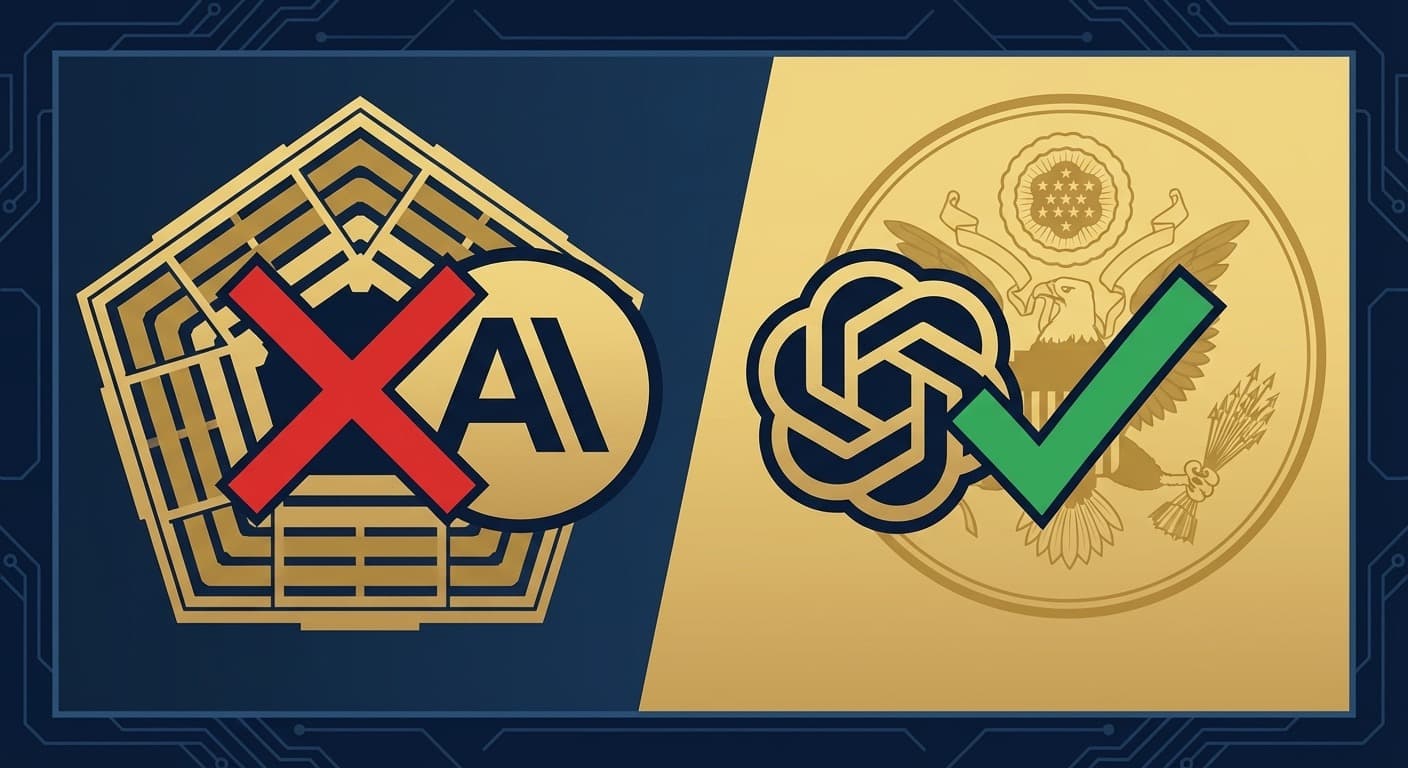
Anthropic Gets Blacklisted, OpenAI Gets the Contract: Five AI Shifts That Rewired the Market Today
The Trump administration designated Anthropic a national security supply-chain risk, OpenAI signed the Pentagon deal within hours, Google's Gemini 3.1 Pro doubled its ARC-AGI-2 score, and OpenAI closed a $110B funding round. Here's what it means if you're building on any of these platforms.
7 min read
Industry Insights·
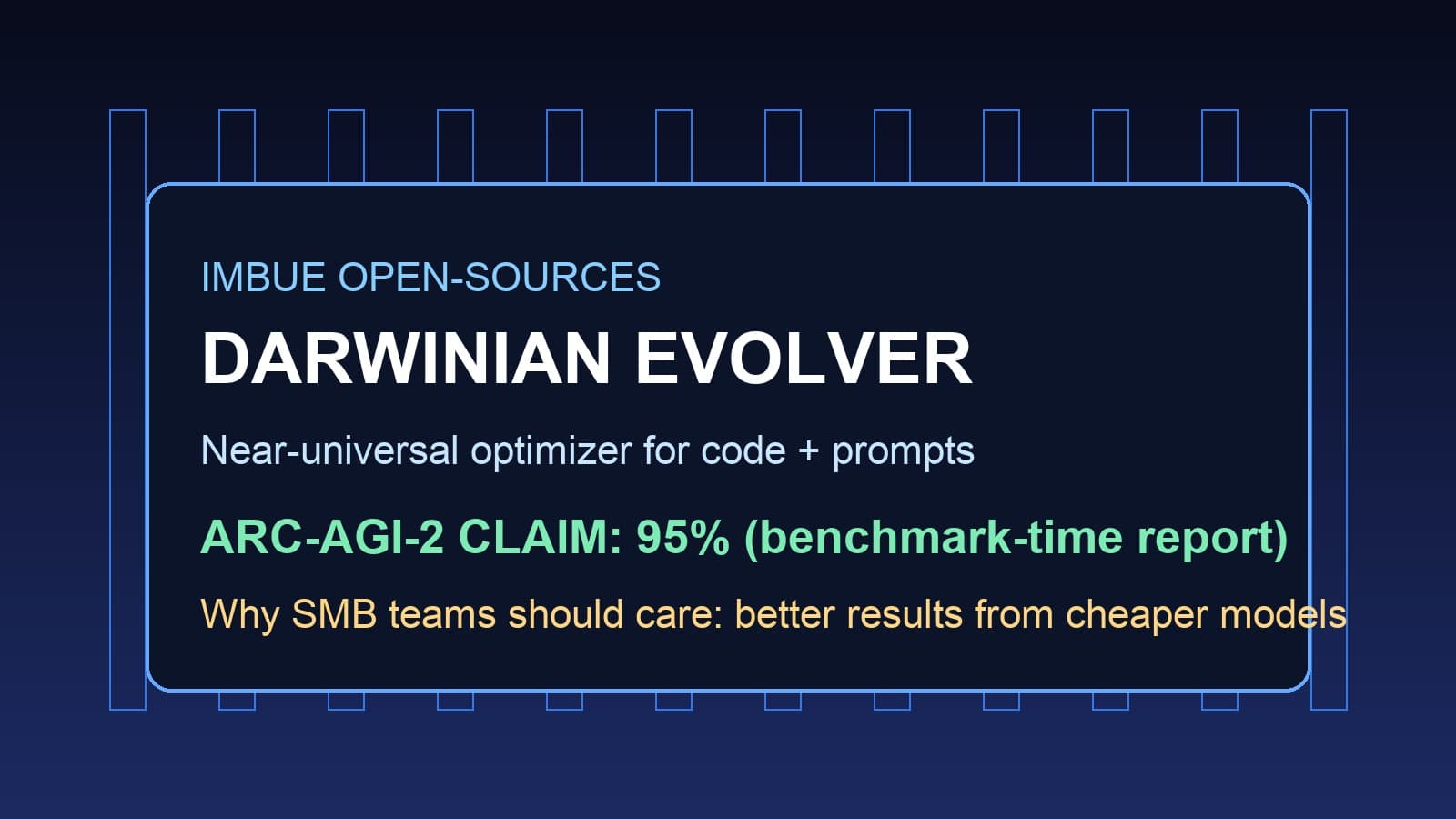
Imbue Open-Sources Darwinian Evolver: Why SMB Teams Should Watch This AI Optimization Framework
Imbue has open-sourced Darwinian Evolver, a framework for automatically improving code and prompts. Their ARC-AGI-2 report claims up to 95.1% with Gemini 3.1 Pro and a near-3x lift for open-weight Kimi K2.5. Here is what small and mid-sized businesses can actually do with that signal.
6 min read
Industry Insights·
OpenAI’s $110B Round, 4,000 AI Job Cuts, and a March 9 Migration Clock: What Agency Operators Need to Reprice
A single day delivered an $840B OpenAI valuation move, explicit AI-driven headcount cuts, and migration deadlines that force near-term workflow decisions for agency operators.
7 min read

Industry Insights·
11 Model Releases That Changed Deployment Plans This Week
The last seven days delivered meaningful model upgrades across reasoning, coding, multimodal, and video stacks. The headline is not benchmark theater; it is where teams can cut spend, avoid migration risk, and pick faster pilot lanes.
9 min read
Industry Insights·
Today in AI: DeepSeek’s V4 Access Split Signals a New Hardware Power Play
DeepSeek reportedly gave Huawei early V4 access while excluding Nvidia and AMD, Reuters says OpenAI and Anthropic are paying up to $400K for forward-deployed engineers, and AI platform economics keep shifting from benchmarks to deployment velocity.
5 min read

Industry Insights·
Today in AI: Anthropic Buys Vercept to Push Computer-Use Agents — Plus 7 More Updates
Anthropic acquires Vercept, Perplexity launches a 19-model agent stack, Alibaba ships Qwen 3.5 Medium, and NVIDIA previews Vera Rubin performance gains. Here are the AI developments worth your attention from February 25, 2026.
4 min read

Industry Insights·
Google Absorbs Intrinsic to Speed Up Physical AI in Factories
Google is bringing Intrinsic into the company to scale AI-powered robotics across manufacturing and logistics. The move could lower integration costs and shorten the timeline from robot simulation to production.
6 min read

Industry Insights·
Samsung's Pixel-Level Privacy Push Signals the Next Battle in Mobile AI
Samsung says a new privacy layer is coming to Galaxy devices, with app-level controls and pixel-level shielding against shoulder surfing. The move highlights a major shift: mobile AI features now compete on trust and privacy architecture, not just model quality.
5 min read
Industry Insights·
MiniMax M2.5: The $1-an-Hour AI That Outcodes Claude
Chinese AI startup MiniMax just released M2.5, a coding-focused model that matches Claude Opus 4.6 on benchmarks while costing $1 per hour to run continuously. It is fully open-source and already shaking up the API pricing landscape.
4 min read
Industry Insights·
Grok 4.20 Beta1 Hits #1 on Search Arena: What xAI's Search Dominance Means for Small Business Research
xAI's Grok 4.20 Beta1 just claimed the top spot on Search Arena with a score of 1226, surpassing GPT-5.2 and Gemini-3. For small businesses, this signals a fundamental shift in how AI can power competitive intelligence and market research.
5 min read

Industry Insights·
Claude Opus 4.6 Claims Code Supremacy: What This Means for Your Business
Anthropic's Claude Opus 4.6 has obliterated the competition on LMArena's Code Leaderboard, achieving a 1560 Elo rating nearly 100 points ahead of its nearest rival. This isn't just a benchmark win—it's a signal that the AI coding gap is widening fast.
4 min read

Industry Insights·
Today in AI: Confluence Labs Scores 97.9% on ARC-AGI-2 — Plus 8 More Updates
A YC-backed stealth startup nearly cracks the hardest reasoning benchmark, SWE-bench goes multilingual, Bridgewater pegs Big Tech AI spend at $650 billion, and Reve's first image model lands in the Arena top three. Everything that moved in AI on February 24, 2026.
4 min read
Explore Other Categories

AI Development
Implementation notes for building AI tools around real business data, handoffs, review queues, and safeguards.
189 articles

Announcements
Product notes, service updates, and BaristaLabs news that affect how small teams use AI at work.
9 articles
Machine Learning
Model concepts explained through thresholds, queues, and error costs that small teams can actually manage.
14 articles

Small Business AI
Plain-language guidance for owners and operators choosing one useful, reviewable AI workflow at a time.
97 articles
Technical Tutorials
Hands-on guides for approval policies, shadow weeks, agent receipts, and other AI workflow controls.
26 articles