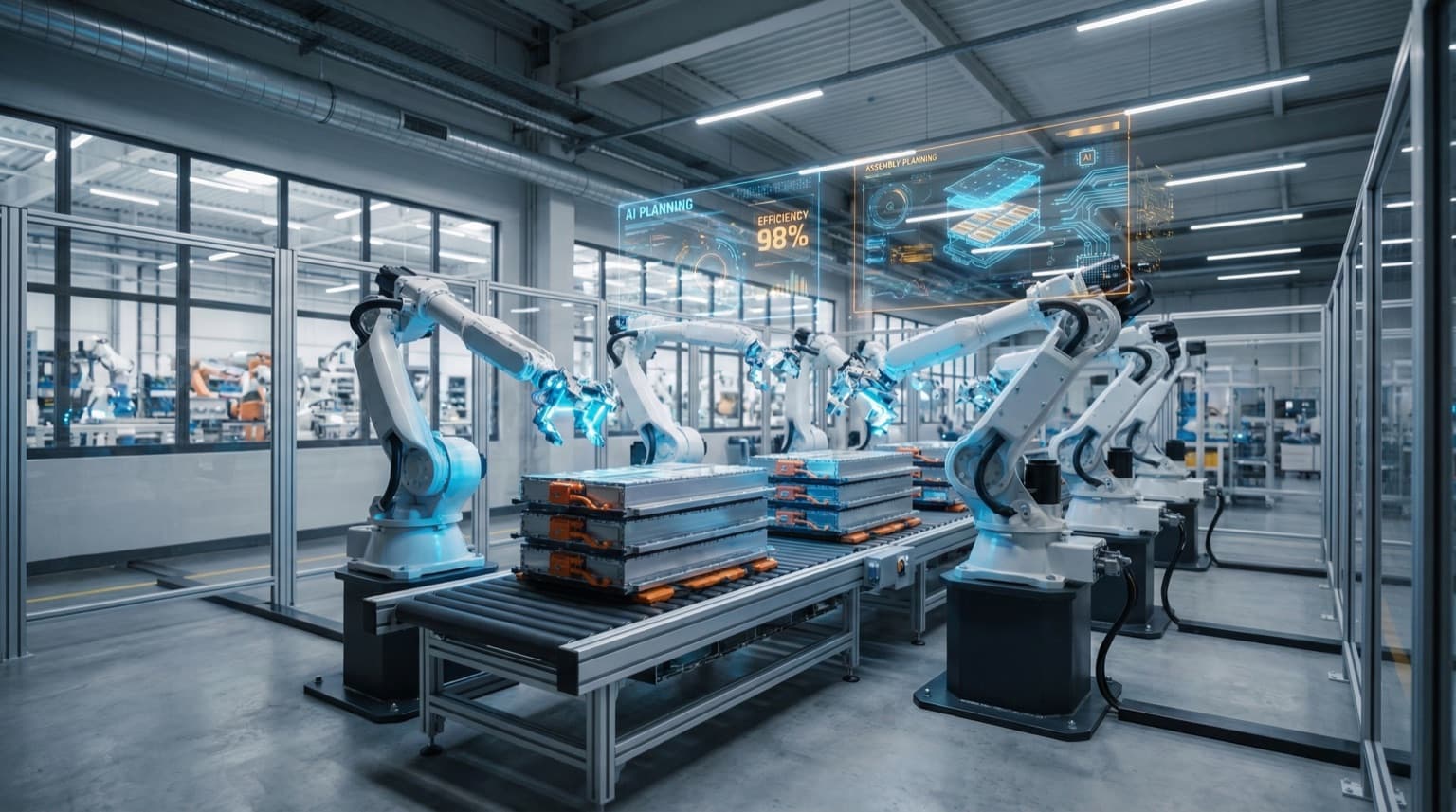

Google is pulling Intrinsic directly into the company, and that matters more than a typical acquisition headline. In Intrinsic's announcement, the team frames physical AI as the layer that connects model intelligence to real work: assembly, testing, movement, and adaptation on the factory floor. The strategic point is simple: if AI is going to reshape operations, it has to leave the browser tab and survive contact with hardware.
This is not Google dabbling in robotics again. This is Google moving a platform team with existing industrial tooling closer to the core AI stack.
Why Intrinsic is more than a robotics startup
Intrinsic has been building what many operators wanted for years: a way to develop robotic workflows without starting every deployment from scratch. Their platform already supports mixed hardware environments, where robots, sensors, cameras, and control systems come from different vendors. That is a huge detail for real businesses because very few factories are greenfield installations.
In practical terms, Intrinsic's model is "Android for robotics":
- A common layer for building workflows across heterogeneous hardware
- Reusable robot behaviors ("skills") instead of one-off codebases
- Simulation-first development through Flowstate before physical rollout
- Faster reprogramming when product mix or line configuration changes
That approach reduces the historical tax on robotics projects: custom integration work that takes months, then breaks when a single component changes.
The integration math Google is chasing
Google has world-class strengths in cloud infrastructure, AI models, and developer tooling. Intrinsic adds a missing bridge: repeatable execution in physical environments. Put together, Google can now pitch a fuller stack that looks like this:
- Perception and reasoning models for detection, planning, and adaptation
- Simulation and orchestration tools to test workflows before deployment
- Cross-vendor runtime layer for actual robotic execution
- Enterprise distribution through existing Google relationships
For small and mid-sized manufacturers, the promise is not humanoid robots in every aisle. The promise is lower project risk. If this integration works, more teams will be able to automate narrow but expensive tasks: quality inspection, parts handling, pallet movement, and repetitive assembly steps where labor scarcity already hurts margins.
Three operational shifts to watch over the next 12 months
1) Pilot cycles get shorter
Most automation pilots fail because setup time eats the budget before value appears. Intrinsic's simulation-to-production workflow is built to collapse that gap. Teams can validate logic in simulation, then push to real systems with fewer custom rewrites.
If Google tightens this loop using its cloud and AI services, pilot timelines could move from quarters to weeks for bounded use cases.
2) Robot vendor lock-in starts to weaken
Factories often avoid new automation because they fear platform dead-ends. Intrinsic's cross-hardware orientation directly challenges that. A neutral software layer means buyers can preserve optionality when selecting robot arms, grippers, sensors, or machine vision modules.
Procurement teams should watch whether Google keeps this interoperability posture or narrows it over time.
3) AI spend shifts from demos to throughput
Generative AI projects inside many operations teams still sit in "assistant" territory: summarization, drafting, dashboards. Useful, but indirect. Physical AI ties spending to hard metrics like cycle time, defect rates, and uptime.
That makes finance conversations easier. When a workflow cuts rework or increases line utilization, the ROI case is less theoretical.
Where this collides with current industry momentum
This move lands during a broader push to operationalize AI in environments outside software-only workflows. We are seeing the same pattern in compute and infrastructure: heavy bets on systems that can support autonomous decision-making with real-time constraints. Our recent breakdown of NVIDIA Blackwell Ultra GB300 highlighted the hardware side of that shift.
On the application side, physical intelligence is becoming a recurring theme in robotics announcements. If you want another reference point, compare this with our coverage of Alibaba's RynnBrain physical AI system, which focuses on spatial and temporal understanding for embodied agents.
Different vendors, same trajectory: AI value migrates from chat interfaces into execution systems.
A 30-day test plan for operations leaders
If you run a facility, distribution network, or manufacturing line, you do not need to wait for a full platform migration to act. Use this announcement as a trigger for a focused experiment:
- Pick one repetitive task with measurable bottlenecks (inspection, sorting, load transfer, etc.)
- Estimate baseline metrics: cycle time, error rate, downtime, labor intensity
- Simulate alternative workflows before touching live operations
- Define a strict success threshold (for example: 15% cycle-time improvement or 20% error reduction)
- Gate expansion on observed gains, not vendor roadmaps
The core idea is to treat physical AI like a throughput program, not a branding program.
What this means for Barista Labs clients
For SMB and mid-market operators, this acquisition is a signal that physical AI is moving into mainstream enterprise channels faster than expected. The winners will not be the companies that "adopt AI" in abstract terms. The winners will be teams that map specific operational constraints to specific automation workflows and instrument the results.
Google did not just buy a robotics narrative. It bought a deployment surface.
And once AI has a deployment surface in the physical world, the conversation changes from experimentation to execution.
AI Pilot Readiness Checklist
Turn the idea into a pilot you can defend.
AI agent articles are easy to bookmark and hard to operationalize. Use the readiness questions as a shared way to decide whether a workflow is specific enough, safe enough, and measurable enough to pilot. If they surface a strong candidate, BaristaLabs can review it with you and help shape a first version that fits your systems, approval process, and risk tolerance.
Please do not submit PHI, customer records, credentials, or confidential workflow exports.
Practical AI Workflow Notes
Want more practical AI operations ideas?
Get short notes on applying AI inside real small-business workflows — from document handling and customer follow-up to internal reporting, compliance, and automation guardrails.