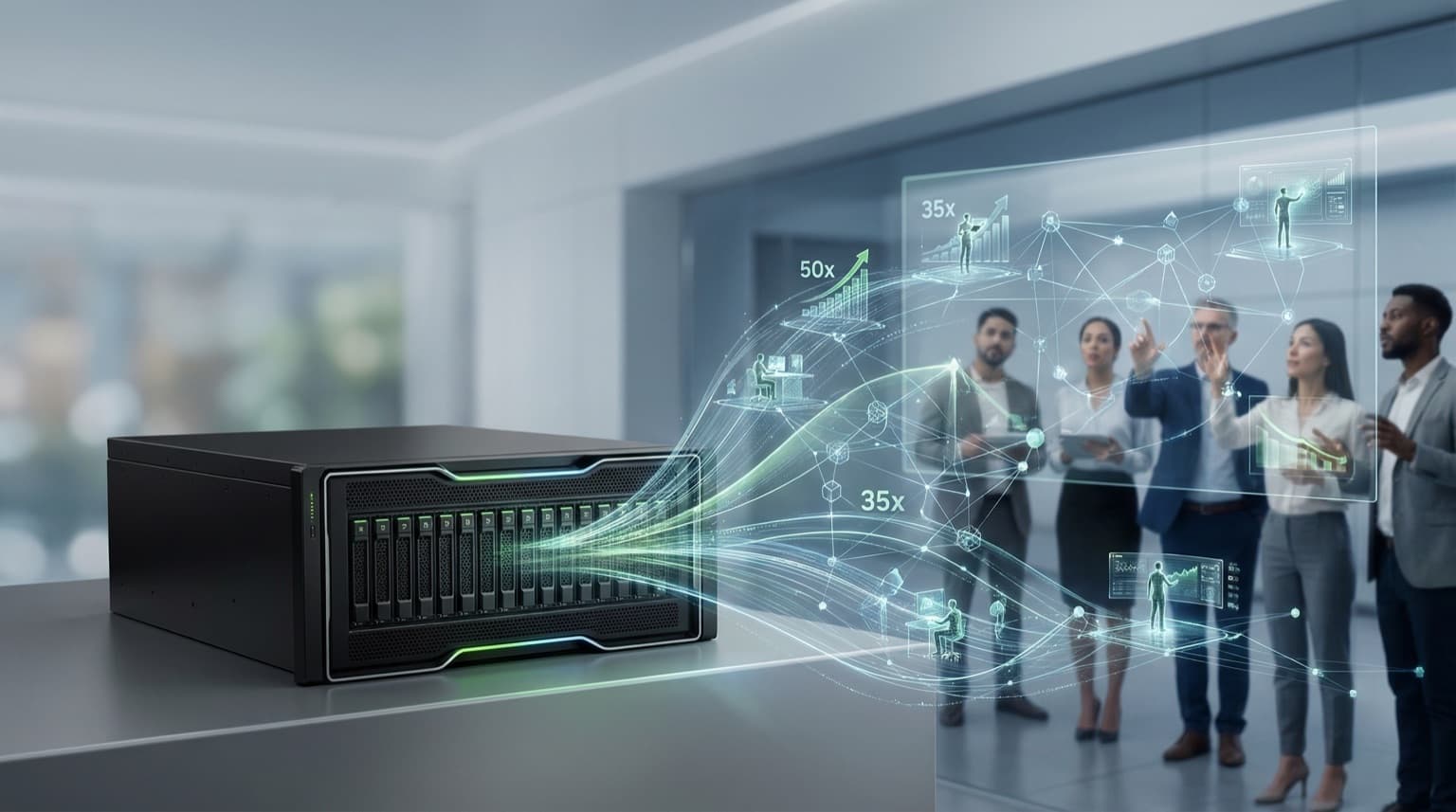

The era of "Agentic AI"—artificial intelligence that doesn't just chat but actively reasons, plans, and executes complex tasks—just got a massive turbocharge.
Today, February 16, 2026, NVIDIA unveiled the Blackwell Ultra GB300, a powerhouse chip designed specifically to break the bottlenecks of modern AI agents. While previous generations focused on training massive models, the GB300 is built for inference—the actual thinking and doing that agents perform in real-time.
For businesses waiting for AI employees that are fast, reliable, and affordable, this is the hardware that makes it possible.
The Numbers That Matter
The specs released by NVIDIA are staggering. Compared to the previous Hopper architecture, the Blackwell Ultra GB300 delivers:
- 50x Higher Performance: Specifically for "agentic" workloads that require deep reasoning and multiple steps.
- 35x Lower Cost: Drastically reducing the price per token generated.
- 1.5x More Power: Than even the recent GB200 NVL72 system.
According to NVIDIA's announcement, the system leverages a new NVL72 rack-scale architecture that acts as a single massive GPU, allowing agents to "think" without getting bogged down by memory constraints.
Why This Matters for Small Business
You might think enterprise-grade hardware is irrelevant to a small business owner. But in the world of cloud AI, hardware is price and capability.
1. Agents Become Affordable Employees
Until now, running a sophisticated AI agent that could reason through a complex problem (like "audit my last 3 months of expenses and categorize them") was prohibitively expensive. The compute costs for "reasoning models" added up quickly.
With a 35x reduction in cost, these high-IQ agents move from "luxury tool" to "everyday utility." Small businesses can now afford to deploy autonomous agents for customer support, data entry, and market research 24/7.
2. The "Wait Time" Disappears
"For agentic coding and interactive assistants workloads where every millisecond compounds across multistep workflows," NVIDIA explains, speed is critical.
If an agent needs to think for 10 seconds for every step of a 5-step task, you're waiting nearly a minute for a result. That's too slow for customer service. The GB300's 50x performance boost means those 50-second waits could drop to sub-second responses.
3. Smarter, Not Just Faster
The GB300 is designed for the "Age of AI Reasoning." This means it handles the messy, non-linear thinking required for real-world tasks. For a small business, this translates to an AI that doesn't just follow a script but can handle exceptions—like a shipping delay or a unique client request—without crashing or asking for human help.
The Technical Edge
Under the hood, the Blackwell Ultra GB300 isn't just a faster chip; it's a rethinking of how AI computers work. It uses liquid cooling to run denser, hotter chips efficiently, and features 800 Gb/s of data throughput per GPU.
This bandwidth is crucial. Agentic AI requires constant "context switching"—remembering a conversation from last week, looking up a database record, and writing an email simultaneously. The GB300 handles this memory shuffling effortlessly.
What's Next?
As cloud providers like AWS, Azure, and CoreWeave begin deploying these GB300 systems later this year, we expect to see a wave of more capable, less expensive AI SaaS tools hitting the market.
For the small business owner, the message is clear: the barrier to entry for employing a digital workforce is crumbling. The hardware is ready; now it's time to get to work.
Ready to integrate AI agents into your business workflow? Contact us to learn how we can help you build your future workforce.
AI Pilot Readiness Checklist
Turn the idea into a pilot you can defend.
AI agent articles are easy to bookmark and hard to operationalize. Use the readiness questions as a shared way to decide whether a workflow is specific enough, safe enough, and measurable enough to pilot. If they surface a strong candidate, BaristaLabs can review it with you and help shape a first version that fits your systems, approval process, and risk tolerance.
Please do not submit PHI, customer records, credentials, or confidential workflow exports.
Practical AI Workflow Notes
Want more practical AI operations ideas?
Get short notes on applying AI inside real small-business workflows — from document handling and customer follow-up to internal reporting, compliance, and automation guardrails.
Related Posts
Meta Is Running AI Agents on CPUs Alone -- and It Changes How Every Business Should Think About AI Hardware
NVIDIA Dynamo 1.0 turns inference into an operating-system problem — and every major cloud provider just signed up.
Adobe and NVIDIA just moved creative AI past image generation and into the production system.