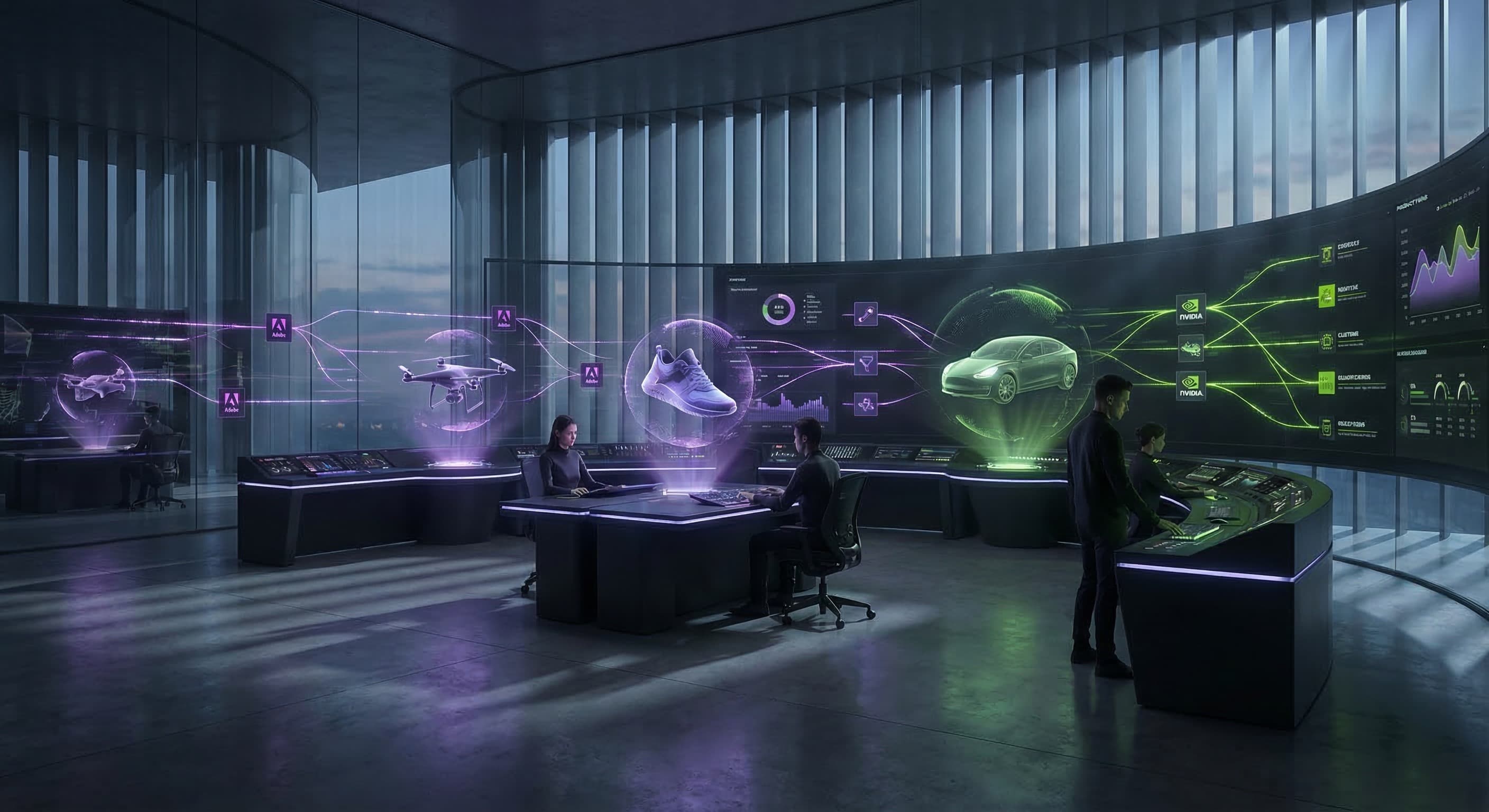

Most AI partnerships still read like model theater: bigger benchmarks, faster inference, prettier demos. Adobe and NVIDIA’s announcement at GTC landed differently. This one is aimed at the part of the stack where creative work actually gets bottlenecked — asset production, brand consistency, review cycles, and campaign throughput.
Adobe says it will use NVIDIA CUDA-X, NeMo libraries, Cosmos open models, and Agent Toolkit to power the next generation of Adobe Firefly foundational models. The two companies are also collaborating on agentic creative and marketing workflows designed to increase content, campaign, and production speed.
That alone would be enough to make the announcement notable. The sharper signal is that Adobe is also launching a public beta for a cloud-native, brand identity-preserving 3D digital twin system built on NVIDIA Omniverse. The promise is marketing automation that can generate consistent pack shots, lifestyle imagery, 3D product experiences, and virtual try-ons from a persistent product representation instead of rebuilding assets from scratch every time.
This is a workflow story disguised as a model story
Shantanu Narayen and Jensen Huang both framed the partnership as a deeper integration between Adobe’s applications and NVIDIA’s AI infrastructure, not a one-off feature add. Narayen emphasized creative precision, control, 3D digital twins, and agentic frameworks. Huang described it as Adobe and NVIDIA taking a long-standing partnership to a new level by uniting research and engineering teams.
That framing matters. The market is flooded with AI tools that can produce a nice image in isolation. Very few can keep a brand system intact across image, video, 3D, documents, campaign ops, and approval workflows.
Adobe is trying to make Firefly more than a generation surface. NVIDIA is giving it the compute, model infrastructure, and agent tooling to behave more like a production layer.
The digital twin move is the most commercially important piece
The Omniverse-based 3D digital twin announcement is the part that deserves the most attention.
A brand identity-preserving product twin solves a more expensive problem than prompt quality. Teams do not usually lose time because nobody can generate an image. They lose time because every channel needs a slightly different asset, every region needs a variant, every stakeholder wants a revision, and every new render risks drifting away from the approved product reality.
A cloud-native product twin changes that equation. If the source object is persistent and interoperable, marketing teams can generate pack shots, contextual lifestyle scenes, interactive 3D experiences, and virtual try-ons from a governed base instead of re-creating the product visually in every workflow. That is where content automation starts looking less like gimmickry and more like margin improvement.
Firefly Foundry points straight at enterprise control
Adobe also said Firefly Foundry will integrate NVIDIA AI infrastructure to deliver commercially safe custom AI at scale, tuned deeply on a company’s proprietary brand content.
This is the enterprise wedge.
Generic generation is easy to demo and hard to operationalize. Enterprises care about IP protection, approved visual language, legal safety, and repeatable output across teams. A custom Firefly layer tuned on owned content is Adobe’s answer to that problem, and NVIDIA’s role gives Adobe a credible path to run those systems with the performance and flexibility large organizations expect.
The long list of Adobe products getting acceleration also reinforces the point: Acrobat, Photoshop, Premiere Pro, Frame.io, GenStudio, and Experience Platform are not random add-ons. They are the actual route from asset creation to campaign execution. If AI improvements touch all of them, Adobe is not just improving generation quality — it is tightening the full operating loop.
The part that changes the toolchain
The phrase to watch in this announcement is not “next-gen Firefly.” It is “agentic creative and marketing workflows.”
That suggests Adobe wants AI to do more than generate assets on request. It wants systems that can move work across steps: assembling campaign variants, adapting content to channels, preserving brand constraints, coordinating production tasks, and feeding output into downstream marketing platforms with less manual glue.
Most teams today still stitch that flow together with a mess of prompts, folders, spreadsheets, reviews, and one-off automation. Adobe and NVIDIA are betting that the next competitive layer is not raw generation quality. It is controlled orchestration.
Verdict: this partnership matters because it moves AI value away from isolated creation and closer to the governed production systems that decide whether marketing work ships fast, stays on-brand, and scales without multiplying headcount.
AI Pilot Readiness Checklist
Turn the idea into a pilot you can defend.
AI agent articles are easy to bookmark and hard to operationalize. Use the readiness questions as a shared way to decide whether a workflow is specific enough, safe enough, and measurable enough to pilot. If they surface a strong candidate, BaristaLabs can review it with you and help shape a first version that fits your systems, approval process, and risk tolerance.
Please do not submit PHI, customer records, credentials, or confidential workflow exports.
Practical AI Workflow Notes
Want more practical AI operations ideas?
Get short notes on applying AI inside real small-business workflows — from document handling and customer follow-up to internal reporting, compliance, and automation guardrails.