
There is a persistent myth in enterprise AI: if you want to do anything meaningful with artificial intelligence, you need a rack full of GPUs. Meta just quietly proved that wrong.
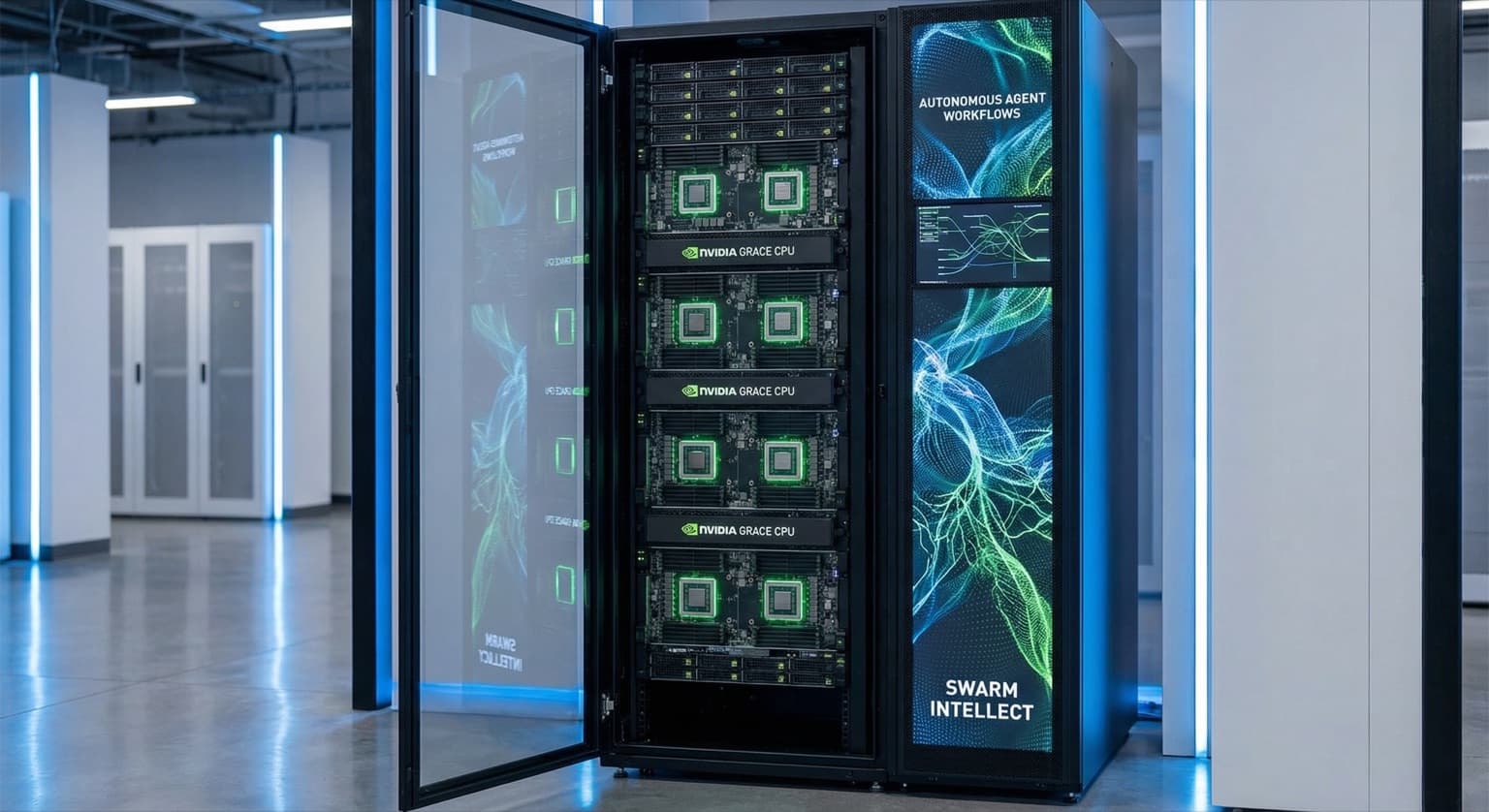
On Tuesday, Meta and NVIDIA announced a sweeping multi-year infrastructure partnership that will see millions of NVIDIA Blackwell and next-generation Vera Rubin chips deployed across Meta's data centers. The headlines focused on the sheer scale -- Mark Zuckerberg's goal to "deliver personal superintelligence to everyone in the world" -- but the most practically useful detail got buried: Meta is now running agentic AI workloads on CPU-only NVIDIA Grace systems, no GPU required.
That matters far more for your business than another billion-dollar infrastructure deal.
GPUs Are Not the Whole Story Anymore
For the past three years, NVIDIA's Grace CPUs have mostly shipped as part of "Superchips" -- bundled with Hopper or Blackwell GPUs in a single package. Nobody was using them standalone. Meta changed that.
According to NVIDIA VP Ian Buck, Grace delivers 2x the performance per watt on backend workloads compared to conventional server CPUs. Meta has already deployed these CPU-only systems at scale for two categories of work:
- General-purpose data center tasks that previously ran on Intel or AMD chips
- Agentic AI workloads -- autonomous AI agents that coordinate, reason, and take action without requiring massive parallel compute
This is a significant shift. The industry narrative has been "AI equals GPUs," and GPU supply constraints have been a genuine barrier for businesses exploring AI. Meta's deployment demonstrates that the agentic AI workloads many businesses actually need -- orchestration, reasoning, tool use, workflow automation -- can run efficiently on CPUs alone.
What Agentic AI Actually Needs
Training a frontier model from scratch? You absolutely need GPUs. Thousands of them. But running an AI agent that schedules your team's meetings, processes invoices, or manages customer support tickets? That is an inference workload, and inference has a very different hardware profile.
Agentic AI systems spend most of their time doing things GPUs are not optimized for:
- Sequential reasoning across multi-step workflows
- Tool calling -- making API requests, reading databases, sending emails
- Waiting on external systems to respond
- Coordinating between multiple specialized agents
GPUs excel at massive parallelism -- processing thousands of matrix operations simultaneously. But an AI agent making a decision about which tool to call next is fundamentally sequential work. A high-performance CPU with fast memory bandwidth handles this efficiently without the power draw, heat generation, or cost of GPU clusters.
Meta's deployment validates what many AI infrastructure engineers have been saying privately: the agentic future that every major company is building toward does not require every workload to touch a GPU.
The Vera Rubin Roadmap: Where This Is Heading
The partnership also locks in Meta as one of the first customers for NVIDIA's next-generation Vera CPU, scheduled for deployment in 2027. Vera adds 88 custom Arm cores (up from Grace's 72), simultaneous multi-threading, and built-in confidential computing capabilities.
That last feature is already in production: Meta is using NVIDIA's confidential computing technology to enable AI-powered features in WhatsApp while maintaining end-to-end encryption. Private, on-chip AI processing means the AI can analyze and respond to messages without decrypting them on a server that could be compromised.
For any business handling sensitive data -- healthcare, legal, financial services -- this model of confidential AI computing is worth watching closely. It shows a path to deploying AI on sensitive workloads without compromising data sovereignty or compliance obligations.
What This Means for Small and Mid-Sized Businesses
Here is the practical takeaway: if Meta -- a company that plans to spend $600 billion on infrastructure by 2028 -- has concluded that many AI workloads run better on CPUs, then small businesses should stop assuming they need expensive GPU access to get value from AI.
Right now, you can build agentic AI systems that run on standard cloud CPU instances. Frameworks like LangChain, CrewAI, and AutoGen orchestrate AI agents on commodity hardware. Open-weight models like Qwen 3.5 and Llama run inference on CPU-only servers with acceptable latency for most business workflows.
Here is how to think about it:
- Training and fine-tuning still need GPUs (or API access to someone else's GPUs)
- Real-time generation at high throughput (image generation, video, fast chat) benefits from GPUs
- Agentic workflows -- reasoning, planning, tool use, orchestration -- run well on CPUs
- Batch processing like document analysis, email triage, and report generation works fine on CPUs
Most small business AI use cases fall squarely into categories 3 and 4. You do not need a $40,000 GPU server to automate your accounts payable process.
The Bigger Picture: Hardware Diversity Is Here
Meta's approach is not about choosing CPUs over GPUs. They are deploying millions of GPU Superchips alongside the CPU-only systems. The insight is about matching hardware to workloads -- something the recent DRAM shortage has made even more critical.
This hardware diversity trend benefits businesses of every size. As cloud providers follow Meta's lead and offer optimized CPU instances for agentic AI, the cost of running AI agents will drop. The current pricing model -- where everything runs on expensive GPU instances regardless of workload type -- is not sustainable.
NVIDIA's strategy is clear: own the entire data center stack, from GPU to CPU to networking. For businesses, that consolidation means a more integrated, optimized infrastructure is coming to every major cloud platform.
What You Should Do This Week
If your business is exploring AI agents or automation, audit your workloads:
- Identify which tasks are inference-heavy vs. generation-heavy. If your AI primarily makes decisions, routes work, or processes information, you likely do not need GPU instances.
- Test agentic frameworks on standard compute. Deploy a proof-of-concept on a regular cloud VM before paying for GPU access.
- Watch for cloud provider announcements. AWS, Azure, and GCP will likely introduce CPU-optimized AI instances as this trend accelerates.
Meta just demonstrated that the future of AI is not just about bigger GPUs. It is about smarter infrastructure choices. And smarter choices are exactly where small businesses can compete.
Need help figuring out which AI workloads fit your infrastructure? Barista Labs specializes in right-sizing AI solutions for businesses that cannot afford to waste money on hardware they do not need.
AI Pilot Readiness Checklist
Turn the idea into a pilot you can defend.
AI agent articles are easy to bookmark and hard to operationalize. Use the readiness questions as a shared way to decide whether a workflow is specific enough, safe enough, and measurable enough to pilot. If they surface a strong candidate, BaristaLabs can review it with you and help shape a first version that fits your systems, approval process, and risk tolerance.
Please do not submit PHI, customer records, credentials, or confidential workflow exports.
Practical AI Workflow Notes
Want more practical AI operations ideas?
Get short notes on applying AI inside real small-business workflows — from document handling and customer follow-up to internal reporting, compliance, and automation guardrails.