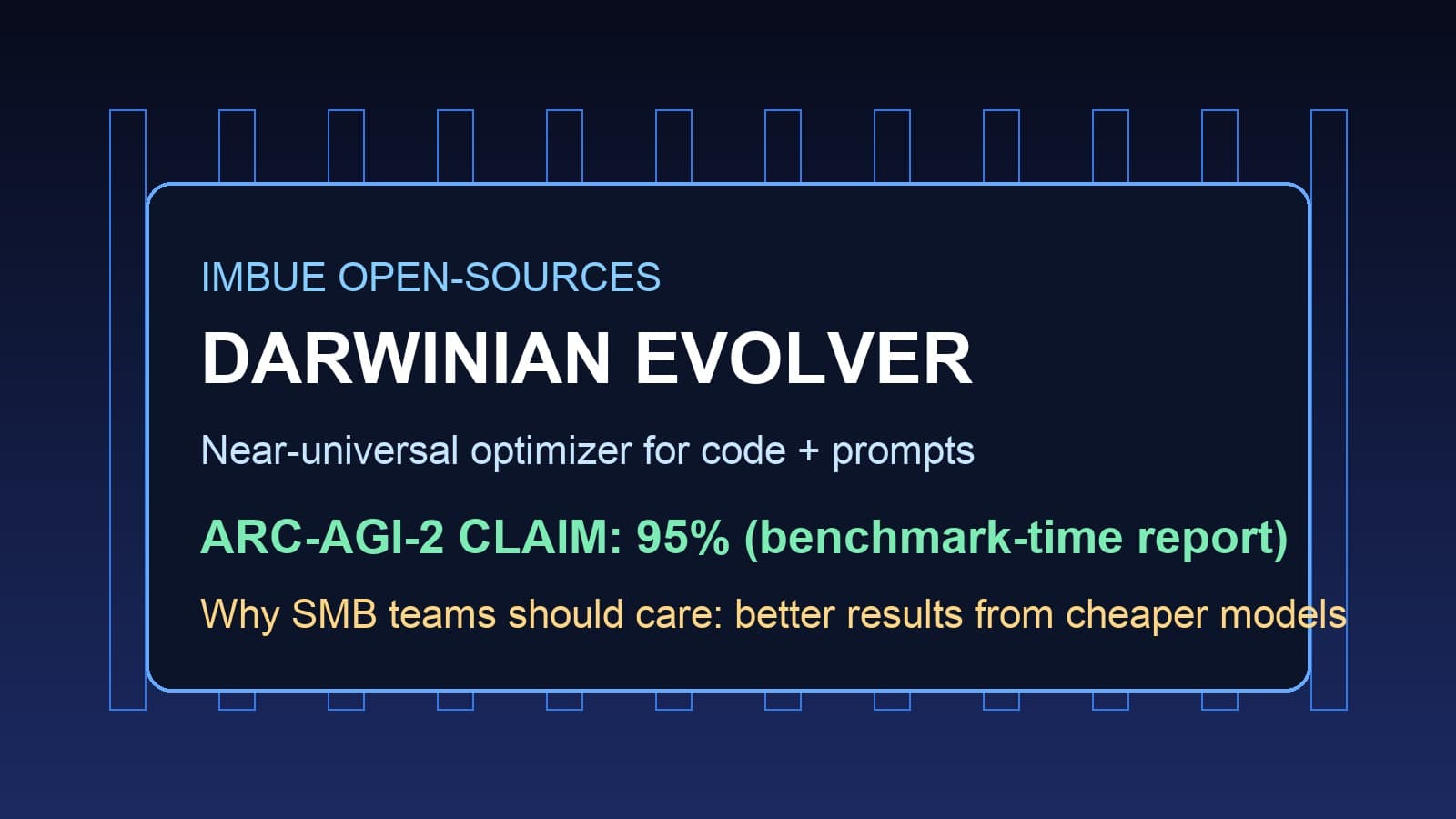

Imbue just open-sourced its Darwinian Evolver framework and paired that release with a high-visibility benchmark claim: major lifts on ARC-AGI-2, including a reported 95.1% run with Gemini 3.1 Pro and a 2.8x gain (12.1% to 34.0%) on open-weight Kimi K2.5.
The announcement circulated on X first, then was backed by technical write-ups and a public GitHub repo. For small and mid-sized businesses, the headline is not "new benchmark drama." The real point is this: optimization frameworks are becoming reusable infrastructure, not just one-off internal hacks at frontier labs.
What Imbue Actually Released
Imbue published:
- A research post on their ARC-AGI-2 approach and reported scores (source)
- A technical post describing the broader "universal optimizer" concept (source)
- The open-source framework itself on GitHub (source)
The framework evolves code or prompts by iterating over three components: an initial solution, an evaluator, and a mutator. In plain terms, it repeatedly tries improvements, scores them, and keeps what works.
That sounds simple, but it matters because many SMB AI projects fail at exactly this step: getting from "works in demo" to "works reliably across messy real inputs."
Verifying the Claims (What Is Confirmed vs. Claimed)
From Imbue's ARC-AGI-2 write-up, the following are explicitly stated by their team:
- Reported 95.1% on ARC-AGI-2 public eval with Gemini 3.1 Pro
- Reported 34.0% on ARC-AGI-2 public eval with Kimi K2.5, up from 12.1% (2.8x)
- Claimed this Kimi result was, at publication time, the top open-weight/open-source score on that setting
- Claimed performance in the neighborhood of, or exceeding, some GPT-5.2 configurations on their comparison framing
Important nuance for operators: their article also notes leaderboard comparability caveats between public-eval and semi-private sets. That is the right way to read this story. Treat it as strong evidence of method effectiveness, not as a universal ranking truth for every workload.
Why This Is Relevant to SMBs Right Now
Most SMB teams are not trying to solve ARC tasks. They are trying to:
- Reduce hallucinations in customer-facing workflows
- Improve extraction/classification quality on real documents
- Increase reliability of AI-generated code for internal tools
- Lower inference cost without collapsing quality
An evolver-style loop is directly applicable to those goals. If you can define a score (accuracy, pass rate, edit distance, support resolution quality, etc.), you can often evolve toward better behavior.
In practical terms, this can help SMBs squeeze more value out of cheaper or open models before paying premium-model prices everywhere.
A Practical Pattern You Can Borrow
If you run a small team, this is a realistic adaptation path:
- Pick one narrow workflow (for example, intake triage, quote drafting, or SOP retrieval).
- Define a measurable evaluator (precision/recall, human QA score, error rate, rework minutes).
- Start from your current prompt or toolchain logic as the baseline organism.
- Use mutation passes (LLM-generated prompt/code revisions) against known failure cases.
- Promote only improvements that outperform baseline on held-out examples.
This is exactly the kind of discipline that separates "AI experiments" from systems that survive production.
Strategic Takeaway
The big shift is not just that Imbue published code. It is that optimization itself is becoming modular and repeatable.
For SMBs, that unlocks a better playbook:
- Keep your model stack flexible
- Invest in evaluation harnesses early
- Treat prompt/code optimization as an ongoing process, not a one-time tuning sprint
As models commoditize, the durable advantage will be in your feedback loops and optimization workflow. Darwinian Evolver is one more sign that this layer is moving into the open-source mainstream.
Want to operationalize this in your business without overbuilding? BaristaLabs helps SMB teams turn AI pilots into measurable, production-ready workflows.
Back-Office Automation ROI Worksheet
Choose the first automation with evidence, not vibes.
AI tools can make almost any workflow look automatable. The ROI worksheet helps you pick the one most likely to pay back quickly. If one workflow rises to the top, BaristaLabs can help decide whether a lightweight tool, integration, or custom pilot is the best next step.
Use broad workflow categories in the form; save specifics for a scoped conversation.
Turn this idea into a pilot
Which workflow should go first?
Use the readiness check to compare impact, effort, risk, owner, and next step before requesting a review.
- 3-5 minutes
- Deterministic score
- No sensitive data
Practical AI Workflow Notes
Want more practical AI operations ideas?
Get short notes on applying AI inside real small-business workflows — from document handling and customer follow-up to internal reporting, compliance, and automation guardrails.