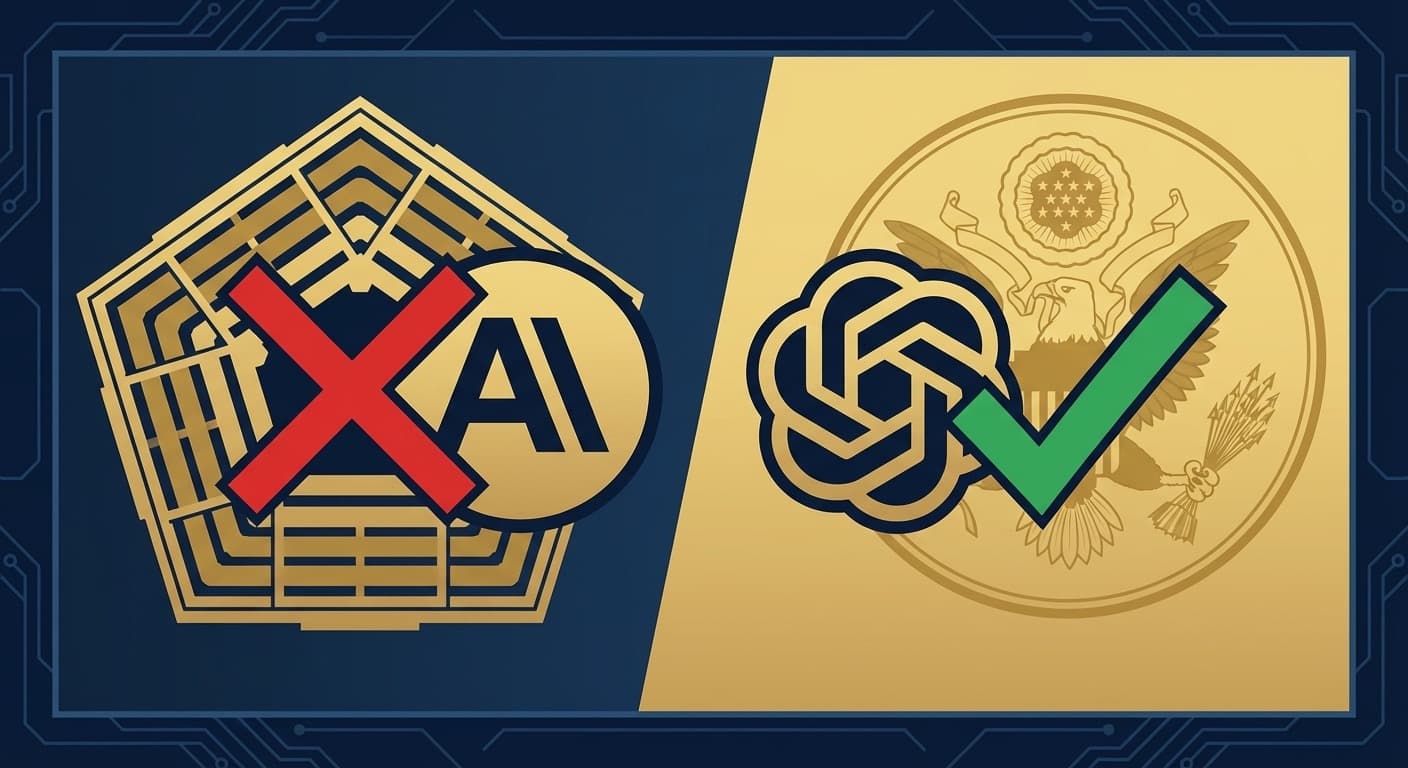

Saturday delivered the clearest proof yet that AI is no longer a technology story — it's a geopolitical one. If you run an agency, dev shop, or any business that touches AI tooling for clients, today's news reshapes your vendor risk map overnight.
Here's what changed, and what it means for your stack.
1. Anthropic Is Now a Government-Banned Vendor — And Every Defense Contractor Must Certify They Don't Use Claude
What happened: The Trump administration designated Anthropic a "supply-chain risk to national security" after the company refused Pentagon demands to remove restrictions on using Claude for domestic surveillance and lethal autonomous weapons systems. Defense Secretary Pete Hegseth announced the designation via X within 13 minutes of a Pentagon deadline expiring. Federal agencies get a six-month phase-out window. Anthropic's DoD contract — valued at up to $200 million — is being severed.
The harder hit: any company that wants to keep Pentagon contracts must now certify it doesn't use Claude in its workflows. That's not just an Anthropic problem. It's a supply-chain audit problem for every defense-adjacent contractor that bolted Claude into their stack.
One-line read: Anthropic drew a principled line on weapons use; the administration drew a harder one on compliance, and the market is now pricing the fallout.
2. OpenAI Signed the Pentagon Deal Within Hours
What happened: While Anthropic's blacklisting was still trending, OpenAI announced it had reached an agreement to deploy its models on Department of Defense classified networks. Sam Altman confirmed on X. No safety restrictions on autonomous weapons use were disclosed as conditions of the deal.
OpenAI has been trying to grow its enterprise and government book for months while Anthropic held an early lead. That advantage just evaporated — not through a product launch, but through a compliance posture call.
One-line read: OpenAI didn't win this contract by building better models; it won by saying yes when Anthropic said no.
3. OpenAI Closes a $110 Billion Round at an $840 Billion Valuation
What happened: Amazon, Nvidia, and SoftBank led a record $110 billion funding round for OpenAI, pushing its valuation to $840 billion. The round underscores the circular nature of AI investment — the same companies building the infrastructure are also funding the model labs running on it.
OpenAI is still the consumer AI leader but faces real competition from Google's Gemini on the frontier and Anthropic on enterprise trust. This round buys runway to compete on both fronts — and signals that despite the DeepSeek-induced valuation jitters earlier this year, institutional appetite for AI infrastructure bets hasn't cooled.
One-line read: $840 billion is a bet that the consumer-to-enterprise transition plays out over the next two to three years; that bet just got a lot bigger.
4. Gemini 3.1 Pro Scores 77.1% on ARC-AGI-2 — Up from 31.1% — at the Same Price as Its Predecessor
What happened: Google DeepMind's Gemini 3.1 Pro, released earlier this week and now circulating in production evaluations, posted a 77.1% score on ARC-AGI-2 — a benchmark designed to test novel reasoning on problems the model has never seen before. Gemini 3 Pro scored 31.1% on the same test. The model also carries a 1 million token context window and is priced at parity with the version it replaces.
ARC-AGI-2 isn't a lab vanity metric. It's increasingly the signal practitioners use to gauge whether a model can handle genuinely ambiguous, unstructured real-world tasks — the kind that make up most of the hard work in agentic workflows.
One-line read: Gemini 3.1 Pro is the first Pro-tier model to make the ARC-AGI-2 number worth paying attention to, and Google is pricing it to displace rather than upsell.
5. Claude Code Security's Zero-Day Detection Is Reshaping Enterprise Security Budgets
What happened: Launched quietly on February 20, Anthropic's Claude Code Security — powered by Opus 4.6 — autonomously identifies zero-day vulnerabilities in production-level codebases. The release triggered a flash crash in several cybersecurity sector stocks, as analysts repriced point-solution vendors that charge SaaS fees for tasks the model now handles inline during development. Snyk published an analysis acknowledging the threat while arguing for layered detection approaches.
This is the week the market confirmed what practitioners suspected: AI isn't just augmenting security workflows, it's starting to collapse the cost structure of certain product categories entirely.
One-line read: Claude Code Security is the clearest sign that AI is moving from "helps your team" to "replaces the vendor category."
Winners and Laggards — by Operator Type
Agency founders with defense-sector clients: Immediate audit required. Any Claude in your stack — even in a vendor's product — creates certification exposure under the new Pentagon supply-chain rules. Map it now.
Enterprise SaaS builders on multi-model stacks: Today is a good day to verify that your abstraction layer isn't vendor-locked to Anthropic endpoints, not because Claude is going away, but because political risk is now a real category in AI vendor selection.
Bootstrapped product teams running on Gemini: Gemini 3.1 Pro at parity pricing with the old model is a clean upgrade path. The ARC-AGI-2 jump suggests meaningful improvement on complex reasoning tasks that was invisible in prior evals.
Security-focused dev shops: Claude Code Security changes your competitive landscape if you're selling vulnerability scanning. Snyk's response — embrace layered detection — is the right defensive posture, but the repricing pressure is real.
Do This Now
Audit your vendor chain for Anthropic exposure — not because Claude is going away commercially, but because any government-adjacent client relationship now carries procurement risk if Claude is embedded downstream.
Avoid for Now
Don't consolidate all inference to OpenAI on the back of today's Pentagon deal. That deal signals political alignment, not technical superiority. Diversifying across two or three inference providers is still the right call for production reliability and pricing leverage.
Agent Governance Scorecard
Move from agent excitement to operating clarity.
If your team is debating how and where agents should run, the scorecard gives business and technical stakeholders a shared language for risk. Use it to spot the gaps BaristaLabs should account for in an agent pilot or implementation roadmap.
Built for agent architecture and risk-review discussions.
Turn this idea into a pilot
Which workflow should go first?
Use the readiness check to compare impact, effort, risk, owner, and next step before requesting a review.
- 3-5 minutes
- Deterministic score
- No sensitive data
Practical AI Workflow Notes
Want more practical AI operations ideas?
Get short notes on applying AI inside real small-business workflows — from document handling and customer follow-up to internal reporting, compliance, and automation guardrails.