//

Industry Insights393 articles · Page 8 of 33
Industry Insights
AI market news translated into workflow decisions, risk boundaries, and practical next steps for small businesses.
Industry Insights articles, page 8

Industry Insights·
Your agent audit log needs a rehearsal, not a promise
RootSign shows why agent audit logs need rehearsal. The chain may verify cleanly, but concurrency, retries, redaction, and tamper tests still deserve a deliberate break-it-first run.
6 min read

Industry Insights·
Your agent stack needs a switchboard, not another brain
The hard part of multi-agent work is not picking a framework. It is the traffic between agents after one request fans out. Here is a copyable ledger for watching it.
9 min read

Industry Insights·
Your SBOM stops before the agent starts
A clean npm audit does not mean a clean workstation. MCP servers, plugins, and skills can sit outside the review. The Agent BOM intake note catches them.
9 min read
Industry Insights·
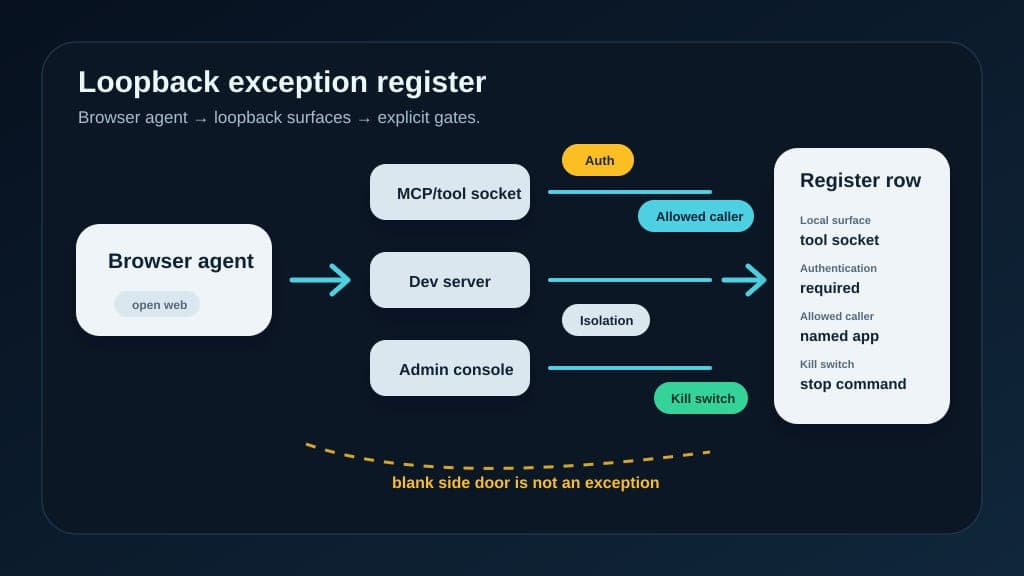
Localhost is not a sandbox when the agent can browse
AutoJack turned a single web page into a host-level code execution path through a local agent control socket. The useful lesson is not panic about one pre-release bug. It is that loopback stops being private when a browsing agent shares a host with privileged local services.
6 min read

Industry Insights·
Give the agent a boarding pass, not a badge
A background coding agent finishes a Worker and hits a sign-in wall. The risky fix is a permanent login. Cloudflare's temporary accounts point at a narrower one: disposable authority plus a claim ticket with a deadline.
7 min read

Industry Insights·
You can't govern an agent you can't name
A company cannot protect a swarm it has not counted. NeuralTrust's $20M raise is a signal that agent security is becoming infrastructure, but the first useful artifact is still a roster.
7 min read

Industry Insights·
Before AI builds your n8n workflow, write the workflow compiler brief
A model can turn a requirements doc into a runnable n8n workflow. The doc is usually missing the decisions the workflow needs. Write the compiler brief first.
8 min read

Industry Insights·
Before your agent gets a toolbelt, build the capability shelf
Hugging Face just shipped a working implementation of the Agentic Resource Discovery draft spec. The idea worth stealing: stop preloading every tool into your agent and give it a registry it can search.
8 min read

Industry Insights·
AI agents need a two-key rule before they move real work
An agent that prepares an action and then approves it isn't governed. MakerChecker shows what a two-key run record looks like for production agents.
7 min read

Industry Insights·
When support AI becomes infrastructure, write the exit kit first
A support agent reads a renewal flag, cites a refund policy, and decides whether to resolve or escalate in one customer thread. Once an AI does that, switching vendors stops being a UI migration. Write the exit kit before it becomes one.
8 min read

Industry Insights·
Ramp's finance agents show why AI needs a buried-context map
Ramp's Applied AI Solutions launch buries the real lesson in one product-page line. Finance agents do not fail on model choice. They fail without a map of the buried context behind every decision.
8 min read

Industry Insights·
The 13-word poison pill hiding in AI search
A 13-word comment can tilt the AI answer a buyer gets about your business. Map source contamination before it becomes reputation risk.
6 min read
Explore Other Categories

AI Development
Implementation notes for building AI tools around real business data, handoffs, review queues, and safeguards.
221 articles

Announcements
Product notes, service updates, and BaristaLabs news that affect how small teams use AI at work.
9 articles
Machine Learning
Model concepts explained through thresholds, queues, and error costs that small teams can actually manage.
14 articles

Small Business AI
Plain-language guidance for owners and operators choosing one useful, reviewable AI workflow at a time.
104 articles
Technical Tutorials
Hands-on guides for approval policies, shadow weeks, agent receipts, and other AI workflow controls.
26 articles