//

Industry Insights396 articles · Page 18 of 33
Industry Insights
AI market news translated into workflow decisions, risk boundaries, and practical next steps for small businesses.
Industry Insights articles, page 18
Industry Insights·
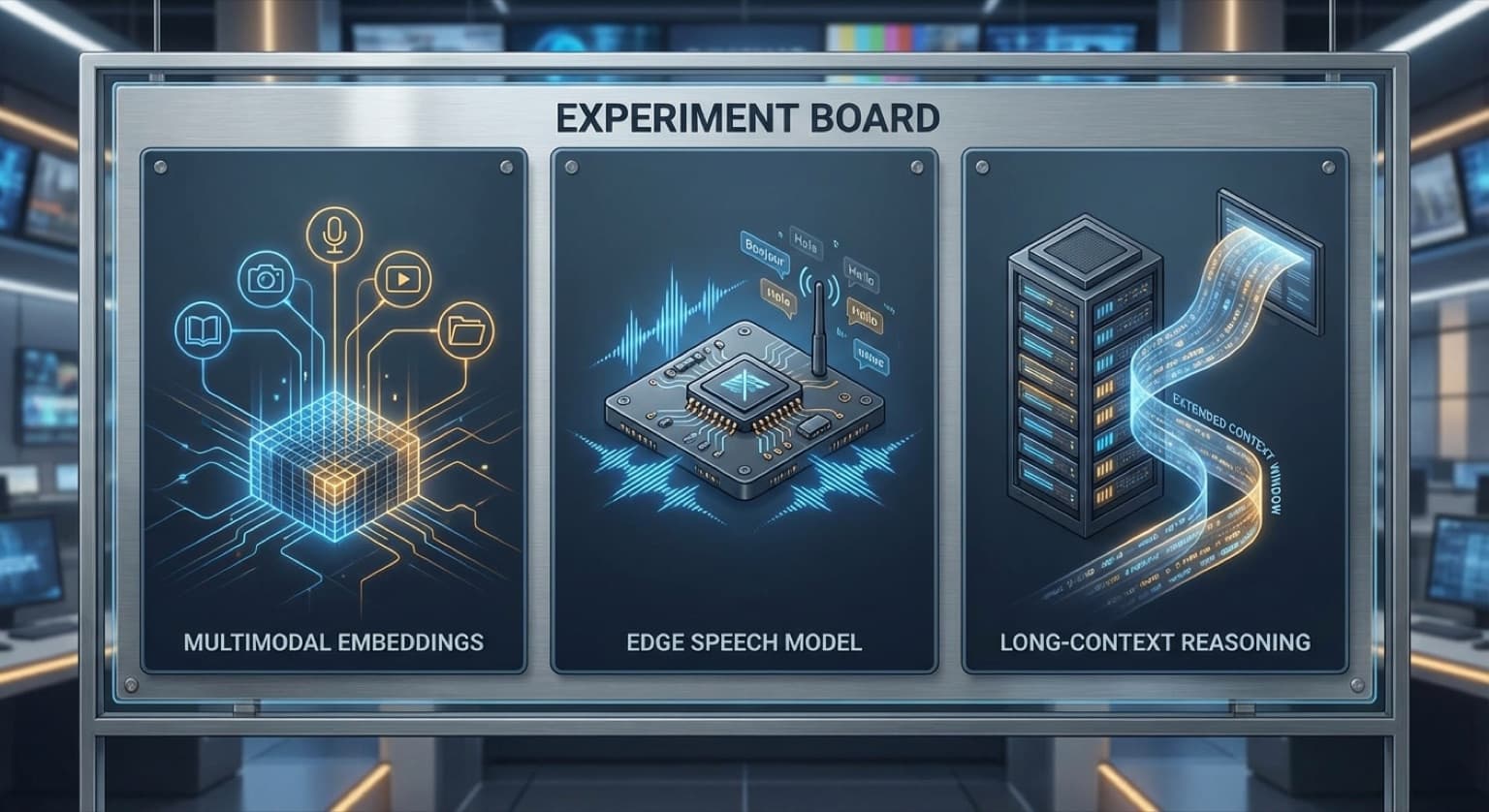
The 27.7-Point Week: Which March Model Releases Earn a Real Migration
A buried-detail board for this week's real model releases: GPT-5.4, Gemini Embedding 2, Granite 4.0 1B Speech, Nemotron 3 Super, and BitNet b1.58 — with eval deltas, licensing, availability, and migration friction.
7 min read

Industry Insights·
Adobe's CEO Just Stepped Down After 18 Years. Here's What SMBs Should Actually Do About It.
Shantanu Narayen's departure from Adobe after 18 years signals deep uncertainty about the company's AI strategy. For small businesses paying Adobe subscriptions, this is a moment to assess — not panic.
5 min read

Industry Insights·
Two different stories, one pressure point: permission to act
Google’s Maps and Groundsource launches, NVIDIA’s benchmark win, Perplexity’s Amazon setback, and Gumloop’s $50 million raise all pointed at the same operating constraint: permissioned action beats raw model theater.
4 min read

Industry Insights·
McKinsey's AI Chatbot Got Breached: What Every SMB Must Know About AI Security
McKinsey's Lilli chatbot exposed tens of millions of internal records through a classic SQL injection flaw. Here is what that breach says about enterprise AI security, AI chatbot security, and the business AI risks smaller companies cannot ignore.
6 min read

Industry Insights·
Meta Delayed Avocado. If Gemini Fills the Gap, Small Businesses Win.
Meta reportedly pushed its Avocado model to at least May after weak internal benchmark results and may license Google Gemini in the meantime. For small businesses using WhatsApp, Instagram, and Facebook tools, that could mean better AI sooner, not later.
5 min read

Industry Insights·
45,000 credits is the part of Perplexity Computer worth stealing
Perplexity’s launch post sold Computer as a new AI agent for Pro users. The pricing page hides the more useful detail: Max includes 45,000 credits, which tells operators exactly where the real constraint sits.
3 min read

Industry Insights·
Claude Can Now Build Interactive Charts and Diagrams in Chat. Here Is Why That Matters for Small Businesses
Claude can now create interactive charts and diagrams right inside the same conversation. For small businesses, that means faster planning, clearer communication, and fewer steps between an idea and something useful.
5 min read

Industry Insights·
Inside browser agents, the boring constraint doing the real work
The smartest part of Google Antigravity's browser-agent setup is not the agent. It's the isolated Chrome profile that blocks normal cookies, keeps automation logins persistent, and makes browser AI safer to run in real businesses.
3 min read

Industry Insights·
58% of Android Bench Is Libraries. That’s the Part Worth Stealing.
Google's Android Bench says more about maintenance-heavy library work than flashy app demos. That makes it more relevant for solo developers and small mobile shops than the leaderboard headline suggests.
4 min read

Industry Insights·
Anthropic Let One Person Run Growth Marketing. Small Businesses Should Pay Attention.
For roughly 10 months, one non-technical marketer helped run growth at Anthropic across six channels using Claude Code, AI agents, a Meta Ads MCP server, and a custom Figma plugin. That workflow has serious implications for SMB marketing budgets.
5 min read
Industry Insights·
Lovable at $400M ARR, Cursor at $2B: AI Coding Tools Are Now a Real SMB Buying Decision
Lovable reportedly jumped from $300M to $400M ARR in roughly six weeks, while Cursor hit $2B annualized revenue. For small businesses, that is a clear sign AI coding tools are no longer a side experiment.
6 min read

Industry Insights·
Perplexity's CTO Just Told Developers to Ditch MCP. Here's What That Means for Your Business.
At their own developer conference, Perplexity's CTO said they're moving away from Model Context Protocol internally despite shipping an official MCP server. For SMBs evaluating AI tooling, this is a useful reality check.
4 min read
Explore Other Categories

AI Development
Implementation notes for building AI tools around real business data, handoffs, review queues, and safeguards.
241 articles

Announcements
Product notes, service updates, and BaristaLabs news that affect how small teams use AI at work.
9 articles
Machine Learning
Model concepts explained through thresholds, queues, and error costs that small teams can actually manage.
14 articles

Small Business AI
Plain-language guidance for owners and operators choosing one useful, reviewable AI workflow at a time.
106 articles
Technical Tutorials
Hands-on guides for approval policies, shadow weeks, agent receipts, and other AI workflow controls.
26 articles