


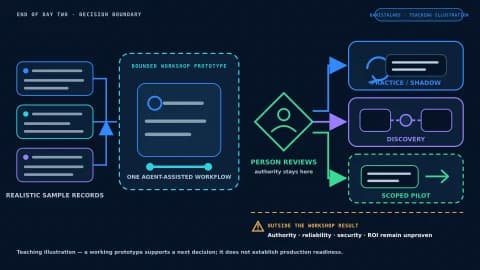
At the end of a two-day AI agent workshop, a team may have a working prototype that uses its own type of work, follows a defined review step, and produces a useful result. That result can show that the team understands and can operate one bounded agent-assisted workflow. It does not show how the workflow will perform with production data, live integrations, sustained volume, or unusual cases.
This boundary matters because a working prototype can create pressure to grant access and authority before the team has tested either one. The day-two decision is smaller: identify what the workshop established, what remains unknown, and whether the next step should be practice, discovery, a scoped pilot, or no further build.
In this article, an agent-assisted workflow is a repeatable process in which an AI tool prepares or performs defined steps while people keep the stated review and decision duties. Production authority means permission to use live data or systems and to take actions that affect customers, records, money, access, or published work.
A workshop can prove that the team can operate one bounded prototype
A useful workshop starts with a specific workflow, not a general goal to “use agents.” The BaristaLabs AI Agent Enablement Sprint asks a team to bring two recurring workflows. The team maps both, selects one, and builds a working version with realistic examples. Before the sprint, BaristaLabs confirms that at least one candidate can be prototyped without production credentials or sensitive data.
That work can show whether the people who do the job can explain the agent's role, run the prototype, and inspect its output. They can also identify where a person still makes a judgment. The work reveals whether the team can describe the workflow through its trigger, source material, repeated decisions, current tools, required approvals, and useful result.
The sprint leaves operating material as well as a demonstration. Its published scope includes reusable prompts and notes, documented human-review and access boundaries, and a 30-day adoption plan. These materials give the team a common way to operate and improve the prototype after the workshop. They also make disagreement visible. If the team cannot agree on the owner, allowed sources, review point, or action boundary, the prototype has found a scope problem before a production build hides it.
Teams that have not selected their two candidates can start with the AI workflow readiness assessment. It scores one workflow by impact, effort, and risk. Use broad workflow descriptions in the assessment; do not enter private records, credentials, or sensitive business data.
A working result does not grant production authority
Workshop conditions are deliberately narrow. Realistic examples help the team learn the workflow, but they do not represent every source, volume level, user, or exception the production system will meet. A prototype that reads prepared documents does not establish how it handles missing, old, conflicting, malformed, or sensitive inputs. A prototype that drafts an update does not establish that it can write to the correct live record or recover from an uncertain result.
The workshop also does not establish the sustained work around the AI output. It does not show how much time reviewers need across representative cases, which corrections repeat, what happens when the normal reviewer is absent, or whether the queue creates a new delay. It does not test live authentication, least access, integration failures, duplicate actions, monitoring, rollback, or incident response unless those items are separately in scope.
A security review and a longer operating test therefore remain separate work. The AI approval policy worksheet can record what the agent may read, draft, change, send, escalate, log, and roll back. It also names the reviewer, the evidence shown during review, actions that stay manual, and the person who owns recovery.
NIST provides a useful outside boundary for this decision. Its AI Risk Management Framework is voluntary guidance for adding trustworthiness considerations to the design, development, use, and evaluation of AI systems. The AI RMF Playbook organizes suggested actions under Govern, Map, Measure, and Manage, but NIST says the Playbook is neither a checklist nor a required sequence. Neither source defines a two-day workshop as evidence of production readiness.
Choose practice when the remaining gap is team fluency
Practice is the smallest useful next step when the workflow is clear, the prototype is bounded, and the main gap is that the team has not used it enough to work consistently. The 30-day plan can assign an owner, select approved examples, schedule review, record repeated corrections, and set a date to decide whether the workflow deserves a larger test.
A shadow run is a stronger form of practice when the team needs evidence from current work but is not ready to give the AI authority. In a shadow week, real inputs enter the process while people continue to make the authoritative decisions. The AI prepares proposed work in the background. The team compares each proposal with the human decision, records the misses, and decides whether any action has earned more permission.
Choose this path when people still need to learn how to review the output, apply the boundary, and recognize exceptions. Do not call the practice period a pilot unless it has a named decision, representative cases, agreed criteria, and an evidence plan.
Choose discovery when the team has not selected the right test
A working workshop prototype can still expose a more basic problem: the selected workflow may be less useful, less reviewable, or more difficult to connect than another candidate. Discovery fits when several workflows compete, the current process is unclear, ownership is disputed, or the team cannot define the sources, actions, and acceptance evidence for a test.
Discovery chooses and scopes the test. The discovery-versus-pilot comparison describes its main output as a recommendation and scope: which workflow to test, under what boundary, with which risks and assumptions, and for which next decision. Discovery does not produce operating evidence by itself.
This path can end without a pilot. The recommendation may be to narrow the workflow, prepare the data, document the current process, use an existing tool, keep the work manual, or stop. That is useful when it prevents an unclear prototype from turning into a larger unclear build.
Choose a scoped pilot when one workflow is ready to produce evidence
A pilot is appropriate when the team has one selected workflow, an accountable owner, representative examples, approved sources, agreed acceptance criteria, required reviewers, and a feasible access and integration plan. The pilot then runs a bounded test and records what passed, what needed correction, what failed, what stayed manual, and whether the stop or rollback path worked.
That evidence must stay tied to the tested boundary. A controlled result from one workflow and sample does not establish general return on investment, compliance, security, or readiness across other teams and conditions. The AI pilot proof guide shows the evidence a later implementation can leave: the workflow before and after, source boundary, reviewer decisions, misses and exclusions, rollback path, value signals, and owner decision.
Choose a pilot when the next question depends on operating evidence rather than more instruction. The team might need to decide whether to expand one source, action, user group, or integration. It might need to revise and retest, shadow longer, or keep the process manual. A better demonstration is too small a goal for a pilot.
Keep the work manual or stop when more authority has no clear case
A workshop can correctly show that the first idea should not continue. The process may depend on judgment that the team cannot state, the source data may need more preparation than the result justifies, or the review burden may remove the expected value. In those cases, keeping the workflow manual is an operating choice, not a failed workshop.
Stopping is slightly different. It ends the current agent effort and removes any access or test integrations that no longer have an owner. Preserve the notes about the workflow, sources, review decisions, and unresolved conditions. Those facts can prevent another team from repeating the same experiment without addressing the reason it stopped.
If the team understands the desired engagement but needs to inspect the commercial boundary, the pricing and engagement guide explains the factors that affect an estimate. BaristaLabs does not publish a universal price on that page. Systems, data preparation, action risk, review, deployment, documentation, and support can change the scope.
End day two with the smallest useful decision
Before the workshop closes, record what the team can now operate under prototype conditions. Beside it, record the production conditions that remain untested. Then choose one next path, one owner, and the evidence that owner needs before the next review.
Use practice when the team needs fluency. Use discovery when it has not chosen a defensible test. Use a scoped pilot when one workflow is ready to produce bounded operating evidence. Keep the work manual or stop when the evidence does not justify more access, budget, or authority.
BaristaLabs uses its two-day sprint to train a team and build one bounded agent-assisted workflow, with review and access limits documented for the handoff. Bring two candidate workflows if you want to choose one bounded prototype and leave with a 30-day practice plan. If you are already deciding between a broader planning engagement and a controlled implementation test, compare discovery and a pilot.
Source note
BaristaLabs service pages define the sprint, discovery, pilot, assessment, approval-policy, shadow-week, pilot-proof, and pricing statements in this article. NIST defines its AI RMF and Playbook as voluntary risk-management resources; NIST does not define the four next paths used here.
No cited source establishes a typical workshop outcome, adoption rate, time saving, production result, return on investment, security result, or production-readiness threshold. Conversion impact is also unknown until the article has a valid baseline and enough traffic and next-step events to support a comparison.
Practical AI Workflow Notes
Want more practical AI operations ideas?
Get short notes on applying AI inside real small-business workflows — from document handling and customer follow-up to internal reporting, compliance, and automation guardrails.