


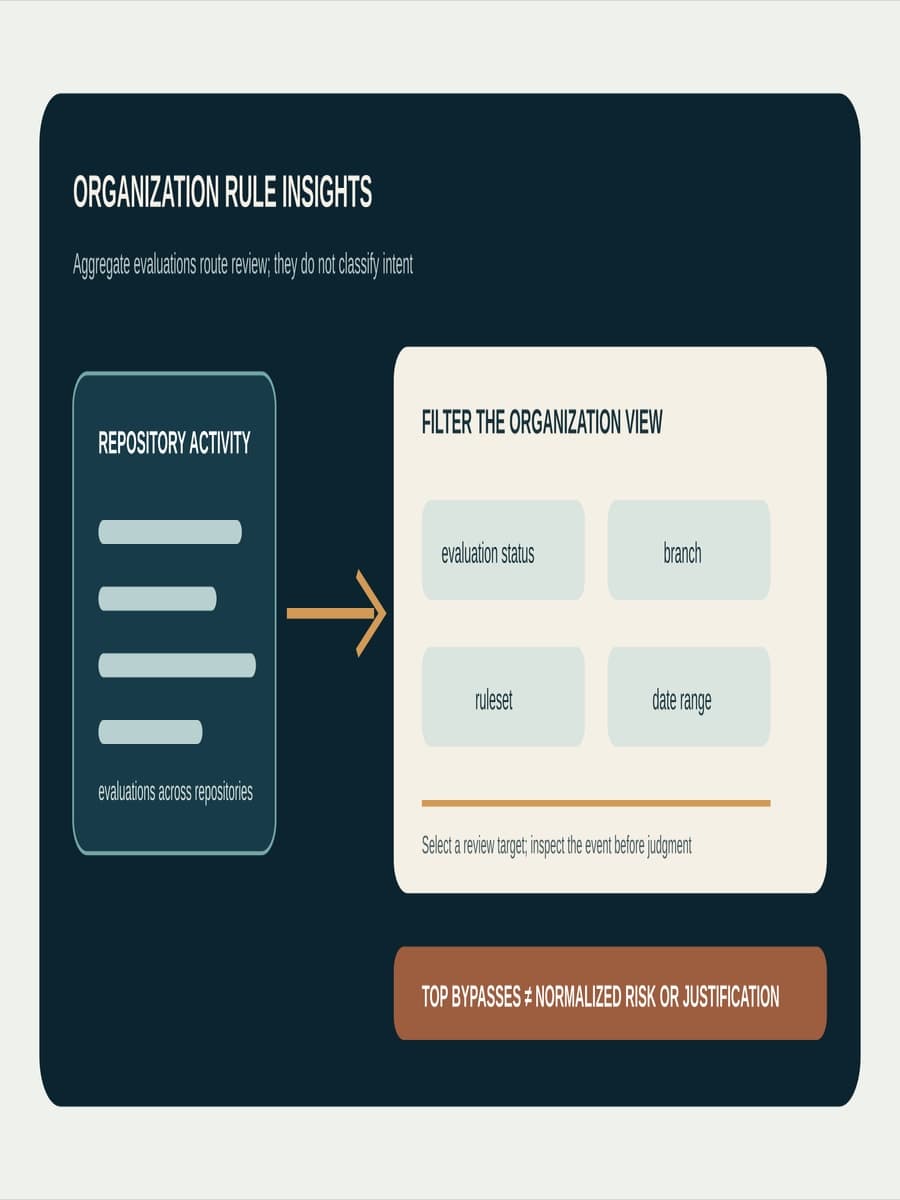
GitHub added an organization-level Rule insights dashboard in public preview on August 12, 2026. It aggregates repository ruleset evaluations, identifies repositories with the most bypasses, supports filters, and exports data to CSV. Governance teams can now choose where to investigate without checking every repository separately.
That convenience changes the first review decision, but not the burden of proof. A repository at the top of a bypass ranking deserves attention; it is not automatically the riskiest repository, and the bypasses are not automatically improper. This article explains what the new view establishes, what it leaves unresolved, and how to turn the first result into a defensible investigation.
What does the organization dashboard add?
GitHub says the new view appears under an organization’s Settings > Repository area. It aggregates rule-evaluation metrics across the organization and lets reviewers filter by evaluation status, branch, ruleset, and date range. Teams can also export the result to CSV for reporting and record keeping.
The dashboard extends repository-level Rule insights, which GitHub says entered public preview earlier in 2026. The new value is scope: a governance or compliance reviewer can compare repositories in one place, then drill into the activity that needs attention.
GitHub specifically highlights “top repositories by bypasses.” That is a useful queue. The changelog does not say the ranking is normalized by pushes, contributors, rule evaluations, repository size, or any other denominator. A high-volume repository may produce more bypasses than a quieter repository even when the underlying rate or consequence differs.
Why is a bypass count a signal rather than a verdict?
A ruleset bypass means an applicable rule did not follow its ordinary enforcement path for that event. GitHub’s ruleset documentation says bypass permission can be granted to people with specified roles, teams, or GitHub Apps. A bypass can therefore be expected under an approved operating model, mis-scoped, overused, or inappropriate. The count alone does not identify which condition applies.
The preview announcement does not publish a bypass-reason taxonomy, an approval-validity judgment, or a risk score. It also does not claim that bypass activity came from an AI coding agent. If a bot or agent appears in the underlying record, the reviewer still needs to distinguish the identity that performed the GitHub action from the person, workflow, and authorization behind it.
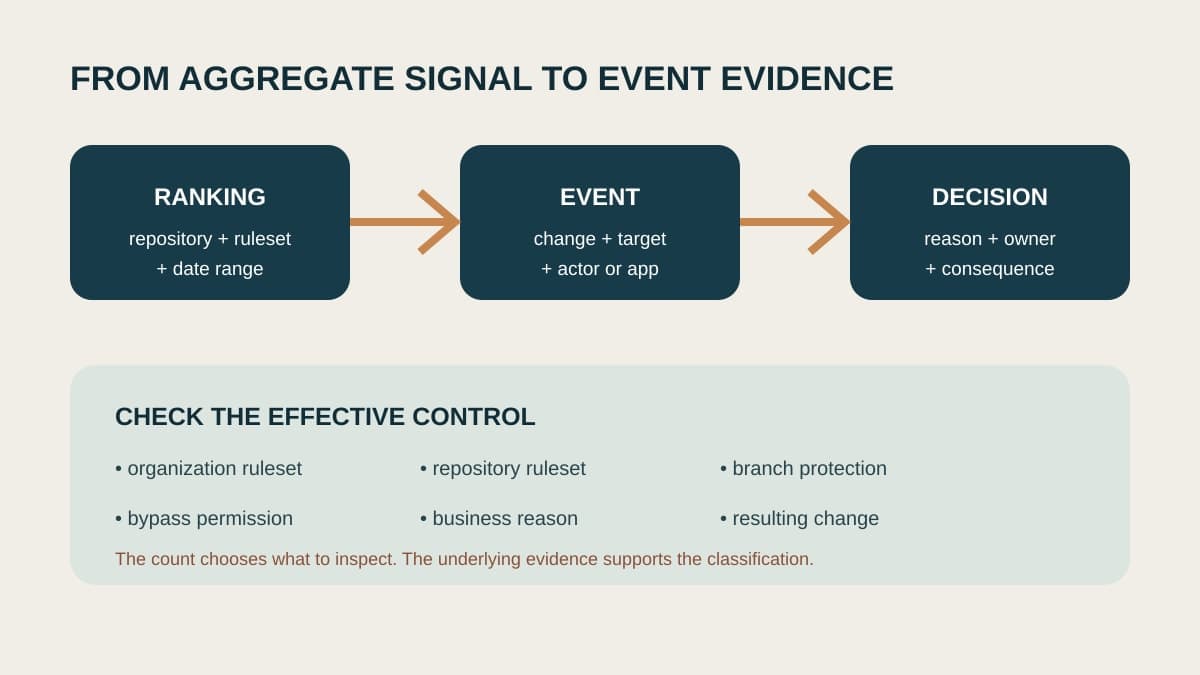
Rules can also layer. GitHub documents that repository rulesets and branch-protection rules work together, and that multiple applicable rulesets are aggregated. Where the same rule is defined differently, the most restrictive version applies. Reviewing only the named rule that was bypassed may miss another organization rule, repository rule, or branch protection that shaped the effective control.
Which result should a team inspect first?
Start with a narrow slice rather than an organization-wide conclusion. Select a recent date range that covers a known operating period, then filter to the repository and ruleset contributing the most bypass activity. Preserve the export or view used to make that selection so a later reviewer can reconstruct why the investigation started there.
Next, add context the ranking does not provide by itself:
- the underlying push or pull request;
- the branch or tag target;
- every applicable organization rule, repository rule, and branch-protection rule;
- the person, team, or GitHub App with bypass permission;
- the documented business reason and approving owner, if one exists;
- the resulting code, configuration, or release consequence; and
- any follow-up that changed permission, scope, or process.
This sequence separates selection from judgment. The dashboard selects an event worth reviewing. The event evidence supports the judgment.
How should AI-assisted changes be handled?
Do not create a separate evidentiary standard merely because a coding agent contributed to the change. The repository rules and bypass permissions still govern the GitHub event. The practical AI question is whether the agent-assisted workflow made the accountable person, generated change, test evidence, and approval path easier or harder to reconstruct.
If an agent prepared a pull request and an authorized app bypassed a rule, record those as separate facts. Determine which identity received bypass permission, who initiated or approved the workflow, which rule was bypassed, and whether the resulting change received the required human review. An AI label does not prove extra risk, and an approved app identity does not prove appropriate use.
This is distinct from configuring automatic Copilot review. BaristaLabs’ earlier analysis explains why Code Quality and automatic Copilot review are separate ruleset choices. Rule insights begins after evaluations and bypasses exist; it helps an organization choose which resulting activity to examine.
What does the public preview leave open?
The changelog establishes the feature’s public-preview state and named capabilities. It does not publish plan eligibility, universal account availability, retention duration, CSV field definitions, API access, alerting, or the method used to rank ties. Verify which controls and data appear in your organization before building a recurring compliance process around them.
The announcement also does not report a benchmark showing that the dashboard reduces incidents, improves enforcement, or identifies harmful bypasses accurately. GitHub’s claim is operationally narrower: the organization view removes the need to stitch repository-level data together by hand and supports trend review and drill-down.
Treat the first export as a discovery aid, not a finished audit record. If a required field—such as approver, reason, linked change, or remediation—is absent, preserve the GitHub evidence and add that field in the team’s own review system rather than inferring it from the repository rank.
What should happen after the first investigation?
Classify the reviewed event using categories your organization already owns, such as expected and documented, expected but poorly documented, unexpected but harmless, or unexpected with corrective action. These are BaristaLabs recommendations, not statuses supplied by GitHub. Keep the underlying evidence attached so another reviewer can challenge the classification.
Then decide whether the dashboard should become a recurring input. A useful cadence has a named owner, a stable date window, preserved filters, a threshold for drill-down, and a way to record closure. Avoid a target of “zero bypasses” unless policy truly prohibits every bypass; that metric can reward concealment or delay legitimate emergency work.
The organization dashboard is most useful when it shortens the route to the right question: which bypass should we understand first? It cannot answer whether that bypass was justified without the change, actor, layered rules, authorization, and consequence. If your team wants to turn that signal into a repeatable investigation, ask BaristaLabs to review one ruleset bypass workflow.
Use the GitHub Copilot enterprise-controls guide to place ruleset evidence, Copilot trigger and write authority, review ownership, and any exception in one current inventory.
Sources
- GitHub Changelog: “Rule insights for organizations in public preview”, August 12, 2026.
- GitHub Docs: “About rulesets”, accessed August 13, 2026.
Repository governance review
Trace one ruleset bypass from signal to decision
BaristaLabs can help map applicable rules, bypass actors, evidence, approval reasons, and follow-up for one representative repository before the review expands.
Useful for engineering and compliance teams replacing repository-by-repository ruleset checks with an organization view.
Turn this idea into a pilot
Which workflow should go first?
Use the readiness check to compare impact, effort, risk, owner, and next step before requesting a review.
- 3-5 minutes
- Deterministic score
- No sensitive data
Practical AI Workflow Notes
Want more practical AI operations ideas?
Get short notes on applying AI inside real small-business workflows — from document handling and customer follow-up to internal reporting, compliance, and automation guardrails.