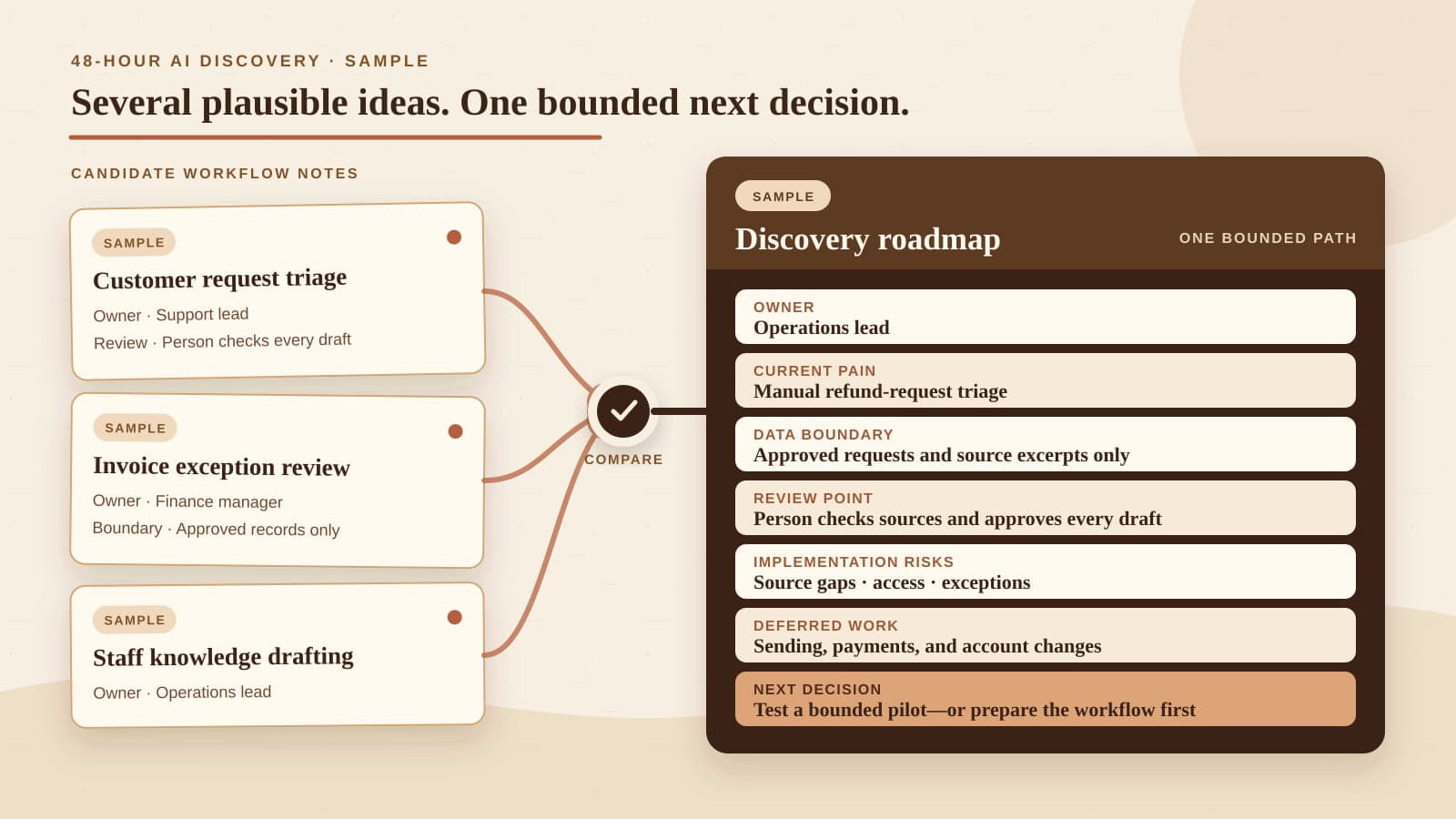

Scoped AI discovery helps a team choose which workflow deserves a closer look before it buys a tool or commits to a build. The work ends with a practical recommendation: a ranked opportunity, a recommended first pilot or alternative next step, the data and review boundaries that shape it, the main implementation risks, and the work that should wait.
Discovery reduces scope uncertainty. It does not prove that an AI system will perform well in production, deliver a financial return, satisfy a regulator, or earn user acceptance. Those questions require a bounded pilot and evidence from representative work.
Discovery starts with candidate workflows, owners, and constraints
Useful discovery begins with work the team can name. “Use AI in customer service” is too broad. “Prepare a draft response and supporting source excerpts for a person reviewing refund requests” is specific enough to examine because it identifies the work, the reviewer, and the consequence of a bad result.
The team should bring a small set of candidate workflows and what it already knows about each one: the current owner, recurring pain, systems involved, data used, customer or staff consequence, review point, and decision constraints. Missing information is acceptable. One purpose of discovery is to make those gaps visible before they become assumptions inside a build estimate.
If the team is still collecting candidates, the workflow readiness assessment provides a useful starting point. It scores one workflow by impact, effort, and risk while asking about frequency, manual time, systems, data sensitivity, approval needs, process clarity, and ownership. Teams that already know the workflow but are comparing SaaS, internal work, contractors, or implementation partners can use the AI implementation path decision matrix to expose the fields that should drive that choice.
The first decision is which workflow deserves deeper examination
Discovery does not need to treat every idea as an equal candidate for automation. The team compares the workflows against the value of improving them, the effort required, the sensitivity of the data, the consequences of a mistake, the clarity of the current process, and the presence of an accountable owner.
That comparison may show that a modest drafting or routing task is a better first pilot than a more visible autonomous agent. A reversible workflow with a clear reviewer can produce useful evidence without asking the team to trust automatic customer communication, record changes, payments, access decisions, or regulated work at the start.
The sequence can vary by client because the unknowns vary. A team with a well-documented process may spend more time on data access and acceptance criteria. A team whose process lives in one employee’s head may need to map the current work before an implementation path can be estimated honestly. The fixed part is the decision the discovery must support: which workflow should move forward, under what boundary, and why?
The selected workflow gets a practical boundary
Once a candidate rises to the top, discovery traces it from trigger to outcome. The team identifies who starts the work, which sources and systems it uses, where people make judgments, which exceptions occur, what the result affects, and who owns the outcome after launch.
The data boundary records what a pilot may use and what stays out. It can cover approved systems and fields, sensitive information, access assumptions, source-quality problems, model or vendor exposure, and retention questions. A useful boundary also names the action level. Preparing a draft for review creates a different risk than sending a message, changing a record, issuing a refund, publishing content, or changing access.
The review point should be concrete. “Human in the loop” does not say what the reviewer sees or decides. Discovery should identify the evidence the reviewer needs, the available decisions, the result of rejection or correction, and the person who can stop the workflow if the pilot exposes a new risk.
The roadmap records a recommendation and the work that remains
The discovery output should be readable by the business owner and the people who would implement or review the pilot. It should connect the recommendation to the facts gathered during the engagement instead of presenting a broad list of AI possibilities.
A useful roadmap contains:
- the candidate workflows considered and the reason for the ranking;
- one recommended first pilot, or a recommendation to prepare the workflow before piloting it;
- the current owner, trigger, systems, sources, decisions, and exceptions;
- the allowed data, excluded data, human review point, and action boundary;
- the acceptance evidence the pilot should collect;
- the main implementation, security, privacy, vendor, and maintenance questions;
- the work deliberately deferred; and
- the next decision, its owner, and the condition for revisiting it.
The roadmap can also recommend a self-serve tool, internal experiment, specialist, or larger program when that path fits the workflow. A discovery that points away from a custom build can still save time and reduce risk. The goal is a defensible next step, not a predetermined sale.
Discovery and a pilot answer different questions
Discovery asks whether the workflow is clear enough and valuable enough to test, which boundary the test needs, and what evidence should determine the next decision. It produces a recommendation and scope. It does not produce operating evidence by itself.
A pilot applies that scope to representative examples or a controlled slice of real work. It should record what passed, what needed correction, what failed, what stayed manual, and how much review the workflow required. The AI pilot proof guide explains the evidence a team can ask for before it expands permission or budget.
Pilot schedules are set after the workflow, access, evaluation cases, reviewers, dependencies, exclusions, and acceptance evidence are agreed. Preparation, an existing tool, a manual path, or stopping may be the better next step.
For a side-by-side view of purpose, inputs, outputs, timing, evidence, and stop decisions, compare AI discovery and a scoped AI pilot.
Proceeding is only one valid outcome
A useful discovery can recommend proceeding with a bounded pilot. It can also recommend narrowing the workflow, collecting better examples, documenting the current process, resolving data access, keeping a consequential decision with a person, choosing an existing tool, or stopping the idea.
Those outcomes are not lesser versions of a build. They answer the question the discovery was meant to resolve. A team that learns why a workflow is not ready can direct its budget and attention toward a stronger candidate instead of forcing an uncertain idea into production.
Start with one candidate workflow
You do not need a complete AI strategy to begin. Name one recurring workflow, its owner, the current pain, the systems and data involved, the review point, and the consequence of a bad result. Then use the workflow readiness assessment to see whether it looks like a first-pilot candidate.
If several workflows remain plausible, AI consulting can help rank them and define the smallest next decision. Bring the incomplete version. The gaps are part of what discovery should make visible.
AI discovery
Bring one candidate workflow
BaristaLabs can help compare the owner, current pain, data, review point, implementation risks, and evidence needed for a bounded first pilot.
Best fit when the team has several plausible AI ideas but no defensible first workflow.
Turn this idea into a pilot
Which workflow should go first?
Use the readiness check to compare impact, effort, risk, owner, and next step before requesting a review.
- 3-5 minutes
- Deterministic score
- No sensitive data
Practical AI Workflow Notes
Want more practical AI operations ideas?
Get short notes on applying AI inside real small-business workflows — from document handling and customer follow-up to internal reporting, compliance, and automation guardrails.