
Owner artifact
Reversible workflow shortlist
Score three candidate workflows before choosing a tool. The first pilot should be repeated, reviewable, reversible, and owned.
- 01
Candidate workflow
Required
Pins down: Name the actual lane, not the department.
Evidence: Inbound quote follow-up, support triage draft, invoice exception packet.
- 02
Review evidence
Required
Pins down: What source material must the reviewer see before approving the AI output?
Evidence: Ticket text, policy link, order status, prior email, source row.
- 03
Reversal path
Required
Pins down: How would the team undo or correct a miss before it becomes expensive?
Evidence: Edit draft, change label, remove internal note, hold customer message.
- 04
Data boundary
Required
Pins down: What can the workflow read, and what should stay outside version one?
Evidence: Public page, approved CRM fields, redacted examples, no payment or HR data.
- 05
Owner
Required
Pins down: Who can pause, approve, or narrow the pilot after the first miss?
Evidence: Support lead, operations manager, finance owner, marketing reviewer.
Adapted from BaristaLabs workflow audit, shadow week, and pause-note guides.
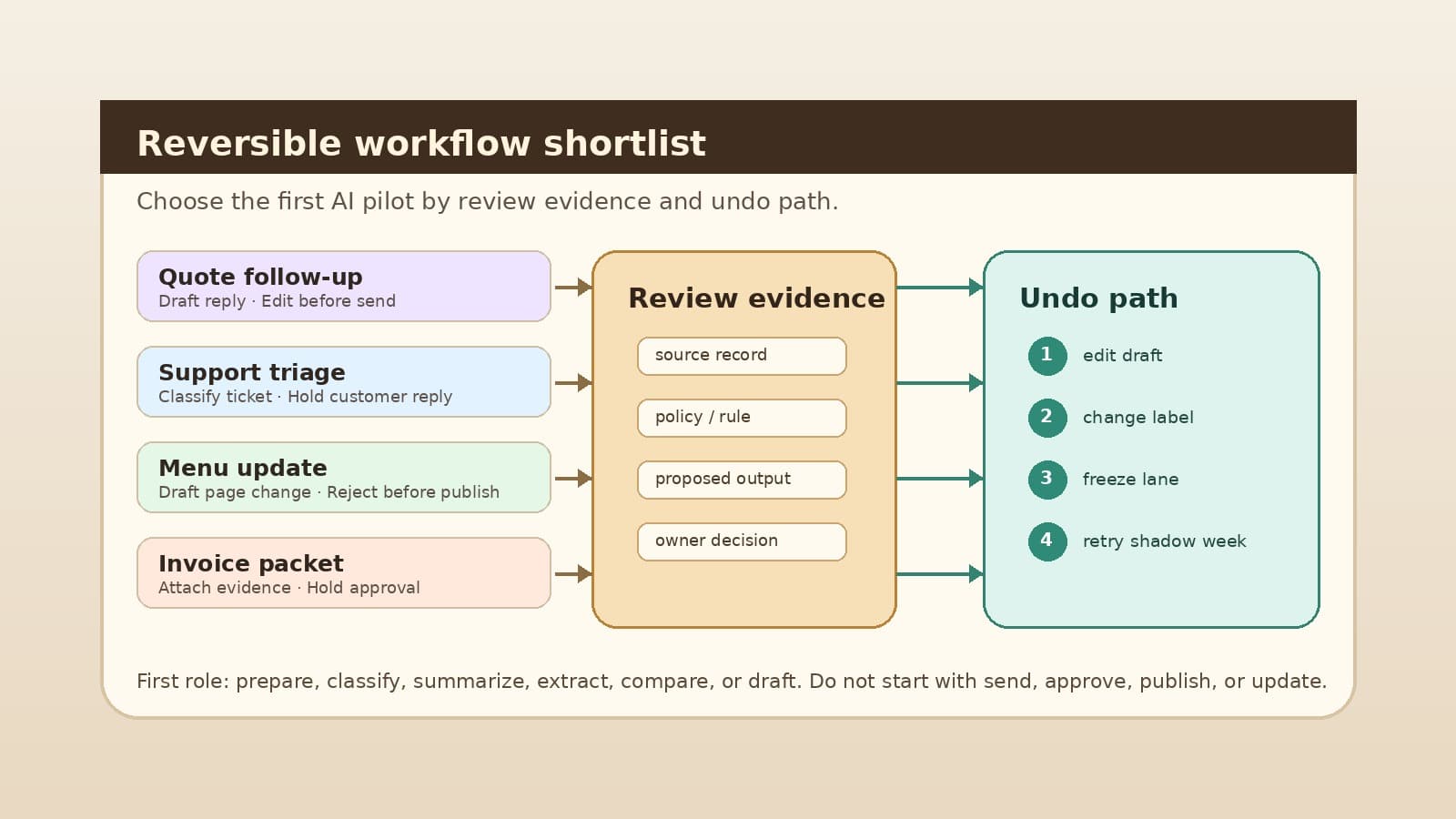
The owner had four ideas on the table before lunch.
The quote follow-up was slow. The support inbox needed triage. The menu page was always one update behind. The weekly operations report took an hour every Friday because the numbers lived in three places.
All four looked like AI candidates. All four had a demo version that would impress the room. The problem was not whether an AI tool could draft a reply, summarize a ticket, rewrite a page, or assemble a report.
The problem was what would happen after the first miss.
A wrong internal label can be changed. A draft quote can be edited. A public menu update that lists the wrong allergy note, a refund promise sent without approval, or a CRM stage change that triggers the wrong follow-up is harder to unwind. The first workflow should not be the one with the loudest complaint. It should be the one where the team can see the evidence, catch the error, reverse the action, and learn from the miss without breaking a customer promise.
That is the job of a reversible workflow shortlist. Before choosing a tool, write down three candidate workflows and score them by how safely you can undo, review, and narrow them.
Reversibility is a better first filter than pain
Small teams tend to pick the workflow that hurts most.
That instinct is understandable. The thing that hurts is visible. It interrupts the owner, annoys customers, or makes someone stay late. But painful work is often painful because it has hidden judgment inside it. The support ticket may involve an angry customer, a refund rule, a security concern, and a policy exception. The quote follow-up may imply pricing, timing, scope, and a promise the business has to keep.
The first pilot needs a different filter: if the AI gets this partly wrong, can we catch and reverse the miss while the workflow is still under review?
NIST's AI Risk Management Framework uses formal language for the same management habit. Its Manage function asks whether a system has achieved its intended purpose and whether development or deployment should proceed. It also calls for assigned mechanisms to supersede, disengage, or deactivate systems that produce outcomes inconsistent with intended use.
For a small business, that can be plain English: who can stop this lane, what gets frozen, and what evidence earns another week?
If you cannot answer that before the first pilot, the workflow may still be important. It is just not the safest first one.
Build the shortlist in one sitting
Do not start with a full automation roadmap. Start with a worksheet.
Pick three workflows from the last ordinary week. One customer-facing workflow. One internal admin workflow. One reporting, content, or operations workflow. Name the actual lane, not the department.
Bad candidate name: "support automation."
Useful candidate name: "first-pass support triage for billing and login tickets."
Bad candidate name: "sales AI."
Useful candidate name: "draft first reply and CRM note for inbound quote requests."
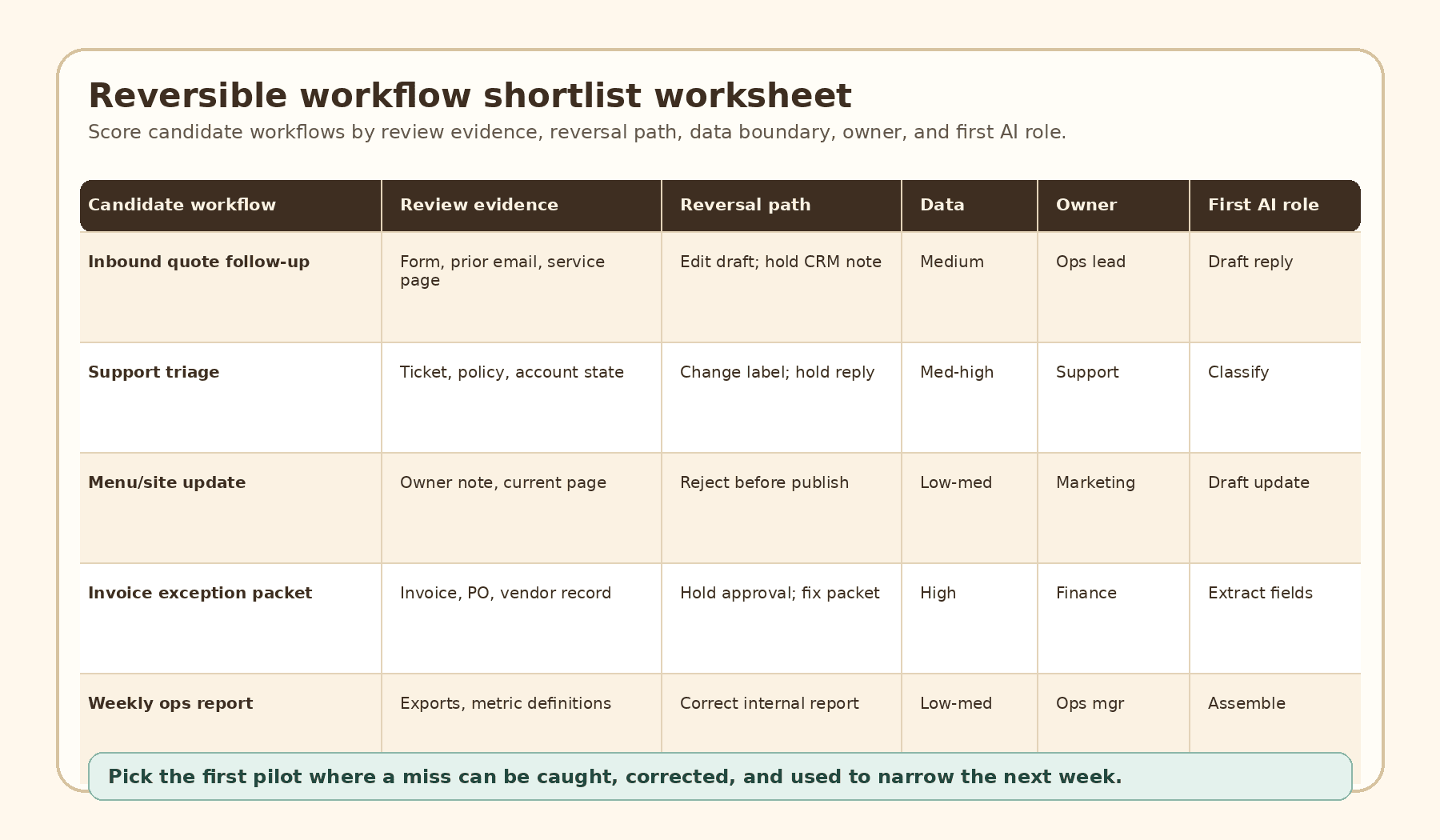
The shortlist should fit on one page:
Scroll sideways to see all 6 columns.
| Candidate workflow | Review evidence | Reversal path | Data sensitivity | Owner | First AI role |
|---|---|---|---|---|---|
| Inbound quote follow-up | Form, prior email, service page, open questions | Edit draft before send; hold CRM note | Medium | Sales or operations lead | Draft reply and missing-field list |
| Support triage | Ticket text, policy link, account status | Change internal label; hold customer reply | Medium to high | Support lead | Classify and prepare reviewer note |
| Menu or service-page update | Source doc, owner edit, current page | Revert draft before publish | Low to medium | Marketing owner | Draft update for approval |
| Invoice exception packet | Invoice, PO, vendor record, policy | Hold approval; correct packet | High | Finance owner | Extract fields and attach evidence |
| Weekly operations report | Source exports, metric definitions | Correct internal report before sharing | Low to medium | Operations manager | Assemble draft report with source links |
This is not a scoring exercise for its own sake. It forces the owner to see which workflow has an undo path.
The best first pilot usually has four traits:
- The work appears often enough to learn from.
- The AI output can be inspected quickly.
- The mistake is recoverable before it reaches a customer, public page, payment, access change, or system of record.
- One person owns the pause or expansion decision.
If no candidate has those traits, the next project is probably a weekly workflow audit, not automation.
Score the undo path before the AI role
The first AI role should be boring enough to review.
That is not a knock on ambition. It is how the team gets evidence without giving the system too much permission too early. The safest first role is often prepare, classify, summarize, extract, compare, or draft. The riskier role is send, approve, refund, publish, update, delete, escalate, or decide.
The quote follow-up may be a good first pilot if the AI drafts a reply, lists missing fields, and prepares a CRM note for review. It becomes a bad first pilot if the system sends the email, marks the lead qualified, and promises a delivery window without a person checking the source.
The menu update may be safer than the support queue if the first version never publishes automatically. The AI can draft the change from an owner note, compare it against the current page, and ask for approval. A miss stays in draft. The reviewer has the source note in front of them. The reversal path is clear: reject the draft or restore the old copy.
The invoice exception may save more money, but the first AI role should probably be evidence packet builder, not payment approval. If the workflow needs purchase orders, vendor history, payment terms, and exception policy, the AI can gather and cite those records. It should not approve the payment.
This is where the first automation you should not automate yet becomes useful. The tempting workflow may still be the right one to study. The first AI action inside it should be the stable slice, not the whole process.
Review evidence is part of the workflow
A human review step is not a magic shield.
A reviewer can only catch what the workflow shows them. If the screen presents a polished AI draft without the source ticket, policy rule, account status, prior message, or field change, the reviewer is being asked to trust the tone. That is not review. That is vibes with a button.
NIST's framework includes documented human oversight in its Map function. The practical version is simple: write down what the reviewer must see before approving the output.
For support triage, the reviewer may need the ticket text, plan tier, relevant help article, prior ticket, escalation trigger, and proposed reply. For quote follow-up, they may need the form submission, service fit, missing fields, prior email, and claims the draft is making. For a content update, they may need the source note, current page, changed section, and publish checklist.
If the team cannot name the evidence, the workflow is not ready for AI assistance. It may need cleanup, source organization, or a shadow week before anyone chooses a tool.
Keep data and agency small in version one
A reversible pilot needs a small data boundary.
OWASP's guidance on sensitive information disclosure is a useful outside check here. It recommends least privilege: only grant access to data necessary for the specific user or process. It also says to restrict data sources to avoid unintended leakage.
That does not mean every first pilot must avoid customer data. It means the pilot should know exactly which records it can read and which records stay out of scope.
The same applies to agency. OWASP's excessive agency category names three root causes: excessive functionality, excessive permissions, and excessive autonomy. Those words sound technical, but owners see the failure in ordinary work. The system could do too many things, touch too many records, or act too far without review.
Write the first version as a permission sentence:
AI may read the inbound form, current service page, and approved CRM fields.
AI may produce a draft reply, missing-field list, and proposed CRM note.
AI may not send the reply, change lifecycle stage, quote pricing, or sync private notes into another tool.
That sentence is more useful than a vague promise that a human stays involved. It gives the builder a boundary, the reviewer a job, and the owner a pause line.
The winner is the workflow with the cleanest learning loop
Once the shortlist is filled out, the safest first pilot usually becomes obvious.
It may not be the most exciting workflow. It may not be the workflow the vendor demo used. It may be the one where the owner can say: this repeats every week, the inputs are visible, the AI output is inspectable, the miss can be corrected, and one person can pause the lane.
A good first choice might be:
Workflow: inbound quote follow-up
First AI role: draft reply, list missing fields, prepare CRM note
Review evidence: form, current service page, prior email, source claims
Reversal path: edit or reject draft before send; hold CRM note until approved
Data boundary: submitted form, public company page, approved CRM fields only
Owner: operations lead
Do-not-automate line: no pricing promises, lifecycle-stage changes, or sent emails
First test: one shadow week using recent inquiries
That is enough to run a serious first pilot. It also gives the team a way to say no to the wrong candidate without sounding anti-AI.
The support queue may wait until escalation triggers are clearer. The invoice exception may wait until finance writes the approval rule. The weekly report may become a low-risk internal pilot. The menu update may work if publishing stays manual.
The shortlist turns the conversation from "Which tool should we try?" into "Which workflow can safely teach us something next week?"
Decide how the pilot pauses before it starts
Before version one runs, write the pause condition.
The first miss should not create a panic meeting. It should trigger the lane decision you already wrote down. The pause-after-miss guide uses this pattern: freeze the narrow lane that produced the miss, inspect the evidence, and decide what earns another week.
For the quote follow-up pilot, a pause condition might be:
Pause customer-facing drafts if the AI recommends a price, timeline, discount, or scope promise not supported by the source evidence shown to the reviewer.
For support triage:
Pause customer-reply drafts if the AI misses refund, account access, legal, security, or angry-customer language.
For page updates:
Pause publish-ready drafts if the AI changes claims, pricing, service scope, legal language, accessibility notes, or regulated information without owner approval.
A reversible workflow is not one that never fails. It is one where the team knows what to do when a miss appears.
Start smaller than the demo
The first AI workflow should survive a normal week.
It should not depend on perfect inputs, a heroic reviewer, or an owner remembering to check five hidden systems. It should produce a visible artifact, show its evidence, stay inside a written data boundary, and leave consequential action with a person until the workflow earns more permission.
BaristaLabs usually starts process automation work here: one repeated workflow, one review screen, one do-not-automate line, one reversible first role. The technology choice matters, but the operating shape matters first.
If three workflows are competing for attention, do not pick the loudest one. Pick the one with the cleanest undo path.
Map the reversible shortlist. Then choose the first pilot.
Implementation help
Turn the shortlist into a safe first pilot
BaristaLabs helps small teams inspect one repeated workflow, define the review evidence, write the do-not-automate line, and build the first automation slice without expanding permission too early.
Best fit when several AI ideas look useful but the team needs to pick the first workflow that can be reviewed, reversed, and learned from safely.
Turn this idea into a pilot
Which workflow should go first?
Use the readiness check to compare impact, effort, risk, owner, and next step before requesting a review.
- 3-5 minutes
- Deterministic score
- No sensitive data
Practical AI Workflow Notes
Want more practical AI operations ideas?
Get short notes on applying AI inside real small-business workflows — from document handling and customer follow-up to internal reporting, compliance, and automation guardrails.