
At 4:42 on a Thursday afternoon, the support manager stopped trusting the pilot.
The AI had drafted a refund reply for a customer whose order arrived late. The tone was fine. The apology was fine. The problem sat in one plausible sentence: "We have credited your account for the full amount."
Nobody had approved a refund. The policy allowed a replacement shipment first. The customer's account did not show a credit. The draft had stitched together an old ticket note, a generous help-center article, and the kind of confident language that makes a busy reviewer almost click send.
The owner did the right thing. She did not cancel the AI project in a burst of frustration. She did not tell the team to keep going because "a human caught it." She paused the pilot and asked for the one thing most AI pilots do not have ready after the first miss: a written restart condition.
That pause is not a failure. It is the first serious management moment in the pilot.
Pause when the miss changes the decision, not just the wording
A typo in an AI draft is editing work. A wrong decision is different.
Pause the pilot when the output would have changed what the business did: approving a refund, promising a timeline, updating a CRM stage, assigning account access, publishing a claim, routing a frustrated customer to the wrong queue, or storing sensitive information somewhere it does not belong.
The first question is not "Was the AI wrong?" The useful question is "What would have happened if a tired person trusted it?"
For the refund draft, the answer was obvious. The business would have sent a promise the system had not earned. That is enough to freeze customer-facing replies while the team inspects the workflow.
For a CRM note, the trigger may be quieter. An AI summary might mark a lead as "budget approved" because it confused "we need budget approval" with "budget is approved." If that note drives a sales forecast or follow-up sequence, the miss is not a harmless wording issue. It changes the next human decision.
The pause condition should be plain enough to say out loud:
We pause this pilot when the AI output recommends, records, or implies an action that is not supported by the source material shown to the reviewer.
That sentence gives the team somewhere to stand. It separates normal editing from business risk.
Freeze the narrow lane that produced the miss
Small teams often overreact in both directions. One group shuts down every AI experiment after one bad draft. Another keeps the pilot running because the mistake was caught in review.
Both moves skip the useful middle.
Freeze the lane that produced the miss. If the refund reply was wrong, stop customer-facing refund drafts. The same pilot may still summarize tickets, group similar issues, or prepare internal notes if those outputs did not create the risk. If a CRM note exaggerated buying intent, pause CRM field suggestions and lifecycle-stage recommendations. The system may still produce a neutral call summary while the team reviews the source rule.
The narrower freeze matters because a pilot is supposed to teach. If every miss becomes a total shutdown, the owner learns only that AI feels risky. If every caught miss becomes proof the review layer works, the team may preserve a bad workflow until the reviewer gets busy.
NIST's AI Risk Management Framework uses more formal language, but the management habit applies here. In its Manage function, NIST says a determination is made about whether an AI system "should proceed." It also calls for mechanisms and assigned responsibilities to "supersede, disengage, or deactivate" systems that produce outcomes inconsistent with intended use.
For a small business, that can fit on one page. What gets disengaged? Who owns the pause? What evidence decides whether the pilot proceeds?
Inspect the evidence the reviewer saw
A bad AI output is rarely just a prompt problem.
Before anyone rewrites instructions, inspect what the reviewer saw when the miss happened:
- the source records the AI used
- the exact output it prepared
- the policy, rule, or example it appeared to follow
- the confidence or reason shown to the reviewer, if any
- the reviewer screen and whether the missing evidence was visible
- the destination system the output would have affected
Do not paste private tickets, customer records, or account details into a new AI chat to debug the old one. OWASP's LLM02:2025 Sensitive Information Disclosure warns that sensitive information can affect both the model and its application context, including PII, financial details, business data, and system credentials. Its access-control advice is practical: "Only grant access to data that is necessary for the specific user or process" and "Restrict Data Sources."
That is also good restart discipline. If the reviewer could not see the refund policy, order status, account credit history, and linked source note, the problem is not only the draft. The workflow asked a person to approve an answer without enough evidence.
The AI workflow security review worksheet is useful during this pause because data exposure and workflow mistakes often meet in the same place. The team should know what the system read, where the output went, what was logged, and whether the next debug step would spread private information into another tool.
Write the pause note in one page
The pause note should be boring. Boring is how you make it usable while the owner is annoyed, the team is defensive, and a customer may be waiting.
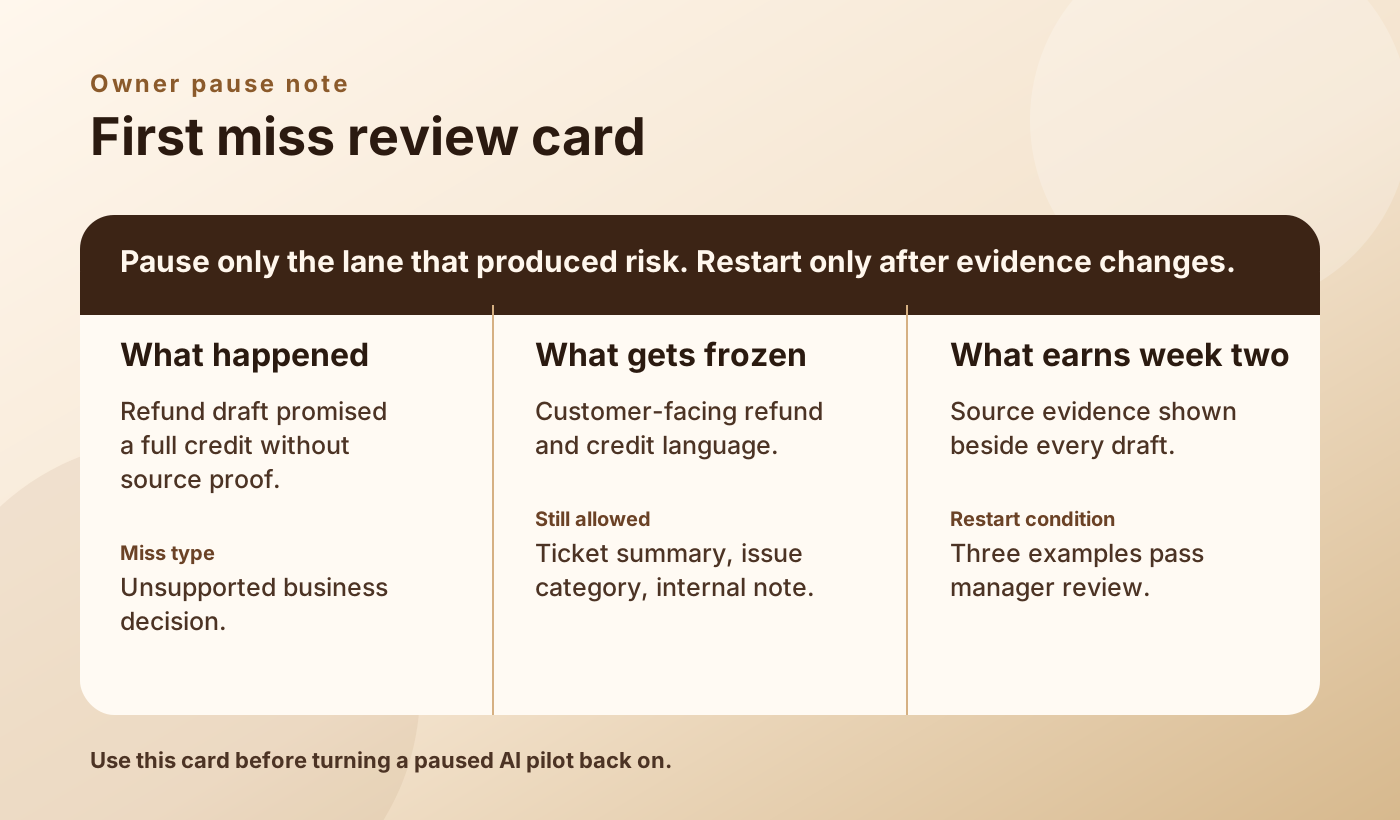
Workflow: support refund reply draft
Miss type: draft promised a full credit not supported by the account record
Owner: support manager
Frozen lane: customer-facing refund and credit language
Still allowed: ticket summary, issue category, replacement-shipment note for review
Evidence to inspect: order status, refund policy, account credit history, source links shown to reviewer
Restart condition: three refund-related examples show source evidence, blocked promise language, and manager approval before any reply is sent
Do-not-automate line: AI may not approve refunds, state that money has been credited, or send customer replies
A note like this changes the emotional shape of the meeting. The pilot is no longer "good" or "bad." It is paused in a defined lane until evidence earns another week.
The owner can also see whether the team is learning the right lesson. "Tighten the prompt" is not a restart condition. "Add examples" is not a restart condition. "Manager approval required for refund language until three reviewed examples pass with source evidence" is closer.
Field note: one miss can reveal the wrong owner
The first miss sometimes shows that the pilot owner is wrong.
A workflow builder can fix retrieval, prompts, and logging. They cannot decide whether a refund promise is acceptable. A marketing lead can review tone, but they may not own the CRM stage that triggers sales follow-up. An operations manager can approve a process note, but they may not own data retention.
If the miss crosses a business decision line, move the restart decision to the person who owns that decision in ordinary work.
Decide what earns another week
Do not restart because the bad draft was deleted.
Restart when the team can point to evidence that the same class of miss is less likely, easier to catch, and cheaper to recover from.
The same framework's Measure function is helpful because it pushes teams to assess metrics, controls, errors, impacts, and production behavior. A small business does not need a formal risk office to borrow that habit. The owner needs a short set of checks that match the workflow.
For the refund example, another week might be earned when:
- refund language is blocked unless the source record shows an approved credit
- the reviewer screen shows the policy, order status, and account credit state beside the draft
- the pilot routes refund promises to the support manager instead of a general queue
- the miss is added to the review examples for the next shadow run
- the workflow logs the source fields used for each refund-related sentence
Those checks rebuild confidence because they connect the miss to the workflow. They do not ask the owner to trust harder.
For a CRM-note pilot, the restart condition may be different. The system may need to quote the source sentence behind any buying-stage suggestion, show before-and-after field values, and keep lifecycle-stage changes draft-only for another week. For an intake workflow, the restart condition may require redaction before examples leave the source system and a hard block on medical, financial, credential, or HR details.
The shape changes. The standard stays the same: another week must be earned by evidence, not enthusiasm.
Use the miss to redraw the do-not-automate line
The most valuable sentence after a first miss may be the one that says what AI still may not do.
Before the pilot restarts, rewrite that line.
For the next week, AI may prepare summaries, categories, source links, and draft language for review. AI may not approve refunds, promise account credits, change CRM stages, send customer messages, or move private records into tools outside the approved workflow.
This is where the pause connects back to readiness. If the team has not run a workflow readiness check, do it before expanding the pilot. If the workflow itself still feels fuzzy, spend a week with the workflow audit before buying or building more. The Learn center has the broader pattern: choose one workflow, write the boundary, shadow-run the output, and let evidence decide the next permission.
BaristaLabs usually helps at this point, not at the panic moment after a pilot has spread across five systems. A process automation review can map the workflow lane, reviewer screen, receipt, and frozen actions. An AI consulting engagement can help rank whether the next safest week is prompt repair, source cleanup, approval design, or a different pilot.
Keep the tie-breaker simple. If the team can name the workflow, miss type, owner, restart condition, and do-not-automate line, the pilot may deserve another week. If it cannot, the pause did its job. It found the missing operating agreement before the AI system earned more permission.
Write the pause note first. Then decide whether to restart.
Implementation help
Plan the next safe week after an AI pilot miss
BaristaLabs helps owners inspect the workflow, miss type, responsible owner, restart condition, and do-not-automate line so a useful pilot can recover without expanding risk.
Best fit after a wrong support draft, bad refund recommendation, risky CRM note, data-boundary scare, or first pilot review where the team needs a calm restart decision.
Turn this idea into a pilot
Which workflow should go first?
Use the readiness check to compare impact, effort, risk, owner, and next step before requesting a review.
- 3-5 minutes
- Deterministic score
- No sensitive data
Practical AI Workflow Notes
Want more practical AI operations ideas?
Get short notes on applying AI inside real small-business workflows — from document handling and customer follow-up to internal reporting, compliance, and automation guardrails.