
ChatGPT for Financial Services: included data is not every subscription
A provider name is not a coverage guarantee. Evaluate included datasets, subscription entitlements, and the financial evidence that reaches the final file.

Sean McLellan
Lead Architect & Founder

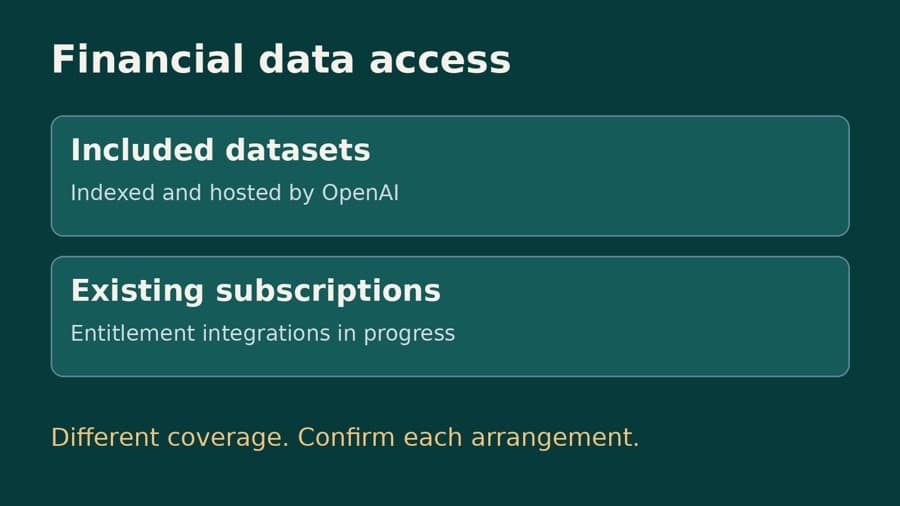
OpenAI's new ChatGPT for Financial Services puts financial datasets, analysis, and document creation in the same product. For a financial institution evaluating it, the important change is not just another model choice: some data is included and hosted by OpenAI, while other access depends on the firm's existing provider subscriptions.
That distinction changes what you can replace, what you still need to buy, and what an analyst must verify before sharing work. Start an evaluation by separating those source arrangements, then follow one financial figure from retrieval into the final spreadsheet or presentation. A useful answer inside chat is not yet a reviewed client deliverable.
Included datasets and existing subscriptions are different offers
In its September 10 announcement, OpenAI says ChatGPT for Financial Services includes datasets from providers such as Daloopa, PitchBook, LSEG News, and Crunchbase. It describes coverage including earnings transcripts, financial statements, company fundamentals, and private-company information. OpenAI says teams can use these included datasets without negotiating separate contracts or setting up connectors, and that it indexes and hosts the data on its own infrastructure.
That is a specific claim about the included datasets, not a statement that every product from each named provider is included. A firm's existing subscription may cover different history, fields, markets, or uses. Before retiring a source or connector, compare the data your actual work requires with the coverage offered in the proposed ChatGPT agreement.
The announcement describes a separate arrangement for existing subscriptions. OpenAI says it is working with S&P Capital IQ, LSEG, MSCI, Dow Jones Factiva, and Moody's on shared sign-in and entitlement integrations. Providers will be able to recognize users through their ChatGPT sign-in and give them access to data they are already entitled to use.
Read that wording carefully: OpenAI describes integrations in progress, not a universal rollout completed for every provider and customer. Shared sign-in can simplify recognition of a subscriber; it does not, by itself, create a subscription. Ask which integrations are enabled for your firm and which provider entitlements they recognize before including them in a deployment plan.
Check coverage against the analysis you need to finish
BaristaLabs' recommendation is to evaluate a defined research task rather than a provider logo list. Choose work your team already understands, using information approved for the evaluation. Record the required companies, reporting periods, fields, source documents, and final output before testing access.
A coverage comparison should include both what the AI can retrieve and what the firm may do with it. Ask the provider or purchasing team to confirm history, refresh frequency, export permissions, and permitted sharing for the relevant dataset and agreement. These are questions to resolve, not restrictions established by the announcement.
Keep included data and subscription-connected data separate in that comparison. If one source supplies a current company profile but the task needs older filings or a specific adjustment note, finding the company is not sufficient. The relevant result is whether the analyst can retrieve the needed evidence and finish the intended work under the applicable terms.
OpenAI says the product is available to eligible financial institutions and directs interested firms to its sales or account teams. The announcement does not give a public price or complete eligibility criteria. A general business finance team should therefore confirm eligibility rather than assume this is an add-on it can activate immediately.
Trace the figure, then inspect the exported work
OpenAI says the product provides granular citations that point to specific tables and passages, with supporting information highlighted for review. Its example is an analyst examining the reconciliation and notes behind adjusted EBITDA. That is a useful evaluation target because a cited number can still be unsuitable if its period, definition, or adjustments do not match the analysis.
For your test, select a figure whose supporting document a reviewer can inspect independently. Ask the product to identify the reporting period, unit, source passage, and relevant adjustments. Then have the reviewer check that the cited material supports the number and the way the analysis uses it; the presence of a citation alone is not a pass.
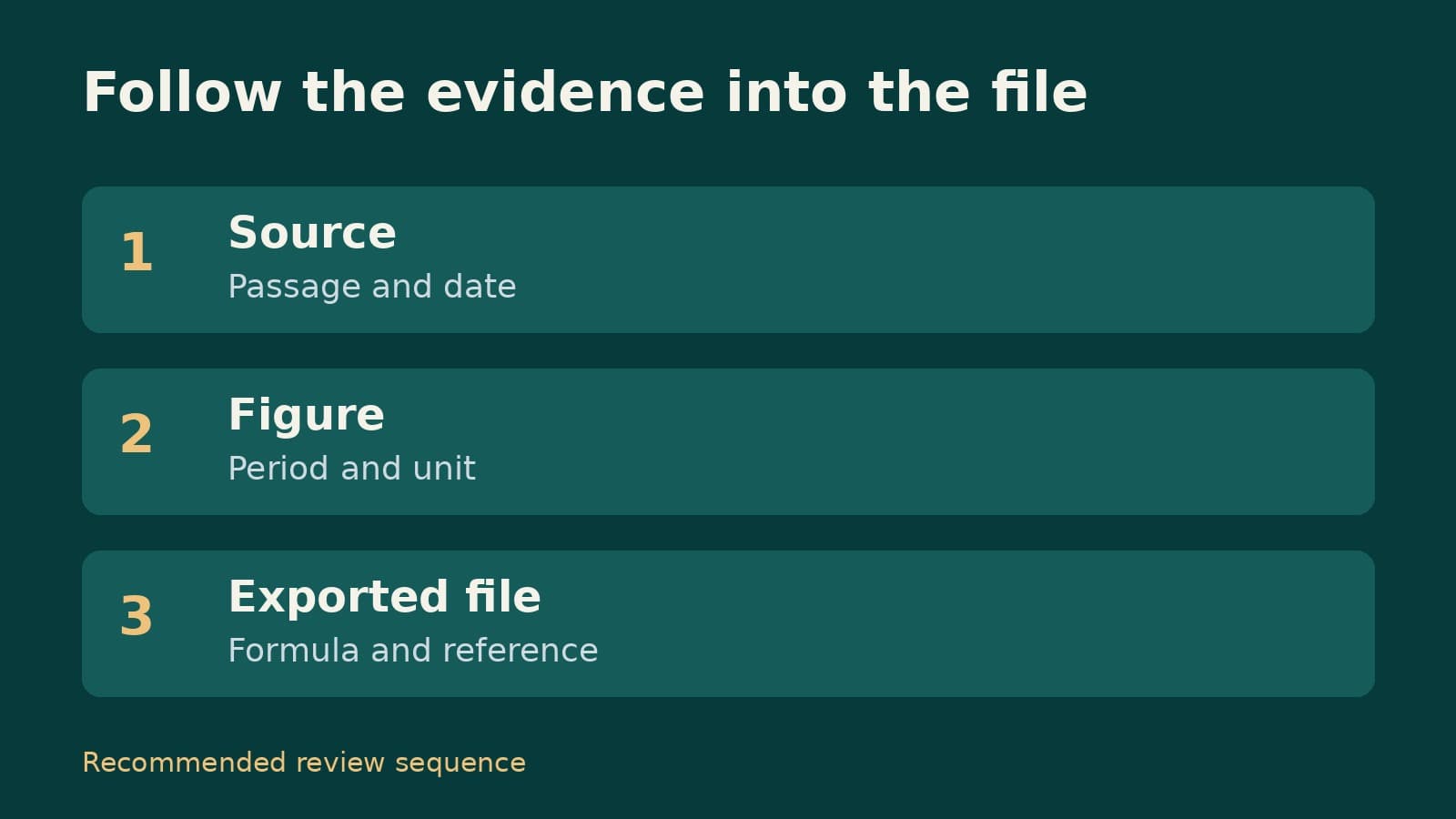
The next test belongs outside the chat window. OpenAI says administrators can publish Excel, Word, and PowerPoint templates through a dedicated admin page, and teams can use firm templates and style guides to produce models, research notes, and pitchbooks. Open the resulting file in the application your team uses and inspect the formulas, units, labels, and references that matter to that deliverable.
Do not assume the chat's citation experience transfers unchanged into every exported format. The announcement does not establish that behavior. Check whether a colleague who receives only the file can identify the source and reconstruct the important calculation; if not, specify the supporting references that must accompany it.
This separates two different benefits: reducing the work of assembling a draft and reducing the work needed to approve it. Measure both during an evaluation, and include review time in the operating budget. Faster formatting is useful, but it does not demonstrate that less financial review is needed.
Buy for verified coverage, not the breadth of the demonstration
The launch makes a packaged financial research workflow worth considering: included data, subscription connections, analysis, and firm-formatted output can be evaluated together. OpenAI also says the product builds on enterprise controls including SAML SSO, SCIM provisioning, and role-based access controls. Those features belong in the firm's security review, alongside confirmation of the particular data arrangements it plans to use.
The purchasing decision should follow the observed result. If the included data covers the required work and the exported deliverable is straightforward to review, the package may reduce integration and preparation work. If the task still relies on a separate subscription or an integration not yet available to the firm, keep that dependency in the cost and rollout plan.
Do not cancel a data source because an AI product names the same provider. Replace it only after confirming equivalent coverage for the work, applicable usage terms, and a reviewable output. That is the difference between buying access to an impressive demonstration and buying a tool the team can use.
Source
OpenAI: Introducing ChatGPT for Financial Services, September 10, 2026. Product capabilities and availability above are attributed to OpenAI; the evaluation method is BaristaLabs' recommendation, not a reported customer result.
Financial research workflow evaluation
Test the source coverage your workflow needs
BaristaLabs can help define a source-to-deliverable evaluation and its review requirements. Your provider and purchasing teams confirm eligibility and data terms.
Bring a sanitized task description and the output your team needs to review.
Turn this idea into a pilot
Which workflow should go first?
Use the readiness check to compare impact, effort, risk, owner, and next step before requesting a review.
- 3-5 minutes
- Deterministic score
- No sensitive data
Practical AI Workflow Notes
Want more practical AI operations ideas?
Get short notes on applying AI inside real small-business workflows — from document handling and customer follow-up to internal reporting, compliance, and automation guardrails.