
OpenAI's government AI offer is not a free deployment
Waived licenses and discounted usage change an agency quote only when the purchasing entity, service, account, and effective dates are confirmed.

Sean McLellan
Lead Architect & Founder

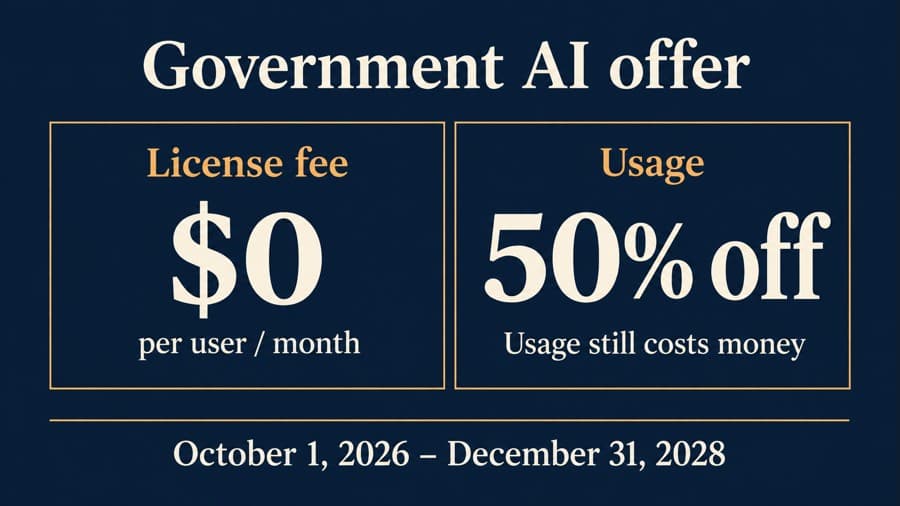
OpenAI's new government agreement removes a license fee, not the cost of using AI. In its September 10 announcement, the company says eligible federal, state, local, and tribal organizations will receive a $0 per-user monthly license fee and 50% off usage under an agreement running from October 1, 2026, through December 31, 2028.
For public-sector technology buyers and the software firms that support them, the immediate decision is what can enter an October purchasing plan. The announcement expands eligibility beyond the federal government, but it does not publish the usage rate card or establish that a contractor's own account qualifies. Separate the offered terms from the questions that still need a written answer before quoting a deployment.
What is free, and what remains metered?
OpenAI describes the standard license fee as $15 per user per month and says the agreement reduces it to $0, with no minimum commitment. It separately offers 50% off usage costs for eligible organizations. Those are different price components: removing the charge for a seat does not remove charges associated with the work performed through the service.
The announcement does not specify the billing units behind “usage,” the complete list of covered services, or the rates needed to price a particular workload. Do not substitute a public API token price, assume an included allowance, or apply the discount to every OpenAI product. Ask for the applicable service schedule, billing unit, base rate, discount treatment, and effective date in the purchasing documents.
BaristaLabs' recommendation is to keep the waived license line and estimated usage on separate lines in the proposal. List implementation and support separately as well. A supplier should not describe an integrated application as free simply because its eligible government customer may have no license fee.
Who should confirm eligibility before quoting work?
The new announcement explicitly extends the same offer to state, local, and tribal governments as well as federal organizations. That makes the offer relevant to public-sector teams outside last year's federal arrangement. It does not establish that every organization serving a public purpose, or every private company working for an agency, receives the same terms.
For an implementation partner, the key question is whose organization will purchase and consume the service. Before relying on the offer in a fixed-price proposal, confirm the eligible contracting entity, the workspace or account that will be billed, and how supplier personnel may access it. The announcement alone does not resolve contractor access, reseller treatment, or charges incurred in a supplier-owned development account.
OpenAI directs interested agencies to its government team for eligibility, pricing, and purchasing options. Registering interest starts that conversation; it is not evidence that an order has been accepted or discounted billing has begun. Keep an unconfirmed discount out of a binding customer price unless the proposal clearly identifies it as a condition.
The October start date matters to an existing deployment
The announced agreement begins October 1, not the September 10 announcement date. An agency with an existing subscription should ask how the new offer applies to its current term, renewal, and billing account rather than assume an automatic change. A team starting before October should confirm what it will pay before the agreement takes effect.
The end date also belongs in the operating plan. The announcement runs through December 31, 2028; it does not state what an organization will pay afterward. A system expected to remain in service beyond that date needs a renewal assumption and an owner who will revisit it before the term ends.
For the broader cost model, our guide to budgeting AI automation beyond the software fee covers implementation, review, exceptions, and ongoing operation. The new work here is narrower: identify which agreement applies to each account and date before inserting the discount into that model.
Daybreak Blue and Red have different terms
The same announcement expands government cyber-defender access. OpenAI says every verified government entity will be approved for Daybreak Blue at 50% off standard commercial pricing, with training and enablement. It says those defenders can request Daybreak Red for advanced vulnerability research, exploit validation, and red teaming at standard commercial pricing.
Do not extend the Blue discount to Red, or turn the ability to request Red into a claim of granted access. These distinctions matter when a security proposal names a specific model or depends on a particular kind of testing. Price and access should both be confirmed for the service the team will actually use.
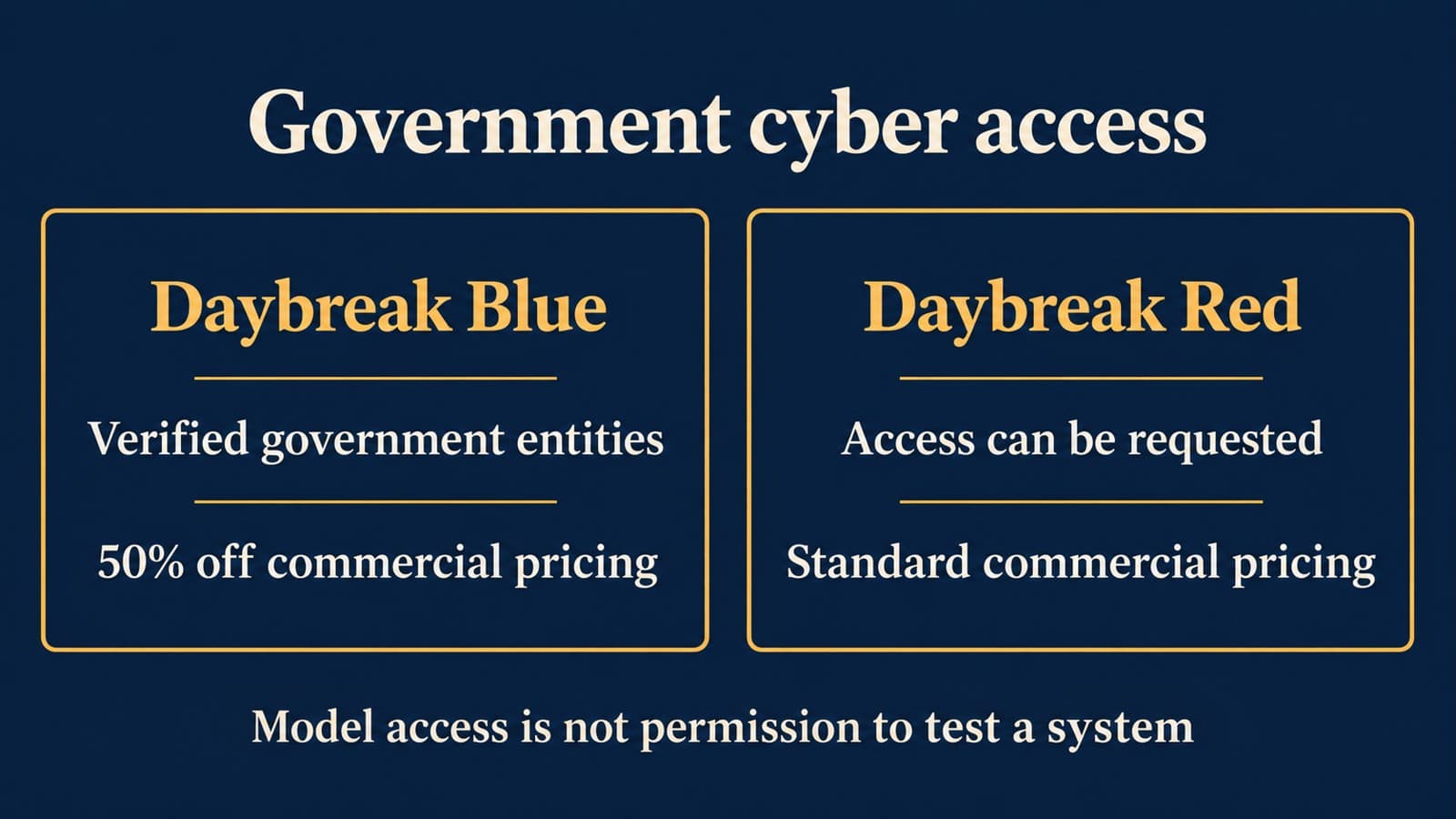
Access to a cyber model is also separate from permission to test an agency's systems. The agency must still decide which systems and actions it authorizes. Our Daybreak defensive-pilot guide covers that operational decision; the new agreement changes the announced government access and pricing terms, not the ownership of a test.
A data-training statement is not a complete deployment approval
OpenAI says ChatGPT Enterprise does not use business inputs or outputs to train or improve its models. It also says participating organizations retain the protections associated with the eligible services they choose. The wording ties protections to the chosen service rather than announcing a single approval for every government use case.
A purchasing team should therefore request the terms and security evidence for its exact service and intended data. A no-training statement does not, by itself, answer questions about retention, records handling, data location, or authorization to connect an internal system. Leave those questions with the agency's established procurement, security, and records owners rather than infer an answer from the discount.
OpenAI also promises buyer guidance, usage estimates, spend controls, onboarding, and FinOps guidance. Ask which controls will be available in the purchased service and what they actually enforce. A promised spend-control feature is not yet a verified hard ceiling on the agency's bill.
What should go into the purchasing request now?
An agency can act before every implementation detail is settled. Send the government team a specific request: the legal purchasing entity, the service being considered, the intended start date, any existing agreement, and the account arrangement for agency staff and suppliers. Ask for written eligibility and the service-specific usage schedule rather than a general confirmation of the headline offer.
Then attach one proposed workload and its expected use to the internal approval request. Mark unresolved rates or access terms as unknown. That gives procurement a concrete question to resolve while keeping an attractive offer from becoming an unsupported project commitment.
If you need help defining the workflow before seeking a quote, BaristaLabs can review its scope and operating requirements. We can help specify the work and integration boundary; eligibility and purchasing terms must come from the applicable government purchasing process and provider.
Source
- OpenAI, “Expanding AI access and cyber defense for federal, state, local, and tribal governments”, September 10, 2026. This article analyzes that public vendor announcement, not an executed agency agreement.
Public-sector workflow planning
Define the work before relying on a discounted quote
BaristaLabs can help specify workflow scope, integrations, review needs, and operating requirements. Provider and government purchasing teams determine eligibility and purchasing terms.
Bring a sanitized workflow description, proposed account arrangement, and the service you are considering.
Turn this idea into a pilot
Which workflow should go first?
Use the readiness check to compare impact, effort, risk, owner, and next step before requesting a review.
- 3-5 minutes
- Deterministic score
- No sensitive data
Practical AI Workflow Notes
Want more practical AI operations ideas?
Get short notes on applying AI inside real small-business workflows — from document handling and customer follow-up to internal reporting, compliance, and automation guardrails.