


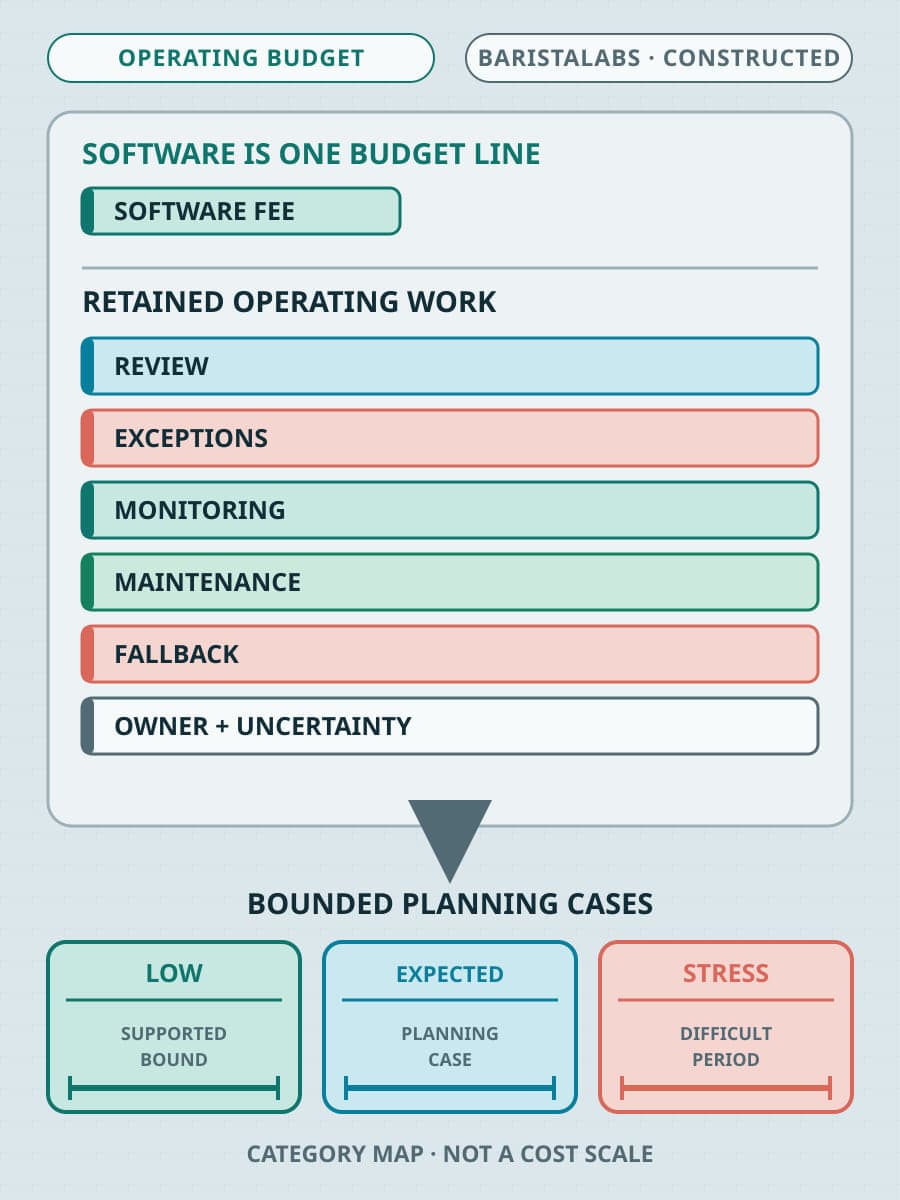
The software fee is one line in an AI automation budget. The workflow may also require source cleanup, integration, tests, human review, exception handling, monitoring, maintenance, training, security work, and a manual fallback. If those costs stay outside the estimate, the business has a software quote rather than an operating budget.
Build low, expected, and stress-case ranges for one recurring workflow. Use your measured volume, your internal labor costs, current written quotes, and explicit assumptions. The result shows the implementation and operating range and identifies the unknown that needs a bounded test before you approve more work.
Measure the current workflow before pricing the new one
Choose a representative period, such as an ordinary week or month. Record the item volume, routine handling time, and backlog. Also record correction work and failures with a customer, financial, access, privacy, or operational consequence. Keep unusual peaks visible, but do not let a quiet period stand in for normal work.
Write down who performs each step and which systems they use. Include the work that happens outside the main task. This work can include finding a document, asking for approval, correcting a record, or explaining a delay. Automation can move or change this work without removing it.
Use your business's loaded labor cost when you convert time into money. Loaded labor cost is the internal hourly cost your business uses for planning a person's time. Do not substitute a public wage estimate or a vendor benchmark. If finance has not approved an hourly planning cost, leave the amount unknown and keep the measured minutes.
This current workflow is the baseline for the budget and for later benefit claims. NIST's AI RMF Playbook Map guidance asks organizations to understand expected benefits and costs against appropriate benchmarks. It also calls for examining monetary costs and non-monetary costs that can result from system errors. Your current process is often the most useful local benchmark for a first workflow estimate.
Separate implementation work from recurring operation
Implementation costs happen before or during the first release. They can include workflow mapping, source cleanup, system configuration, integration, access controls, and tests. They can also include review design, escalation steps, monitoring, staff training, and rollout. A proposal can include some of this work and assign the rest to your team.
Estimate internal and external implementation work on separate lines. Attach external amounts to a dated quote or contract term. Attach internal amounts to an owner, estimated hours, and your business's loaded labor cost. If scope is still unclear, use a range or mark the line unknown instead of turning an early guess into a fixed total.
Recurring costs begin when the workflow starts operating. Software subscriptions and model usage belong here, along with hosting, storage, support, and any other metered service. Record the vendor's billing unit, included volume, minimum commitment, overage rule, and the date you checked the source. Vendor plans and units change, so an undated rate is a weak planning input.
Human work remains part of recurring cost. Estimate review time for routine outputs, exceptions, corrections, recovery, and monitoring. Add source updates, rule changes, integration maintenance, training, and vendor or model changes. Include the cost of a manual fallback for unavailable or unsupported cases.
Keep released time separate from cash savings
A workflow can create value without reducing an expense. Faster response, a smaller backlog, more consistent preparation, or time returned to an employee may improve the operation. That time becomes cash savings only when the business names a real financial change, such as less overtime, a lower contractor bill, avoided hiring, or the removal of another paid service.
Track benefits beside the budget, but do not subtract every released hour from cost as if it were cash. Record the baseline, the observed change, who can use the released capacity, and the decision that would turn it into a financial effect. This keeps a useful operational benefit from becoming an unsupported return-on-investment claim.
Build low, expected, and stress cases from visible inputs
Use the same cost categories in all three cases. Change only the inputs that have a reason to change, and attach each input to a measurement, quote, or explicit assumption.
The low case uses a supported lower bound. It may use the lower end of an implementation quote, measured routine volume, a low observed review time, and few exceptions. It should not assume that review, maintenance, or failures cost nothing unless the tested workflow supports that conclusion.
The expected case is the planning case you consider most plausible. It should use representative volume, the likely implementation scope, measured or tested review effort, expected exception work, current software terms, and normal maintenance ownership. “Expected” is an assumption label, not a guarantee.
The stress case tests a plausible difficult period. It may use peak volume, higher review time, more exceptions, a source or integration change, an incident, or temporary use of the manual fallback. Keep the case connected to a condition the business can recognize. A vague worst case cannot guide ownership or reserves.
Use a table like this. Preserve unknown until a quote, measurement, or bounded test supplies the missing input.
Cost input
Source preparation and cleanup
- Source
- Named owner estimate or scoped quote
- Low case
- Range or unknown
- Expected case
- Range or unknown
- Stress case
- Range or unknown
- Uncertainty to retire
- Which sources need repair before testing?
Cost input
Integration, tests, controls, and rollout
- Source
- Scoped implementation quote plus internal hours
- Low case
- Range or unknown
- Expected case
- Range or unknown
- Stress case
- Range or unknown
- Uncertainty to retire
- Which systems, permissions, and failure paths are in scope?
Cost input
Software, model, hosting, and support
- Source
- Dated vendor terms using the workflow's measured unit
- Low case
- Range or unknown
- Expected case
- Range or unknown
- Stress case
- Range or unknown
- Uncertainty to retire
- How does peak volume change metered use?
Cost input
Routine human review
- Source
- Sample volume × review minutes × local loaded cost
- Low case
- Range or unknown
- Expected case
- Range or unknown
- Stress case
- Range or unknown
- Uncertainty to retire
- How many cases pass without edits?
Cost input
Exceptions, corrections, and recovery
- Source
- Baseline records or bounded-test results
- Low case
- Range or unknown
- Expected case
- Range or unknown
- Stress case
- Range or unknown
- Uncertainty to retire
- Which exception classes remain manual?
Cost input
Monitoring and investigation
- Source
- Named owner estimate plus telemetry quote
- Low case
- Range or unknown
- Expected case
- Range or unknown
- Stress case
- Range or unknown
- Uncertainty to retire
- What must be logged, retained, and checked?
Cost input
Maintenance, source changes, and retraining
- Source
- Internal owner estimate or support terms
- Low case
- Range or unknown
- Expected case
- Range or unknown
- Stress case
- Range or unknown
- Uncertainty to retire
- How often do rules, sources, vendors, or integrations change?
Cost input
Manual fallback and important failure consequences
- Source
- Continuity plan, incident records, and local consequence estimate
- Low case
- Range or unknown
- Expected case
- Range or unknown
- Stress case
- Range or unknown
- Uncertainty to retire
- Who owns the fallback, and how long can it run?
Calculate each case over the same time period. Add the one-time implementation lines to the recurring cost for that period. Keep an important non-monetary consequence beside the total when the business cannot support a dollar value. A precise total built on hidden unknowns is less useful than a bounded range with the gaps exposed.
The agent observability cost estimator can help with one part of the monitoring line. It converts a measured day of trace telemetry into comparable ingestion, retention, and evaluation costs. It covers telemetry cost only. It does not estimate total workflow cost, human review, exceptions, maintenance, implementation, or business failure consequences.

Use a bounded test to retire the largest unknown
Find the input that can change the decision most. For one workflow, that may be reviewer minutes per item. For another, it may be the exception rate, source-cleanup effort, integration scope, or telemetry volume. Do not start a broad pilot when a smaller test can measure that input directly.
The SBA's small-business AI guidance recommends starting small and testing whether a tool adds value. Apply that advice to the budget. Run a bounded sample against representative routine work and difficult cases while people retain the current approval and fallback path.
Record the sample dates and volume, inputs used, reviewer edits and rejections, exceptions, correction work, metered software use, monitoring data, and staff time. Then replace the relevant assumptions in all three cases. The test does not need to prove the full business case. It needs to reduce the uncertainty that could make the next commitment unsound.
If the largest unknown is implementation path rather than operating volume, use the AI implementation path decision matrix. It compares self-serve software, internal work, automation platforms, specialists, consultancies, and implementation support against workflow scope, data, action risk, ownership, and proof needs.
Approve the test only when expected cost fits and stress has an owner
Review the budget with the workflow owner and the person responsible for the money. Include the people who will review, maintain, monitor, or recover the system. The expected case should fit the available budget and staffing. The stress case should name its cause and the person who responds. It should also define when the team narrows, pauses, or returns to the manual path.
Budget the controls as operating work. The AI workflow controls guide helps define the workflow and data boundaries, approval policy, review queue, evidence, monitoring, escalation, and rollback. These controls affect implementation and recurring cost because people must build, use, review, and maintain them.
A complete planning range does not guarantee that the automation will produce savings or acceptable results. It gives the business a bounded commitment, visible assumptions, and a testable unknown. That is enough to decide whether to run the next test, revise the workflow, choose a different implementation path, or keep the work manual.
BaristaLabs uses process automation and integration to map one recurring handoff. The work connects implementation choices to review, exceptions, monitoring, and fallback ownership. If the software price is visible but the surrounding work is not, budget one AI workflow before committing to the build.
Source note
The NIST AI RMF Playbook provides voluntary suggestions rather than a required budgeting method. Its live Map page states that AI RMF 1.0 is being updated. It also states that the Playbook will be updated after the framework revision. NIST supports the use of context, benchmarks, expected benefits, monetary costs, and non-monetary failure costs. The three-case budgeting method in this article is BaristaLabs guidance. The SBA supports starting small and testing whether an AI tool adds value. Neither source supplies vendor rates, labor assumptions, implementation-hour benchmarks, exception rates, or savings estimates. This article does not claim a universal return on investment or publish a BaristaLabs cost benchmark.
AI automation budget
Budget one workflow before committing to the build
BaristaLabs can help your team measure the current workflow, expose retained human work, define controls and fallback needs, and turn the largest unknown into a bounded test.
Best fit when a software price is visible but implementation scope, review load, exception work, or ongoing ownership is still unknown.
Turn this idea into a pilot
Which workflow should go first?
Use the readiness check to compare impact, effort, risk, owner, and next step before requesting a review.
- 3-5 minutes
- Deterministic score
- No sensitive data
Practical AI Workflow Notes
Want more practical AI operations ideas?
Get short notes on applying AI inside real small-business workflows — from document handling and customer follow-up to internal reporting, compliance, and automation guardrails.