


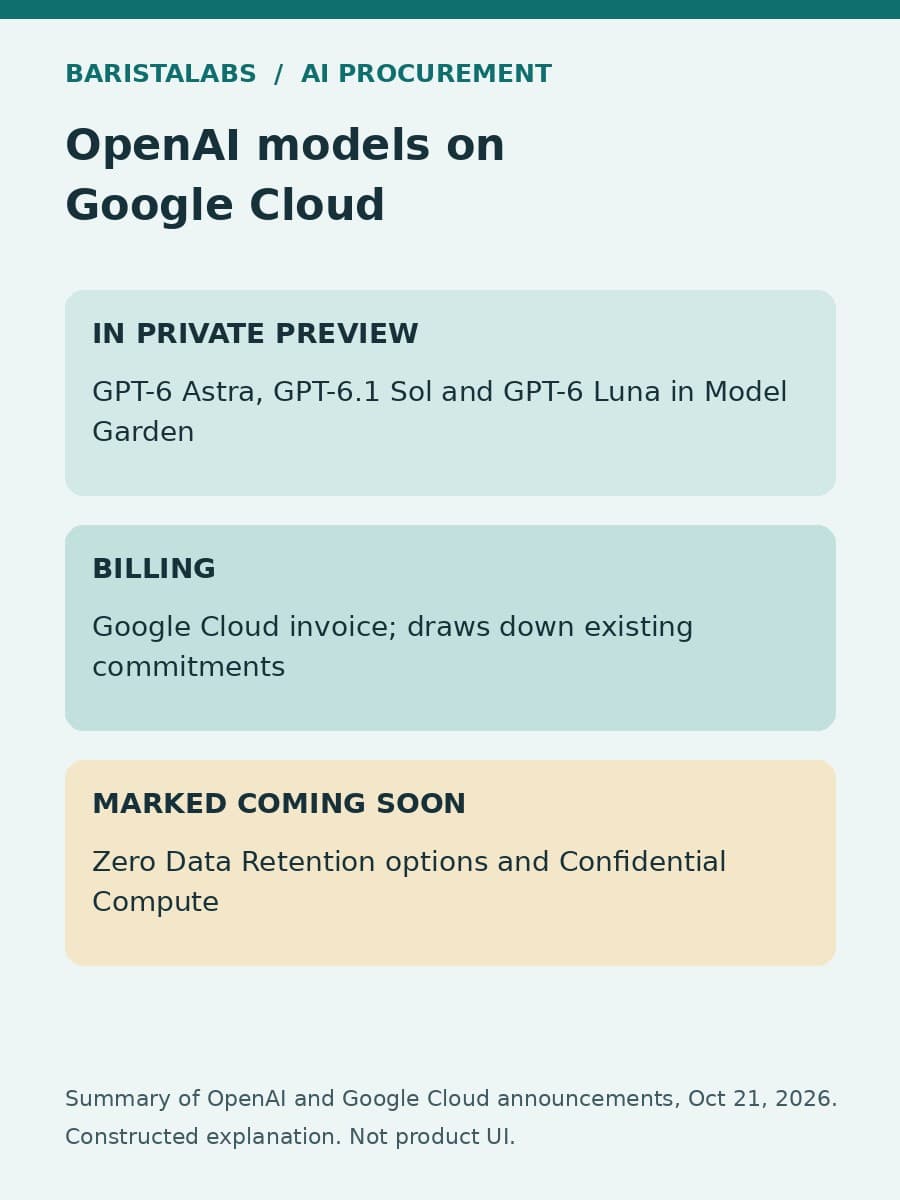
OpenAI and Google Cloud announced on October 21 that OpenAI models are coming to Google Cloud’s Model Garden. If your company already has a Google Cloud spend commitment and also pays OpenAI directly, this opens a second way to buy the same family of models: through Google Cloud Marketplace, billed on your Google Cloud invoice.
That is a real procurement change. It is also an early one. Google says the models are rolling out in private preview to select enterprise customers, and OpenAI says general availability is planned in the coming weeks. Before moving budget or workloads, it helps to separate what the announcements describe as available now from what they describe as coming soon.
What the two announcements say
OpenAI’s announcement says the partnership brings its frontier models and Codex agentic workflows into Model Garden. Customers will purchase the models there, transacted through Google Cloud Marketplace, and enterprises with Google Cloud spend commitments will be able to draw those commitments down for these purchases. OpenAI also notes that Microsoft remains its primary cloud partner.
Google Cloud’s announcement names three models:
- GPT-6 Astra, described for demanding coding, computer use, professional work and scientific research.
- GPT-6.1 Sol, described as near-Astra capability at lower cost.
- GPT-6 Luna, described as a fast, cost-efficient model for everyday work at scale.
Google says customers in the preview can build with these models through its APIs and connect local Codex CLI and Desktop workflows to its Gemini platform for inference. Both companies say OpenAI models will later appear in Google Antigravity. OpenAI calls the second product the Gemini Agent; Google calls it Gemini for business.
How the billing route works
The financial mechanism is the clearest part of the announcement. Google says that because the models are transacted through Google Cloud Marketplace, usage appears on a single Google Cloud invoice, draws down existing cloud commitments and counts toward Flexible Savings Plans across model providers.
For a finance team, that can matter more than any model feature. A company that has committed spend with Google Cloud and separate OpenAI usage may be able to consolidate the two. Neither announcement publishes per-token prices for the Google Cloud route, so there is no basis yet for saying it will cost more or less than buying from OpenAI directly. Ask your Google Cloud account team how your specific commitment treats these Marketplace purchases rather than assuming every contract works the same way.
Which protections are live and which are coming
Google lists several governance features for OpenAI workloads on its platform. Some are described in the present tense, and some are explicitly marked as coming soon.
Scroll sideways to see all 2 columns.
| As described on October 21 | Status in Google’s announcement |
|---|---|
| Prompts, context and outputs stay within your designated data perimeter and are not used to train foundation models | Described as current |
| Authenticated identity, VPC Service Controls protection and unified audit logging | Described as current |
| Models run on dedicated Google Cloud infrastructure behind isolated gateways | Described as current |
| Zero Data Retention options | Coming soon |
| Confidential Compute | Coming soon |
| Availability in Gemini for business and Google Antigravity | Coming soon |
The table reflects Google’s wording on announcement day, not a test of the preview. If a workload requires zero data retention today, the announcement does not yet support moving it. Wait for that option to be documented for your account, or keep the workload where your current terms already cover it.
What the announcements leave open
Several details a buyer would normally need are not in either post: regions, rate limits, model-version and deprecation policy, whether every OpenAI API feature your application uses is available through Google’s APIs, and a firm general availability date. None of that means the answers are bad. It means they have to come from documentation or your account team, not from the launch posts.
BaristaLabs would also treat the Codex connection carefully. Google says local Codex CLI and Desktop workflows can be connected to its platform for inference, but we did not review public setup documentation for that path. Confirm how authentication, logging and billing attribution work for developer machines before pointing a team’s coding agents at a new endpoint.

A small pilot before a budget decision
Our recommendation, not a requirement from either company, is to start with one existing OpenAI workload whose data needs are already understood. Request preview access, then run that workload through Model Garden alongside your current route with the same prompts and inputs. Compare output quality, latency, error handling and the charges that appear on each invoice.
The point of the pilot is to replace assumptions with your own numbers. If the Google Cloud route produces equivalent results, satisfies your data terms and draws down a commitment you would otherwise underuse, moving more spend may be reasonable. If a required protection is still marked coming soon, the sensible answer may be to wait a few weeks.
Teams already working across clouds may find our notes on Bedrock third-party model spend alerts useful, because watching usage on a cloud invoice raises similar questions. For help scoping a side-by-side pilot, our AI consulting work can connect the workload owner, the data requirements and the person who manages the cloud contract.
Sources and limits
- OpenAI: OpenAI models are coming to Google Cloud, published October 21, 2026; accessed October 21, 2026.
- Google Cloud Blog: Google Cloud brings OpenAI models to customers, published October 21, 2026; accessed October 21, 2026.
This article interprets the launch announcements. BaristaLabs has not tested the private preview, and it reports no prices, benchmarks or customer results. Availability and terms should be confirmed for your own account.
Model procurement
Compare one workload before moving spend
Bring one OpenAI workload, its data requirements and your current cloud commitment. BaristaLabs can help plan a side-by-side preview pilot.
Start with one workload and the person who owns the cloud contract.
Turn this idea into a pilot
Which workflow should go first?
Use the readiness check to compare impact, effort, risk, owner, and next step before requesting a review.
- 3-5 minutes
- Deterministic score
- No sensitive data
Practical AI Workflow Notes
Want more practical AI operations ideas?
Get short notes on applying AI inside real small-business workflows — from document handling and customer follow-up to internal reporting, compliance, and automation guardrails.