


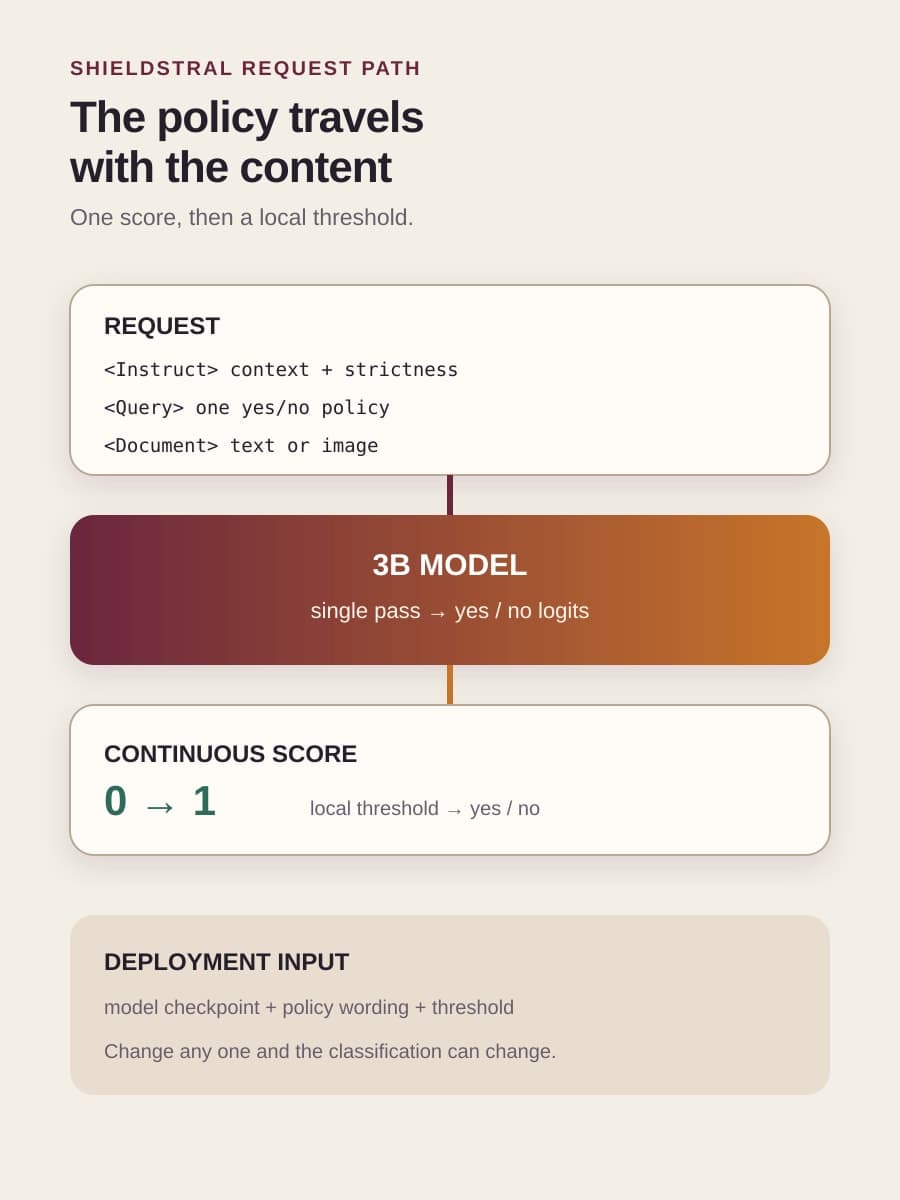
Mistral introduced Shieldstral on August 4, 2026, as a 3B open-weights, policy-adaptive multimodal safety classifier under the Apache 2.0 license. Its runtime request includes evaluation instructions, a yes-or-no policy question, and the text or image to classify. A team can therefore change the moderation question and alter classifications without retraining the model checkpoint.
That flexibility changes the stakes of a policy edit. For an operator, the release unit now has four parts: the immutable checkpoint revision, the exact <Instruct> and <Query> strings, the classification threshold, and the representative held-out corpus version. This article explains how to keep those dependencies visible so a policy change has regression evidence, an owner, monitoring, and a rollback path.
Shieldstral separates context, policy, and content in each request
The public repository identifies the model as mistralai/Shieldstral-1.0-3B. That model ID is not an immutable checkpoint revision. Record the repository commit or an artifact digest for the exact checkpoint under test. According to the technical report, the model uses a fixed system message that defines the moderation task, followed by a user message with three adaptive fields. Each field has a separate job:
<Instruct>states the evaluation context and strictness.<Query>asks one specific yes-or-no policy question.<Document>contains the item to evaluate: a prompt, a response, a prompt-response pair, or an image with optional text.
These fields should remain distinct in implementation and testing. A stricter <Instruct> can change how the model handles a borderline case, while a more specific <Query> can change which conduct the model evaluates. <Document> is the content under review, not another place to hide policy rules.
Shieldstral processes the structured request in one forward pass and emits one yes or no token. The report's scoring path reads the logits for those two token IDs and softmax-normalizes them into a continuous yes score. An application can rank items by this derived score or compare it with a threshold to produce a binary decision.
The paper uses a threshold of 0.5 for its binary evaluations. That value describes the paper's setup; it does not establish the correct production threshold for every moderation workflow. A threshold controls where the score becomes a decision, so it must stay attached to the policy wording and the consequences of a false positive or false negative. The BaristaLabs threshold-tuning guide covers that separate business decision in more detail.
A mutable policy string expands the release unit
With a fixed-category classifier, teams often treat the checkpoint and threshold as the important model controls. Shieldstral adds natural-language policy wording to the inference path. If that wording changes, the model receives a different input even when the weights, serving code, and threshold remain fixed.
That makes the exact <Instruct> and <Query> text release dependencies. A policy document in a wiki is not enough if the production request uses a shortened, translated, reformatted, or manually copied version. Reviewers need the string the model received, because that is the version that produced the score.
The representative held-out corpus completes the operational release unit. It supplies evidence about how one checkpoint, wording version, and threshold behave on cases the team did not use to tune the setup. The corpus does not need to travel with each live request, but its version and results must remain attached to the release decision.
For each approved combination, record the immutable checkpoint revision or artifact digest, exact <Instruct> text, exact <Query> text, threshold, corpus version, and reviewer. This information makes a later disagreement reproducible. It also lets the deployment owner restore the prior combination instead of guessing which isolated setting to reverse.
Test a policy edit against the same held-out cases
The following policy-diff example is illustrative. It contains no Shieldstral result or customer data, and it does not predict how the model will respond to any specific wording change.
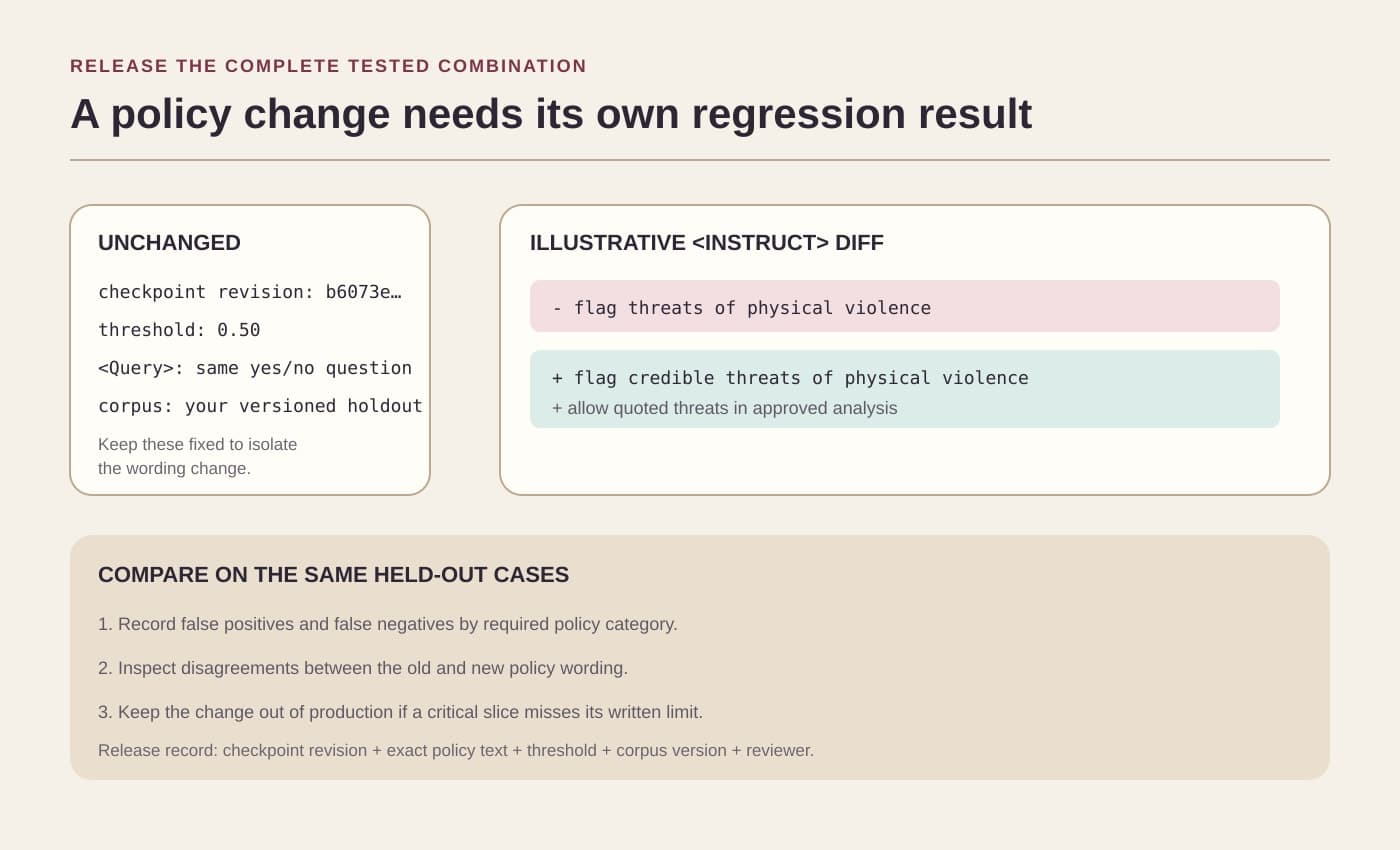
Start with the currently approved combination and one proposed wording revision. Change either <Instruct> or <Query>, not both. Keep the other field, the immutable checkpoint revision, the threshold, the document formatting, and the held-out corpus version fixed. Run every held-out case once with the approved wording and once with the proposed wording. Store both scores and both binary decisions beside the human label.
The first useful review is the disagreement set: cases for which the old and new wording produce different classifications. Reviewers should determine whether each change matches the intended policy revision. They should also compare false positives and false negatives by policy category, language, modality, and other required slices. A stable aggregate can conceal a serious local regression.
This test is narrower than a full production guardrail evaluation. Teams still need representative traffic, required languages, complete conversations where relevant, attack coverage, and full-path latency evidence. The multilingual and multi-turn guardrail testing guide explains that broader replay; the policy-diff test answers a different question about what changed when the policy text changed.
A policy owner should approve the intended meaning of the revision. A moderation or model owner should review the disagreement and error evidence. The deployment owner should release the complete combination and verify that rollback restores the prior checkpoint revision, wording, and threshold, with the earlier corpus results still available for comparison.
After release, monitor the score distribution, the share of cases near the threshold, reviewer reversals, appeals, and category-level error samples where labels arrive later. A sudden shift after a wording release can show that the new text changed the decision boundary more broadly than reviewers expected. Monitoring should identify the wording version and checkpoint for every event, or the team will not be able to connect the shift to the release.
Mistral's benchmark results support local evaluation
The report describes training on about 54.1 million examples: 45.2 million open-source text samples, 4.4 million synthetic contrastive text samples, and 4.5 million multimodal samples. It evaluates Shieldstral across 16 benchmarks with 21 splits and says all evaluation samples were held out from the training data. This is the paper's training and evaluation boundary. It does not test a reader's policy wording or production traffic.
On the policy-adaptability benchmark, Shieldstral reports 91.3% F1. The benchmark uses an independently designed taxonomy with 12 superclasses, 26 subcategories, and 52 leaf categories. It applies 90 fixed, manually authored canonical queries. Across the three multimodal benchmarks - VLGuard, UnsafeBench, and LlavaGuard - Shieldstral reports an average F1 of 83.8% and leads two of the three. The technical report limits its "nearly 7×" size comparison to text-safety benchmarks. Mistral's launch post uses "up to 7×" when it summarizes the four benchmark axes. Keep every figure attached to its datasets, labels, prompts, thresholds, and baselines. None of these results is a universal ranking or production guarantee.
The language results need the same restraint. The paper's appendix says prompt classification underperformed for Arabic, Indonesian, and other low-resource languages. Mistral also names multilingual coverage, longer-document reliability, and broader multimodal safety as continuing work. A team should keep required languages and content forms visible in the held-out corpus instead of assuming one average covers them equally.
Mistral says Shieldstral can run on one 16GB NVIDIA GPU. The public model repository provides Apache 2.0 weights in model formats that include Safetensors and Transformers support. The cited launch post, report, and model page do not establish a hosted Mistral API product, universal latency or throughput, or total production cost. Those deployment properties remain local measurements.
Sources
- Mistral AI, "Introducing Shieldstral", August 4, 2026.
- Calvi et al., "Shieldstral", arXiv:2607.25857, July 2026; PDF.
- Mistral AI, Shieldstral-1.0-3B model repository, accessed August 4, 2026.
Release the tested combination and keep its rollback intact
Shieldstral gives teams a practical way to adapt moderation criteria without training a new checkpoint for each policy. Teams only get that benefit when they control each release dependency. Policy text needs a version, a diff, same-corpus regression evidence, a named reviewer, monitoring, and a rollback to the last approved combination. These controls also fit the wider pattern of responsible AI workflow controls, where the decision, evidence, owner, and recovery path remain visible.
BaristaLabs can help a team design one policy-change regression test for a real moderation workflow. The scope can stay small: one checkpoint, one wording change, one threshold, and one representative held-out corpus.
Treat policy wording as part of the release. Refuse to ship a wording change without evidence from the same held-out corpus and a tested rollback to the prior combination.
Policy-change review
Test the wording change before it becomes production behavior.
BaristaLabs helps teams define representative cases, error limits, ownership, and rollback for one AI moderation policy change.
Built for teams operating customer-facing AI, content review, agent safety, or multimodal moderation.
Turn this idea into a pilot
Which workflow should go first?
Use the readiness check to compare impact, effort, risk, owner, and next step before requesting a review.
- 3-5 minutes
- Deterministic score
- No sensitive data
Practical AI Workflow Notes
Want more practical AI operations ideas?
Get short notes on applying AI inside real small-business workflows — from document handling and customer follow-up to internal reporting, compliance, and automation guardrails.