


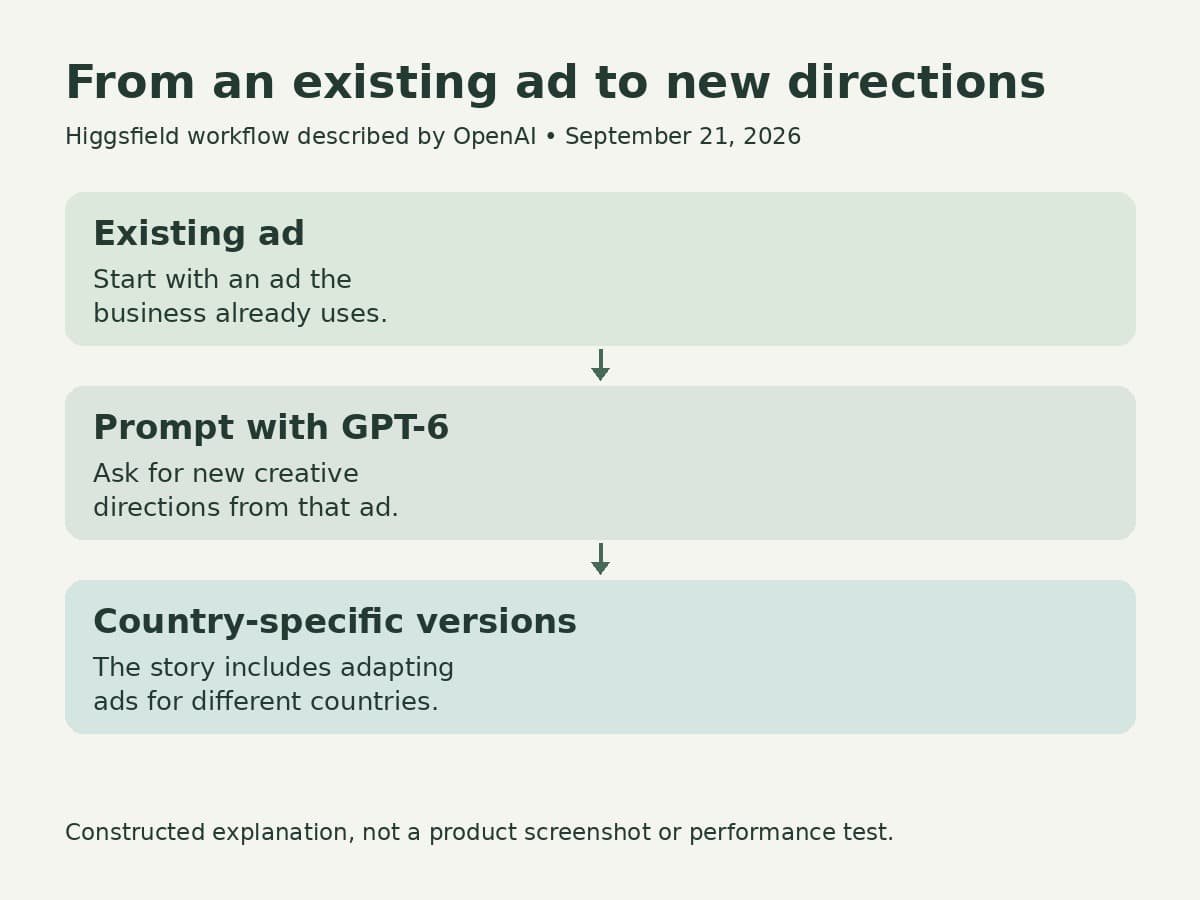
OpenAI’s September 21 customer story about Higgsfield describes a useful change in AI-assisted advertising: a business can start with an existing ad and ask for new creative directions, including versions for different countries. The example request is “Take my top-performing ad and generate 100 new variations,” with GPT-6 selected in the workflow.
For a small marketing team, that makes the original ad a reusable starting point. It also makes the brief more important. A country-specific version may need different language, imagery, or pacing without changing what the business promises to sell. The useful question is what each variation is allowed to change.
What the Higgsfield story actually shows
OpenAI describes GPT-6 Astra as supporting both customer-facing ad creation and software development inside Higgsfield. In the ad workflow, a prompt leads to new creative directions based on an existing ad. The story specifically mentions customizing ads for different countries.
The “100 new variations” line is an example prompt, not a reported campaign result, a guaranteed output allowance, or a measure of how many usable ads a team will receive. The story does not provide conversion results, review time, pricing, or language coverage. It also does not identify the underlying video renderer. Those details would need separate verification before a purchase or production commitment.
Higgsfield’s CEO also says one engineer can deliver new exploration features within a day, attributing the speed to Astra’s planning and collaboration between creative staff and engineers. That is a customer account published by the model vendor. For an advertiser, the more directly useful development is the ability to begin creative exploration from an ad the business already understands.
Separate the creative brief from the offer
Our recommendation is to brief the parts that can vary separately from the facts that must remain accurate. Background, opening shot, tone, and pacing are creative choices. Product contents, price, delivery eligibility, and the terms of an offer need an approved source.
Country-specific work complicates that distinction. Some commercial details should change between markets, but the generator should not decide the replacements. Supply the approved local price and delivery terms rather than asking it to infer them from the original ad.
A coffee product provides a straightforward example. A team could explore different settings for the same bag of beans while retaining its actual pack size and product description. If it also wants a new-country version, someone responsible for that market should supply the correct currency, availability, and delivery promise. These are proposed briefing choices, not a demonstration of Higgsfield’s controls.
Scroll sideways to see all 2 columns.
| Part of the ad | What to put in the brief |
|---|---|
| Product appearance and contents | Approved product references and the exact item being sold |
| Visual setting and opening | The creative elements the team wants to explore |
| Spoken and on-screen claims | Approved wording or facts the reviewer can check |
| Price, shipping, and availability | Market-specific terms supplied by the business |
| Destination | The landing page that fulfills this version’s offer |
This is more useful than a broad instruction to “keep it on brand.” A reviewer can compare a pack size or delivery claim with its source. A general brand instruction leaves too much of that work implicit.
Review the whole promise, including the landing page
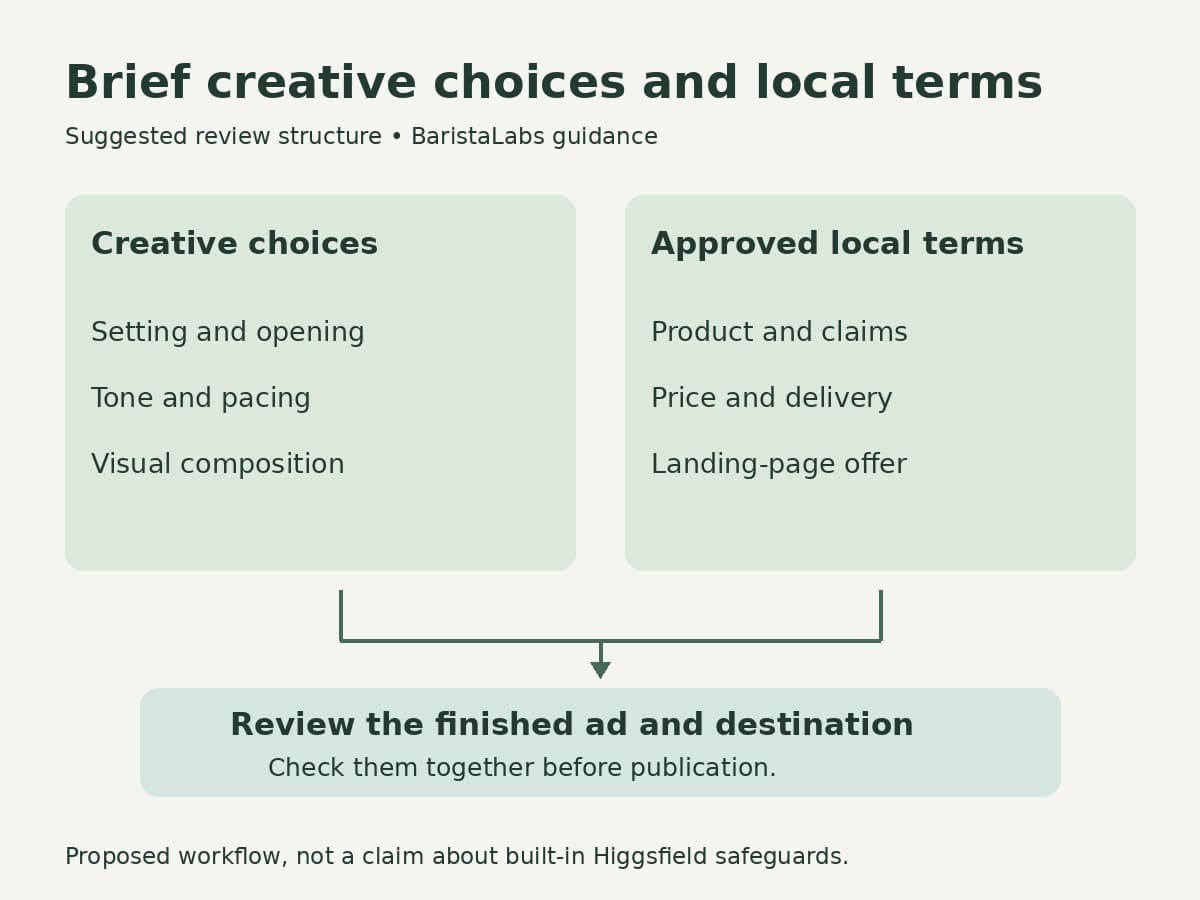
Review a finished variant as a customer would encounter it: picture, voice, captions, offer, and destination together. A translation can read well while the voiceover says something different. A correct local price in the video can still lead to a page with an unavailable product or another market’s terms.
For country-specific versions, use a reviewer who understands the language and the offer in that market. Ask them to check the commercial meaning, not just fluency. A softer phrase in the source language should not become a stronger product claim in translation. Keep any rejected claim and its correction with the asset so that the next revision does not reintroduce it.
The visual review has a separate job. Compare the depicted item with the actual product, including packaging and anything shown as included. Attractive imagery is not enough if a customer would reasonably expect something the business does not supply.
Our earlier coverage of Canva Magic Layers focused on making existing assets editable again. Here, the decision comes after new versions have been created: which versions still describe an offer the business can deliver?
Use variations to answer a campaign question
A large batch can help explore creative directions, but it does not by itself create a useful advertising test. Decide what the next campaign should teach you before choosing which variants to run.
If the question concerns the opening scene, keep the offer and destination consistent while comparing openings. If the question concerns entry into another country, record the local changes explicitly. Results from different markets can reflect differences in audience, price, or fulfillment as well as the creative work; do not attribute all of the difference to the generated video.
Start with a batch your team can actually review. Keep the original ad, the brief, the approved local terms, and the final version together. Track correction work alongside production time so that faster generation does not hide a slower approval process.
The Higgsfield story suggests a more flexible starting point for creative work. A useful finished ad still needs a clear relationship to the product, the market, and the page a customer reaches. Define those relationships before asking for more versions, and the team has a concrete basis for deciding which ones to use.
Source
OpenAI: Higgsfield AI ships new video features in a day with GPT-6 Astra, September 21, 2026. Product descriptions and the CEO’s account above come from this vendor-published customer story. Briefing, review, and campaign-testing recommendations are BaristaLabs guidance, not claims about built-in Higgsfield safeguards.
AI-assisted video production
Define what each ad version can change
BaristaLabs can help structure creative briefs, product references, and approval steps for AI-generated campaign media.
Bring an existing ad and the markets you want to adapt it for.
Turn this idea into a pilot
Which workflow should go first?
Use the readiness check to compare impact, effort, risk, owner, and next step before requesting a review.
- 3-5 minutes
- Deterministic score
- No sensitive data
Practical AI Workflow Notes
Want more practical AI operations ideas?
Get short notes on applying AI inside real small-business workflows — from document handling and customer follow-up to internal reporting, compliance, and automation guardrails.