


Maya drags citrus-summer-final.png into a message to the freelance designer. The image shows a cold drink on a tiled counter, a bright awning behind it, and more room on the right for offer copy.
"Can you make a YouTube crop and clean up the shadows?"
The file leaves. The useful production fact does not.
The awning and half the counter were generated when Maya expanded a real product photo with an image tool. The drink is real. The setting is partly synthetic. None of that is visible in the filename or the flattened PNG.
Maya and the campaign are fictional, an illustration of a common production path. We will follow this one asset through five handoffs: internal creation, freelance editing, brand approval, platform upload, and the disclosure a customer can see.
At every transition, one narrow question matters: will the next person know that AI helped create or edit the ad when someone must say so publicly?
First handoff: the source leaves its maker
Maya remembers exactly what happened. She selected the product photo, expanded the background with a generative tool, rejected several results, and exported the chosen composite.
Her colleague who receives the file knows only that Maya made it. The freelancer sees only pixels.
This is the first opening for the origin fact to vanish. Most creative handoffs describe the next task: resize this, revise the offer, soften the shadow. They rarely preserve a fact that seems settled inside the maker's head.
A lightweight origin handshake would change the message by one sentence:
Example
AI origin: yes, the background was generated with [tool or supplier]. Maya Chen attests to this version. No platform declaration has been submitted yet.
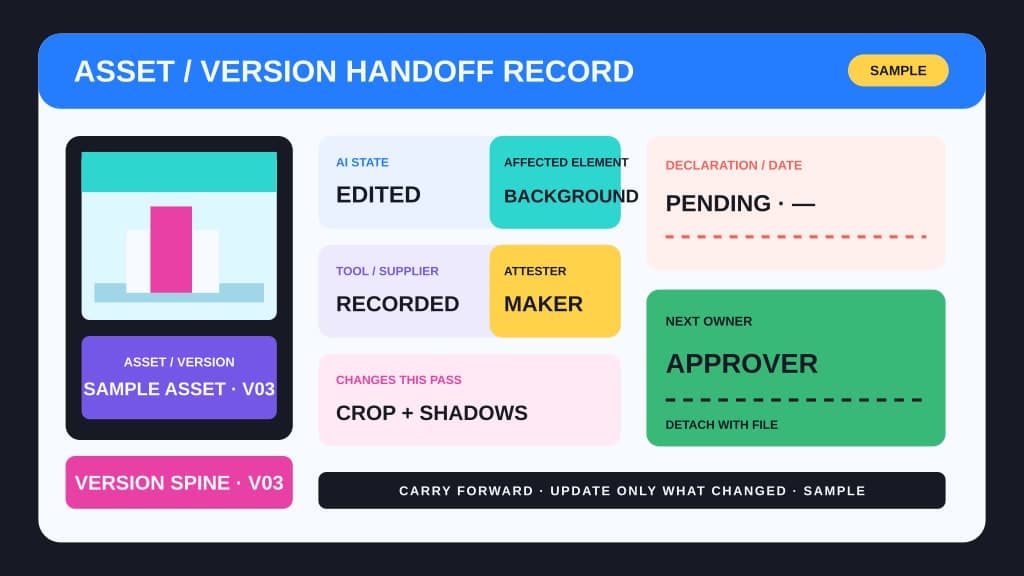
That sentence carries four things: whether AI created or edited the asset, which tool or supplier was involved, who is standing behind the statement, and whether anyone has submitted a declaration to the ad platform.
It does not try to solve licensing, rights, campaign eligibility, source ownership, or every revision. Those belong in the broader brand-asset approval and provenance foundation. The handshake here has a smaller job: keep a private production fact alive until it becomes a public disclosure decision.
That narrowness is what makes the habit usable. Maya can add the sentence to a task comment, an asset description, or the message that transfers the file. The location can vary. The four facts should not.
If you need the portable record rather than another explanation, copy the AI creative-origin handoff worksheet. It adds the exact asset version, affected element, declaration owner, and next handoff owner around the same durable facts.
Second handoff: the freelancer returns a cleaner file
The designer crops the image for YouTube, adjusts contrast, repairs a hard edge around the glass, and sends back citrus-summer-yt-final.jpg.
The return message says, "Ready for review."
Now the file has two production histories. Maya knows the background came from AI. The designer knows what changed during the freelance pass. The approver, copied only on the return message, knows neither.
A polished export is unusually good at hiding its own history. Each edit makes the asset easier to use while the surrounding context becomes easier to drop. A downloaded attachment can outlive the task thread. A renamed file can break the trail entirely.
This is where teams often hope the file itself will settle the question. Google says it embeds imperceptible signals such as SynthID in output from its own generative AI tools. That is useful technical support for those outputs, but it does not replace the human handoff across a mixed set of tools and suppliers.
The sender still needs to restate what the next person must know:
Example
AI origin: yes, the supplied background was generated with [tool or supplier]. This freelance pass cropped and retouched the composite. Luis Ortega attests to the returned version. No platform declaration has been submitted yet.
Luis is not being asked to reconstruct Maya's entire session. He is carrying forward the fact she supplied and attesting to his own handoff. If Maya sent no origin statement, he should ask before returning the file as ready.
Third handoff: brand approval answers a different question
The marketing director opens the JPG in the review queue. The drink looks accurate. The price is current. The logo has enough clear space. The shadow no longer resembles a cutout.
She approves the ad.
That approval may be perfectly sound and still leave the disclosure question unanswered. Brand approval asks whether the asset should run. The origin handshake asks what the uploader must say about how it was made.
Combining those decisions into a single "approved" state invites trouble. An approver can endorse the customer-facing result without knowing that the setting was generated. The green status then gives the uploader false confidence that every required question has been resolved.
The approval handoff should repeat the origin statement beside the decision:
Example
Approved for campaign use. AI origin: yes, based on the maker and editor attestations. Priya Shah attests to this approval handoff. Platform declaration remains pending.
Priya does not need to become a forensic examiner. She needs enough context to stop an unqualified approval from erasing a known fact.
This matters more as small teams compress their production loops. A single operator can now move from performance data to new creative much faster, as we explored in the one-person marketing team model. Speed removes waiting. It can also remove the conversations where origin used to travel informally.
The remedy should be equally compact. The origin statement moves with the asset because hallway memory no longer can.
Fourth handoff: upload turns memory into a declaration
The agency media buyer receives a folder of approved creative. She was not in the source-photo conversation, did not hire the freelancer, and never saw the review comments. Her task is to upload the files, set destinations, and schedule the campaign.
This is the first handoff where the private fact meets a platform control.
Google's July 9 announcement, "Expanding AI transparency in ads", introduces a "How this ad was made" section for My Ad Center. Google says people will be able to reach it globally from the three-dot menu or information icon on ads across Search, YouTube, and Discover.
The panel will indicate whether AI created or edited an ad. Google says ads created with its generative AI advertising tools will receive an automatic disclosure in My Ad Center. For ads created elsewhere, Google is introducing a control advertisers can use to declare generative AI use.
Our fictional citrus ad was made elsewhere. The agency buyer therefore needs a reliable answer from the production chain. Visual inspection cannot supply it. Neither can an approval status or filename.
The final internal handoff should be explicit:
Example
AI origin: yes. The background was generated with [tool or supplier], followed by freelance retouching. Priya Shah attests to the approved version. Jordan Lee submitted the advertiser declaration in Google Ads.
The last field changes from "pending" to "submitted," and the record names the person who performed the action. Keep that submission with the asset rather than in the media buyer's memory.
Google also says a label may appear directly on the ad, depending on local requirements. It may appear automatically or after an advertiser uses the new control. The announcement does not specify rollout timing, account availability, or how every type of edit should be classified. Advertisers should verify those details in their own Google Ads accounts before relying on this workflow.
Fifth handoff: the customer sees the public answer
A customer encounters the citrus ad on YouTube. Once the feature is available for that ad, she can use its three-dot menu or information icon to open My Ad Center and find the "How this ad was made" section.
The production chain will then become a short public answer: whether AI created or edited the ad.
The customer does not see Maya's source photo, Luis's retouch notes, Priya's brand review, or Jordan's upload task. Nor should she need to. The operating burden belongs to the advertiser and its suppliers.
Google says misleading or deceptive ads remain prohibited whether AI created them or not. Disclosure does not turn a misleading claim into an acceptable one. It also does not remove the ordinary work of checking copy, imagery, offers, and landing pages.
The origin handshake solves a more specific failure. It helps the public answer reflect a fact already known inside production.
The handshake has to survive the quiet gaps
The weak points in this journey were not dramatic. Nobody falsified a declaration. Nobody tried to conceal AI use. Each person completed the task they received.
The fact disappeared because the task changed at every handoff.
Maya talked about composition. Luis talked about retouching. Priya talked about brand approval. Jordan talked about campaign setup. By the time the platform asked about AI, the one person facing the control was the person furthest from creation.
Teams can repair that transition without building another heavy governance program. Choose one place where every sender must state the same four facts in plain language:
Example
AI origin: [yes/no/unknown]. Tool or supplier: [name]. Attested by: [person]. Platform declaration: [not required/pending/submitted by person].
"Unknown" is important. It prevents silence from being interpreted as "no." If a supplier cannot answer, the uncertainty reaches the approver and uploader instead of disappearing behind a clean export.
The wording can fit into the systems the team already uses. Start with the AI creative-origin handoff worksheet, then use an AI content production workflow or small process automation step to carry the statement forward when it crosses several tools. Automation should carry the human attestation, not manufacture one.
Start with one ad that crossed the most hands last month. Copy the origin handoff, then trace who made the source, who edited it, who approved it, who uploaded it, and what declaration was submitted. BaristaLabs can help you map that one asset's origin handoff before you widen the practice.
Then return to the fictional citrus ad. The customer sees a simple disclosure because four people kept one sentence intact. The public label begins long before the three-dot menu. It begins when the first sender remembers to say what the file cannot.
Trace one ad before the next upload
Bring one asset and map its origin handoff
BaristaLabs will follow one real ad from its first source through every editor and approver, then identify who should carry the AI-origin fact into the platform declaration.
Best fit for teams that use employees, freelancers, agencies, or several creative tools before an ad reaches Google.
Turn this idea into a pilot
Which workflow should go first?
Use the readiness check to compare impact, effort, risk, owner, and next step before requesting a review.
- 3-5 minutes
- Deterministic score
- No sensitive data
Practical AI Workflow Notes
Want more practical AI operations ideas?
Get short notes on applying AI inside real small-business workflows — from document handling and customer follow-up to internal reporting, compliance, and automation guardrails.