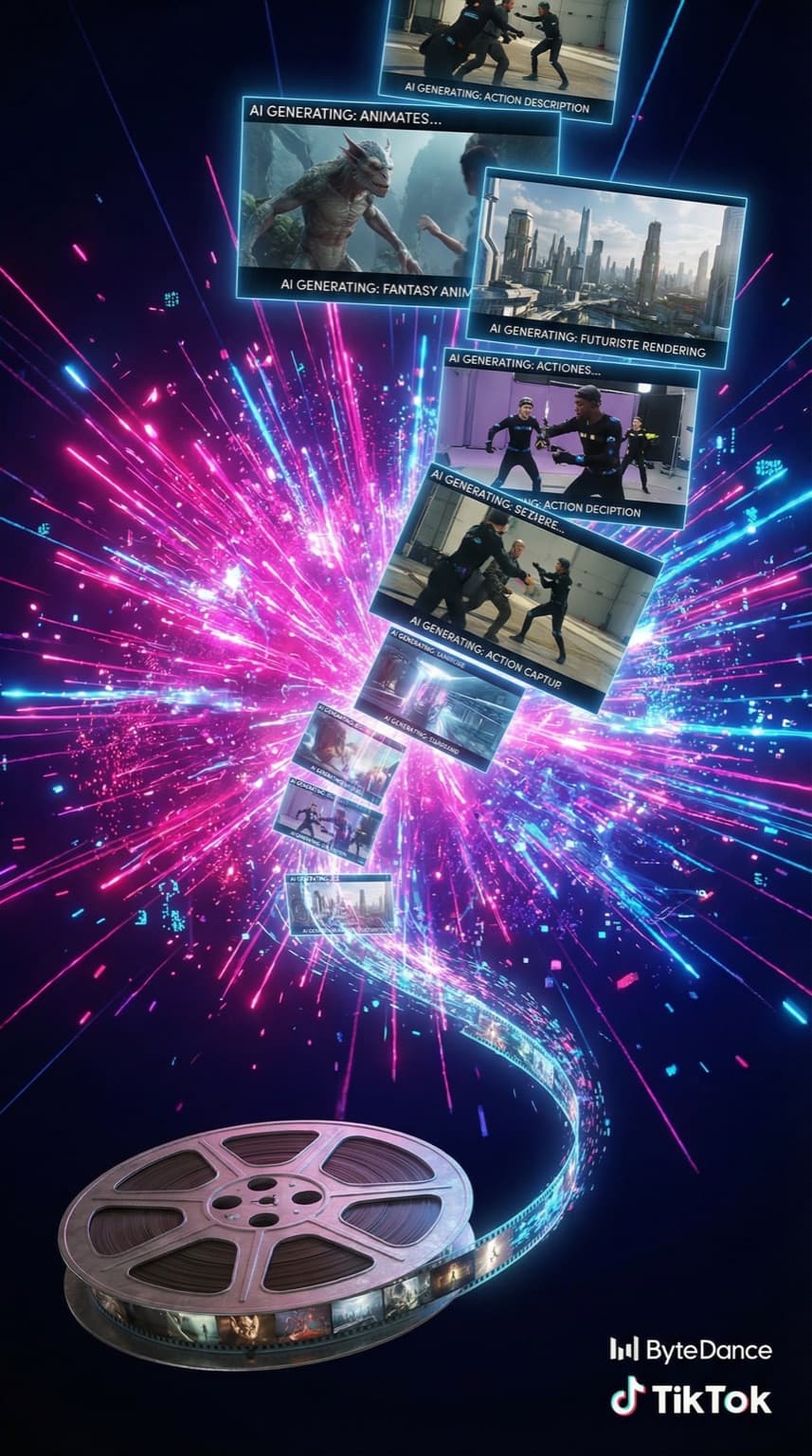

In a major shakeup for the generative AI landscape, ByteDance—the parent company of TikTok—has officially released Seedance 2.0, a new video generation model that is already drawing direct comparisons to OpenAI's Sora.
With Hollywood-quality visuals, a highly accessible free tier, and rumored custom silicon backing it, Seedance 2.0 represents a significant escalation in the tech rivalry between Chinese and US companies. For small businesses, however, this competition brings good news: powerful video marketing tools are becoming cheaper and more accessible than ever before.
The Viral Launch: Titanic Endings and Celebrity Face-offs
Seedance 2.0 didn't just launch quietly; it exploded onto social media with a series of viral demonstrations that showcase its understanding of complex prompts and cinematic physics.
Early users have flooded platforms with mind-bending clips, with tech news outlets highlighting the model's rapid adoption. Two examples, in particular, have captured the internet's attention:
- A "Titanic alternate ending": In a photorealistic sequence, Leonardo DiCaprio's Jack is rescued, rewriting cinematic history with startling clarity and emotional resonance.
- Celebrity Action Scenes: A generated fight scene featuring likenesses of Brad Pitt and Tom Cruise, which reportedly references the controversial Epstein files, demonstrating both the model's high fidelity and the potential content moderation challenges ahead.
These demos highlight the model's ability to handle specific character consistency, dynamic action, and complex narrative prompts—features that were previously the domain of massive VFX studios.
Under the Hood: SeedChip and "Hollywood Quality"
Reports suggest that ByteDance isn't just relying on software. The company is allegedly developing its own proprietary AI chip, dubbed "SeedChip," designed specifically to optimize video generation workloads. This vertical integration could allow ByteDance to offer faster generation times and lower costs compared to competitors relying on general-purpose GPUs.
The output quality of Seedance 2.0 is being described as "Hollywood-quality," capable of generating high-resolution textures, realistic lighting, and consistent object permanence. This places it squarely in the ring with OpenAI's Sora, which recently entered the market with similar promises of cinematic realism.
The Game Changer: Accessibility and Free Tiers
While the technology is impressive, the pricing model is what might truly disrupt the market. ByteDance has launched Seedance 2.0 with a generous free tier:
- 10 credits per day for free users.
- 2 credits per video generation.
This means anyone—including small business owners and independent creators—can generate up to 5 high-quality videos every single day for free.
In contrast to expensive enterprise-focused tools or waitlisted betas, this aggressive pricing strategy mirrors the "freemium" growth tactics that made TikTok a global phenomenon. It lowers the barrier to entry significantly, allowing users to experiment with AI video without an upfront financial commitment.
What This Means for Small Businesses
For Small and Medium-sized Businesses (SMBs), the release of Seedance 2.0 is a massive opportunity. Video content is consistently the highest-performing medium on social media, but it has traditionally been expensive and time-consuming to produce.
Here is how SMBs can leverage Seedance 2.0 immediately:
1. Rapid Ad Prototyping
Instead of spending thousands on a video shoot that might not perform, businesses can use Seedance 2.0 to generate multiple variations of video ads from text prompts. You can test different visual hooks, settings, and styles (e.g., "luxury coffee shop morning" vs. "busy urban cafe") to see what resonates with your audience before committing to a larger production.
2. Social Media Content at Scale
Consistency is key on platforms like Instagram and TikTok. With 5 free videos a day, a small marketing team (or a solo founder) can maintain a daily posting schedule of high-quality visuals.
- Idea: A bakery could generate slow-motion "b-roll" of pastries rising in the oven.
- Idea: A real estate agent could generate fly-through videos of dream homes to illustrate blog posts.
3. Visualizing Concepts for Clients
Service-based businesses, such as interior designers, architects, or event planners, can use text-to-video to show clients a "mood board in motion." Describing a "rustic winter wedding with fairy lights" is one thing; showing a generated 10-second clip of it is another.
4. Leveling the Playing Field
As we've discussed previously, AI tools are the great equalizer. A local boutique can now produce video content that looks as polished as a national chain's campaign, purely by mastering prompt engineering rather than buying expensive cameras.
The Bigger Picture: US vs. China Tech Rivalry
The launch of Seedance 2.0 highlights the intensifying competition between US and Chinese tech giants. While OpenAI (US) has led the charge with Sora and GPT-4, ByteDance (China) is proving to be a formidable competitor, leveraging its massive user data and engineering resources.
For the end user, this competition can increase the number of available tools. Businesses should review the workflow's data path and vendor terms before they upload customer, employee, or confidential material. Check the exact product, plan, account, region, interface, and settings in use.
Getting Started
To start using Seedance 2.0:
- Sign up for the platform (check ByteDance's official channels for access links).
- Experiment with the free daily credits.
- Focus on prompts: Be descriptive with lighting, camera angles, and textures.
- Integrate the videos into your existing social media calendar.
The video AI revolution isn't coming; it's already here. With tools like Seedance 2.0 and Sora, the only limit for small business marketing is now imagination, not budget.
Related Reading:
Back-Office Automation ROI Worksheet
Choose the first automation with evidence, not vibes.
AI tools can make almost any workflow look automatable. The ROI worksheet helps you pick the one most likely to pay back quickly. If one workflow rises to the top, BaristaLabs can help decide whether a lightweight tool, integration, or custom pilot is the best next step.
Use broad workflow categories in the form; save specifics for a scoped conversation.
Turn this idea into a pilot
Which workflow should go first?
Use the readiness check to compare impact, effort, risk, owner, and next step before requesting a review.
- 3-5 minutes
- Deterministic score
- No sensitive data
Practical AI Workflow Notes
Want more practical AI operations ideas?
Get short notes on applying AI inside real small-business workflows — from document handling and customer follow-up to internal reporting, compliance, and automation guardrails.