


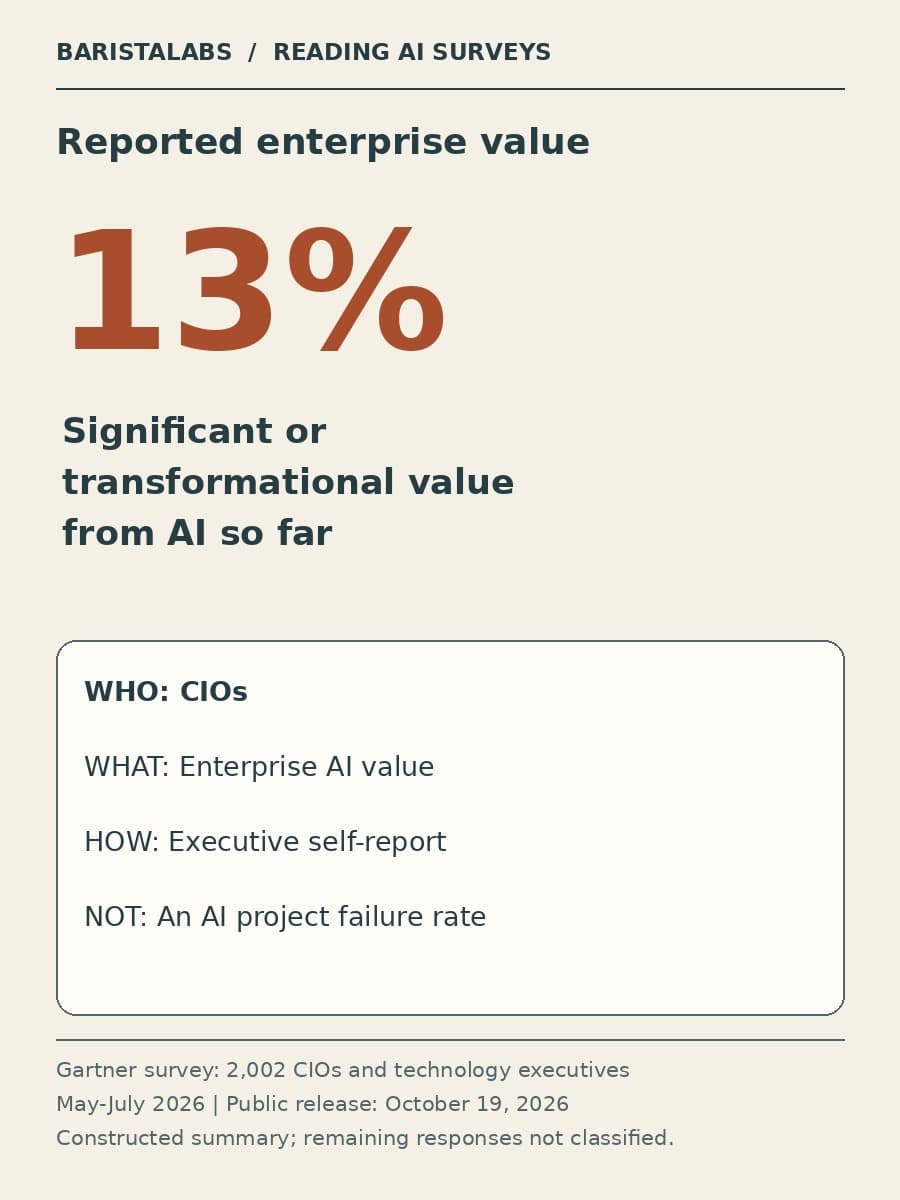
Gartner reported on October 19 that only 13% of CIOs say their enterprise has realized significant or transformational value from AI so far. That is a sobering finding for anyone approving another AI purchase. It is also a narrower claim than saying the other enterprises have failed.
The distinction changes the budget conversation. A survey about the scale of value executives perceive cannot tell you whether a particular workflow saves money, whether an investment lost money, or how likely your next project is to succeed. It can tell you why claims about adoption and activity deserve closer examination.
What the 13% actually measures
The Gartner 2027 CIO and Technology Executive Agenda survey covered 2,002 CIOs and technology executives from May to July 2026. The public release says 13% of CIOs reported significant or transformational enterprise AI value “so far.”
Each part of that description matters. The unit is an executive’s assessment of enterprise value, not an individual software task. The threshold is significant or transformational value, not any positive result. The timing concerns value already realized, rather than an expectation about next year.
An organization could have a useful drafting tool without describing its overall AI value as transformational. That is a possible explanation of the measurement, not a finding about the respondents outside the 13%. Gartner’s public release does not provide the full distribution of answers or enough detail to assign those respondents to categories such as modest benefit, break-even, loss, or too early to judge.
For the same reason, the headline is not an audited return-on-investment result. It does not publish the cost and benefit accounts behind every executive’s response. Nor is it an SMB failure probability: the release describes CIOs and technology executives, not a representative survey of small-business owners.
The useful reading is that substantial perceived enterprise value remains uncommon in this survey. Turning that into a claim that nearly all AI projects lose money would change both the unit being measured and the meaning of success.
Why another Gartner headline can look more optimistic
Gartner’s separate October 19 keynote release says 58% of leaders reported some positive value from their AI initiatives. It attributes that finding to a Q2 2026 survey of more than 1,000 functional leaders.
These figures need not contradict one another. “Some positive value” is a different threshold from “significant or transformational value.” Functional leaders assessing initiatives are also a different respondent group from CIOs assessing enterprise value.
A department can see a worthwhile improvement while an enterprise leader still sees a collection of isolated benefits. The sources do not establish that this happened in the same organizations; the example explains why the questions can produce different answers.
Do not subtract the two percentages to estimate how many companies have minor benefits. Do not arrange them as a before-and-after trend. The public releases do not supply a common sample, a matching question, or linked responses that would support either comparison.

When a vendor includes a survey statistic in a proposal, ask what question it answers before discussing what the number means for your business. A percentage without its population and threshold is easy to reuse and difficult to evaluate.
The stopping-rule findings are associations, not a promised return
The CIO release contains a more operational finding. Gartner calls executives “vanguards” when they deliver better business outcomes while also reporting high CEO-perceived AI value. Organizations with guidelines for deciding when an AI pilot should not enter production were 2.3 times more likely to be vanguards. Those with guidelines for abandoning low-value AI already in production were 2.6 times more likely.
Gartner also reports that only 31% and 17% of CIOs, respectively, had those practices. The recommendation to define an exit before committing more money is useful. The multiples should not become a promise that writing a stopping policy will multiply your returns.
The public release reports relationships between practices and a defined group of executives. It does not describe a randomized test in which otherwise identical organizations adopted stopping rules. Better management, stronger business partnerships, or other differences could contribute to both the practices and the outcomes. The source does not isolate those explanations.
For a buyer, the practical implication is a question about governance: who can end a low-value deployment after it has become part of normal work? That decision can be difficult once employees, integrations, and recurring contracts depend on it. Our guide to expanding, revising, or stopping an AI pilot covers the local evidence for that decision. The survey supplies a reason to take the question seriously, not an answer for a particular project.
Bring the headline back to the purchase in front of you
A business does not need to demonstrate enterprise transformation to justify a useful tool. It does need to say what improvement it is buying and how the team will recognize it.
For a drafting assistant, faster preparation may be enough if the reviewer can use that time productively and the subscription and checking work remain affordable. For a system that updates customer records, the business also needs evidence about wrong updates, recovery, and the authority to approve changes. These are different purchases even when both vendors use the same language about AI productivity.
Keep the proposed outcome in its original unit. Reduced handling time is a time result. A smaller backlog is a service result. A lower contractor invoice is a financial result. They can be related, but one should not silently stand in for another. Our AI automation budget guide explains how to separate released capacity from an actual expense reduction.
The conversation with a supplier can then become specific: which result has been measured, in which workflow, against what earlier process, and with what continuing human work? A well-supported answer may justify a limited purchase even while the larger enterprise value remains modest. An answer consisting only of adoption numbers or a broad market statistic leaves the business case unfinished.
Gartner’s finding is a reason to demand clearer evidence, not to treat every AI proposal as either inevitable transformation or inevitable failure. The most useful response to the 13% headline is to preserve its meaning—and ask for a different kind of evidence when making your own investment decision.
Sources and scope
- Gartner CIO and Technology Executive Agenda survey release, October 19, 2026. Source for the 13%, sample, fieldwork period, vanguard definition, and stopping-rule findings.
- Gartner IT Symposium/Xpo keynote release, October 19, 2026. Source for the separate functional-leader finding of some positive value.
Both public releases were checked October 20, 2026. BaristaLabs has not inspected the underlying survey responses or full questionnaire. Interpretations and purchase examples above are our analysis, not additional Gartner survey results.
AI investment evidence
Define the outcome before buying the tool
BaristaLabs can help examine one workflow, separate measured improvements from assumptions, and scope a test that answers the purchase decision.
Bring a sanitized process outline and the outcome you want to improve.
Turn this idea into a pilot
Which workflow should go first?
Use the readiness check to compare impact, effort, risk, owner, and next step before requesting a review.
- 3-5 minutes
- Deterministic score
- No sensitive data
Practical AI Workflow Notes
Want more practical AI operations ideas?
Get short notes on applying AI inside real small-business workflows — from document handling and customer follow-up to internal reporting, compliance, and automation guardrails.