


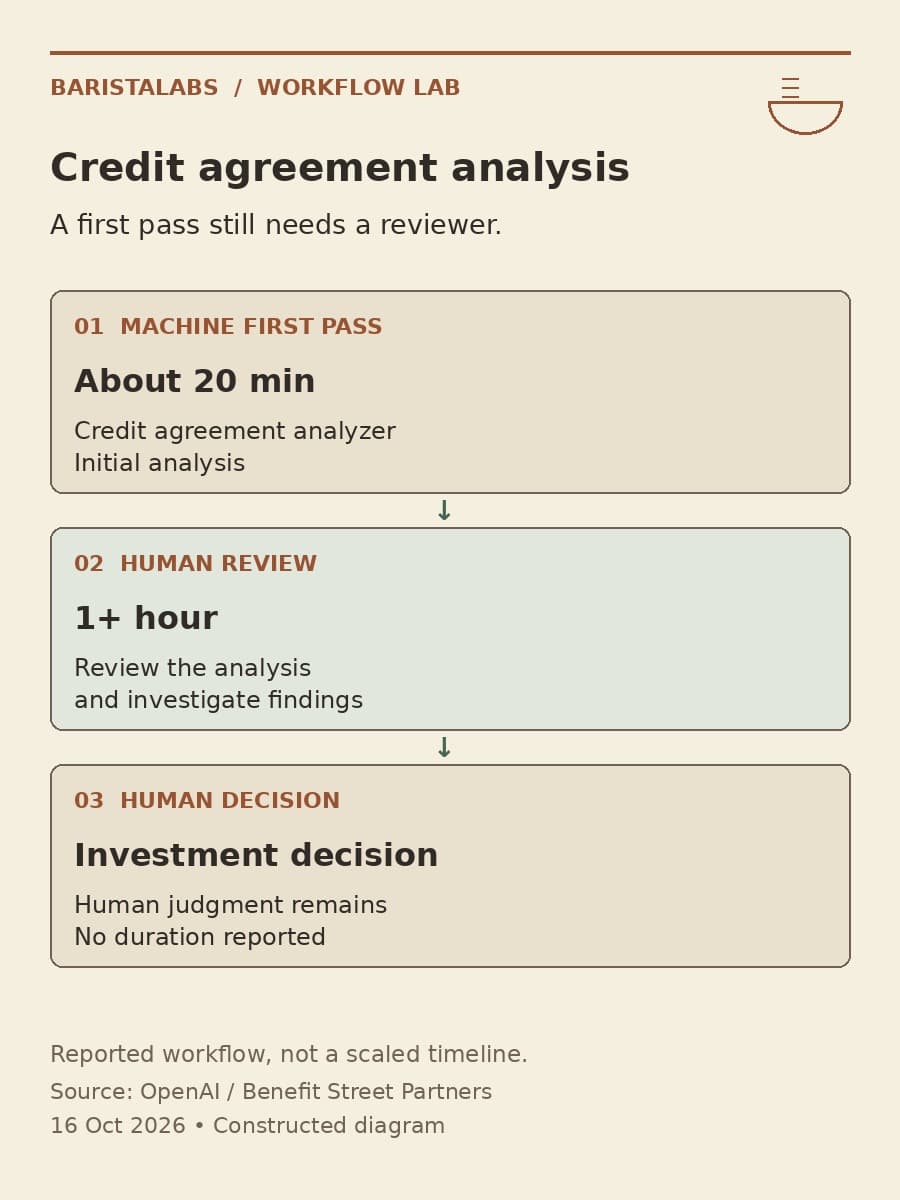
Benefit Street Partners’ credit agreement analyzer takes about 20 minutes to produce a first-pass analysis. A person then spends an hour or more reviewing it. That second measurement is essential to understanding the result described in OpenAI’s October 16 customer story.
The investment manager is using AI-assisted tools to add review capacity and rigor within existing deal timelines, rather than simply to do more deals. For a business owner evaluating document analysis, this suggests a more useful buying question than how quickly a model can summarize a file: can the team use the prepared analysis to investigate more of the questions that matter before a decision is due?
The tool prepares analysis; a person makes the investment decision
OpenAI describes agreements that are often 300 pages or longer. Portfolio manager Anant Kumar brought together law-firm memos about clauses and risks to watch for, and built a tool to analyze those agreements. The story says the analyzer has been refactored with GPT-6 Astra and is live in the company-hosted portal.
This is not just a shorter document appearing on a screen. The intended use is to identify provisions that could shift value away from lenders and give an analyst more information for underwriting. Kumar explicitly keeps the ultimate investment decision with a human.
The reported 20 minutes is therefore a preparation measurement, not the time to an approved investment decision. The hour or more of human review remains part of the workflow. OpenAI does not provide a comparable before-and-after duration for the complete agreement-review process, a published accuracy rate, or an independent evaluation. Those omissions prevent a defensible claim that the tool saves a particular percentage of total review time.
The distinction also matters outside finance. A supplier-agreement assistant might prepare a list of unusual terms without having authority to accept them. A procurement manager still needs to check the source language, resolve ambiguity, and decide whether to involve legal counsel. That example is an application of the workflow idea, not a reported BSP use case.
Faster follow-ups may be the business benefit
Underwriting involves further diligence and revised memos responding to an investment committee’s questions. According to Kumar’s account in the story, a round of comments that previously took days or weeks can now be turned around in a day, with some questions answered during the meeting itself.
Those are attributed observations about follow-ups, not a controlled comparison of every deal. Deal timelines vary from a few days to a few weeks, and the source does not publish a standard number of rounds. Still, the operating mechanism is clear: tools that make evidence easier to examine can help analysts respond while a decision is still open.
A small business can use the same distinction when defining a trial. If a bid review must finish before a submission deadline, a faster initial summary may be useful because it leaves room to clarify a questionable obligation. The benefit might be a better-informed decision on the same number of bids, rather than permission to accept more bids or reduce staffing.
Before buying, name the constraint you want to change. Is it the wait for a first pass, the time a qualified person spends checking it, or the delay while someone answers a follow-up? A pilot that records only model response time cannot tell those explanations apart.
Budget the reviewer’s work before increasing volume
The BSP example gives a reason to protect review capacity, not remove it from the estimate. If prepared analyses arrive faster than qualified people can inspect them, the business has moved the queue rather than cleared it.
For one bounded document type, BaristaLabs recommends recording these fields for each case:
Scroll sideways to see all 3 columns.
| Field | What to record | Decision it supports |
|---|---|---|
| Machine elapsed time | When processing starts and when the first pass is ready, including failed attempts | Whether preparation fits the working deadline |
| Human review effort | Active checking, source lookup, corrections, and specialist escalation | How much qualified capacity the workflow needs |
| Follow-up rounds | Questions raised, when evidence is returned, and whether another revision is needed | Whether the tool improves the path to a decision |
| Disposition | Accepted after review, revised, rejected, unresolved, or returned to the manual process | Whether apparent speed produces usable work |

Keep elapsed time and labor effort separate. A model may run while a person works on something else; waiting for a specialist can lengthen a case without consuming that entire period as active labor. Do not add unlike timers and call the result a staffing saving.
Start with the people who already have authority to review the work. Agree on the document volume they can accept, the evidence they must see, and what happens when a case cannot be resolved before its deadline. If a trial increases unfinished reviews, reduce intake or change the preparation step before expanding access. Our AI automation budgeting guide explains how to carry retained human work into the wider operating estimate.
Do not confuse building the tool with running the analysis
The customer story describes a separate tracker that compares how business development companies value the same loan, using public SEC filings. Kumar used Codex for code review. Its first version took about a day; he estimates 10–12 total development hours including later additions and interface refinements.
Those figures describe building that tracker. They are not the agreement analyzer’s processing time, an implementation quote for another company, or evidence that Codex itself performs every analysis in the portal. Likewise, a working first version does not establish how much deployment, maintenance, data preparation, or user support another organization will need.
For a buyer, these are two decisions with different evidence. The build decision asks whether a useful tool can be implemented and maintained. The operating decision asks whether its outputs help a qualified reviewer complete real work. A fast prototype may justify an operating trial without justifying broader rollout.
Decide what the pilot must improve
Choose one existing review process with approved source material and a named decision owner. Do not upload confidential agreements to an unapproved service to reproduce a customer story. Keep the existing approval authority and manual route while testing the preparation step.
Before the trial, agree on a concrete improvement: more complete answers before a deadline, fewer unresolved follow-ups, or less active review effort without losing important issues. Preserve the source references and reviewer corrections needed to check that result. The proposed worksheet above is BaristaLabs guidance; OpenAI does not say BSP uses that protocol.
If the trial produces faster drafts but leaves the reviewer rebuilding the analysis, change the evidence presentation before increasing volume. If it lets reviewers investigate important questions that previously went unanswered, that can be valuable even without a headcount saving. Use the recorded dispositions and review effort to decide whether to expand, revise, or stop the pilot.
BSP’s longer-term aspiration is continuous underwriting across deals as news happens. The source presents that as future work, not an achieved autonomous monitoring system. The immediately useful lesson is narrower: measure how prepared analysis changes the work of the person who still owns the decision.
Source and limits
- OpenAI: Benefit Street Partners answers questions faster with Codex, published October 16, 2026; checked October 19, 2026. This is a vendor-published customer story with company-attributed observations, not an independent benchmark.
BaristaLabs has not operated or tested BSP’s tools. The pilot worksheet, intake recommendation, and small-business examples are our analysis, not additional BSP results. This article is workflow guidance, not legal or investment advice.
Document review workflows
Plan reviewer capacity before adding more AI drafts
BaristaLabs can help map one document workflow, define the reviewer’s evidence and authority, and measure preparation, checking and follow-ups in a bounded pilot.
Bring a sanitized process outline, not confidential agreements.
Turn this idea into a pilot
Which workflow should go first?
Use the readiness check to compare impact, effort, risk, owner, and next step before requesting a review.
- 3-5 minutes
- Deterministic score
- No sensitive data
Practical AI Workflow Notes
Want more practical AI operations ideas?
Get short notes on applying AI inside real small-business workflows — from document handling and customer follow-up to internal reporting, compliance, and automation guardrails.