


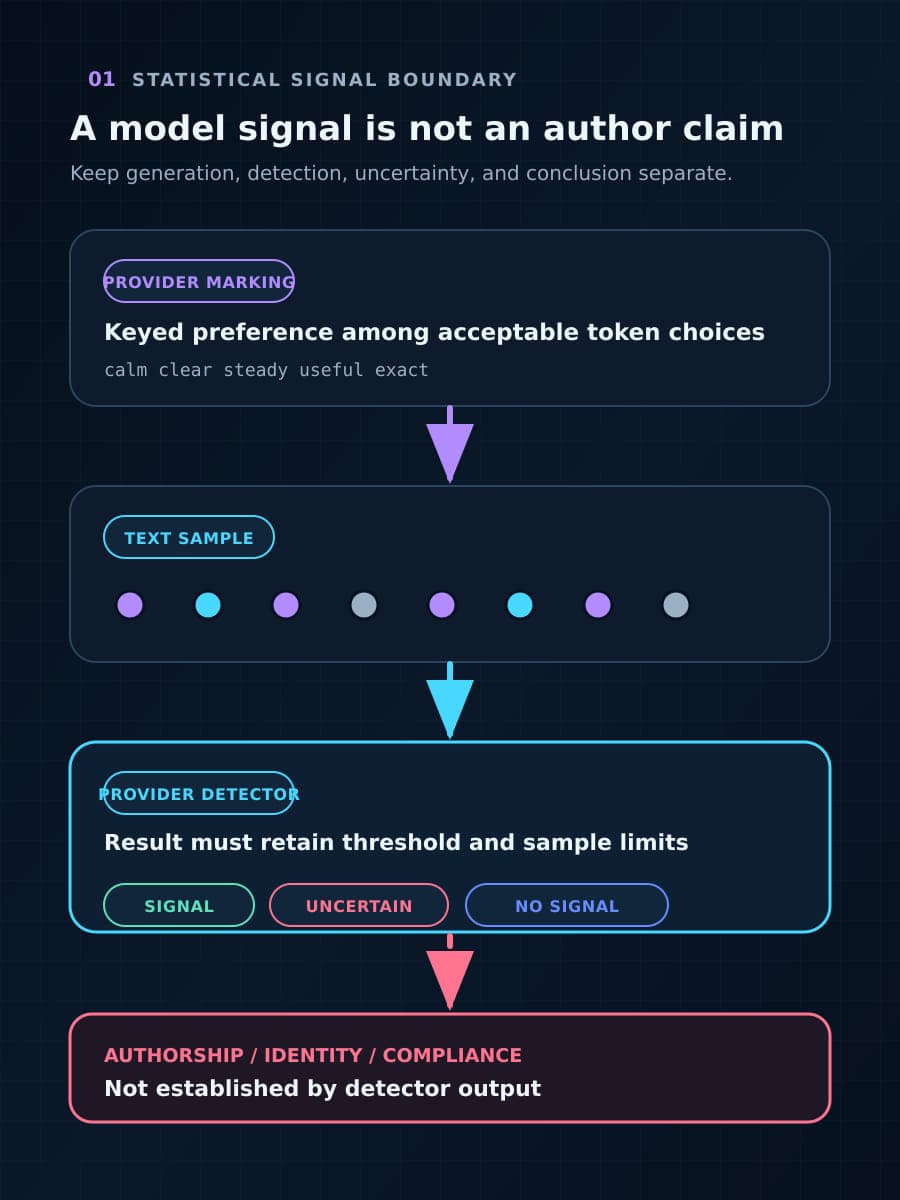
Anthropic says future Claude models will generate text with a statistical watermark, and the company plans to offer a detection API. For businesses that commission, review, or publish AI-assisted writing, the important change is not a visible label. It is the arrival of a provider-controlled signal that can estimate whether Claude was involved in a passage.
That signal has a narrow meaning. Anthropic says it cannot identify a person, organization, or chat; distinguish writing from heavy editing; prove human authorship; or detect text from another model. This article explains how the watermark works, where its evidence weakens, and what a business should decide before connecting detection to an approval or investigation.
How can plain text carry a watermark?
A language model selects each next word or token from a set of candidates. Some choices are constrained: a fact, formula, or piece of code may have one clearly correct continuation. Other choices are low stakes because several words would preserve the meaning.
Anthropic says its version of SynthID-Text uses those low-stakes choices. A secret key and the preceding words influence the randomness used to select among acceptable candidates. Across enough choices, the resulting sequence can be tested for consistency with the keyed pattern.
No hidden character or identifying payload is inserted. Anthropic says the method adds no tokens, has negligible speed impact, and does not increase the price to serve or use the model. Its announcement reports no quality impact in internal testing. Separately, the 2024 SynthID-Text paper reports no capability or quality change in benchmarks, human comparisons, and a live experiment involving nearly 20 million Gemini responses. That paper supports the underlying technique; it is not an independent audit of Anthropic's future implementation.
What would a positive result actually mean?
The strongest supported reading is: Claude was likely involved in producing or processing enough of this passage for its keyed pattern to register. Anthropic explicitly says the watermark cannot separate “Claude wrote this” from “Claude heavily edited this.”
That leaves several common business questions unanswered:
Scroll sideways to see all 2 columns.
| Question | What the watermark supplies |
|---|---|
| Which employee or supplier submitted the text? | No identity or account information |
| Did Claude draft it or substantially edit it? | No distinction between those roles |
| Is the person named as author responsible for it? | No authorship or responsibility judgment |
| Is the content accurate, licensed, approved, or compliant? | No review of those properties |
| Did another model produce it? | No; another provider would use a different key or method |
A detector result therefore should not overwrite a source record or editorial decision. It is another piece of evidence with a provider-defined scope, not a replacement for the record of who requested the work, which tools were used, who reviewed it, and what was approved.
Where does the signal become weak?
Anthropic documents several limits that matter in routine work. Short samples provide fewer word choices, so detection works less well. Factual passages offer fewer interchangeable continuations. Proofreading may change too few words to register, and code is often too constrained to carry much of a watermark beyond arbitrary choices such as comments.
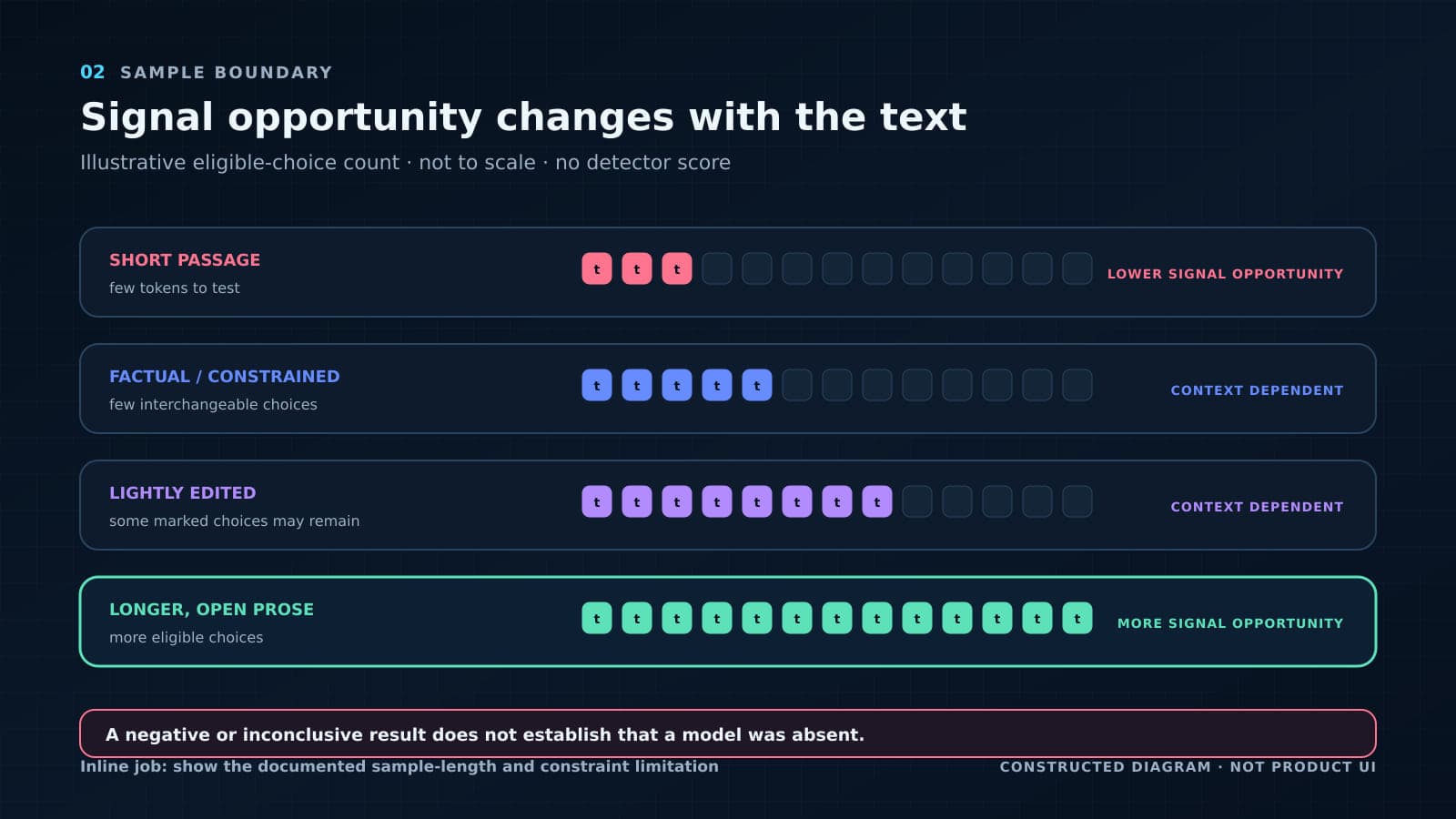
Editing also changes the evidence. Anthropic says light editing probably will not remove the pattern completely, while a complete rewrite can. A translation produced by Claude should carry the mark because Claude chooses every word. Older Claude models launched before August 2 have a transition period, and Anthropic says watermarking will reach them over the coming months.
These are not edge cases for a business. Product descriptions can be short and factual. Legal copy can be constrained. A human editor may rewrite a draft extensively. A negative or inconclusive result in those settings does not establish that Claude was absent.
When will teams be able to check?
Anthropic says a detection API is coming “soon,” but its August 14 announcement does not provide a release date, pricing, access rules, thresholds, retention terms, or a dispute process. Future Claude models will produce marked text, while the older-model rollout will happen over time. Teams should not write a production dependency around details that have not been published.
The regulatory context is firmer but still role-specific. The European Commission says about 190 organizations signed its Code of Practice on Transparency of AI-generated Content before the AI Act's marking obligations began applying on August 2, 2026. The Commission describes measures for providers and deployers, while noting that the legal marking obligation applies to AI-system providers. Anthropic says it will apply watermarking globally at launch because it does not yet have a durable way to limit it by region.
A global technical rollout does not make every customer subject to the same legal duty. Businesses should determine their own role, content type, and jurisdiction with appropriate counsel rather than treating detector availability as a compliance verdict.
What policy should exist before the API call?
Start with the decision the result is allowed to influence. A reasonable content-quality workflow might use a positive result to request the existing tool-use record or route a passage for ordinary editorial review. A high-consequence workflow should not let the result alone accuse a worker of misrepresentation, reject a supplier invoice, establish ownership, or certify disclosure compliance.
Keep four states separate in the system that manages the work:
- Declared use: what the employee, contractor, or supplier says about model involvement.
- Detection result: provider, API version, sample submitted, timestamp, result, and any threshold or confidence the final API documents.
- Editorial decision: accuracy, rights, brand, privacy, and approval findings made through the normal review.
- Disclosure decision: whether a public label or notice is required for that use and audience.
This is BaristaLabs' operational recommendation, not an Anthropic requirement. The separation prevents a probabilistic model signal from silently becoming an identity claim or legal conclusion. It also gives a person a reviewable path when declared use and detection disagree.
Anthropic's watermark could become useful evidence because it is tied to the model's generation process rather than stylistic guesses. Its usefulness depends on preserving the boundary Anthropic itself describes. Before the detection API enters a publishing queue, ask BaristaLabs to review one content workflow and define exactly what a positive, negative, or inconclusive result may change.
Sources
- Anthropic: “How Claude's text watermark works”, August 14, 2026.
- European Commission: “Strong backing for the Code of Practice on Transparency of AI-generated Content”, July 31, 2026.
- Dathathri et al.: “Scalable watermarking for identifying large language model outputs”, Nature, October 23, 2024.
AI content workflow review
Define what one detector result may change
BaristaLabs can help your team map the source record, review decision, disclosure owner, and escalation path around one AI-assisted content workflow.
Useful before a content, procurement, compliance, or people-operations team makes detector output part of an approval rule.
Turn this idea into a pilot
Which workflow should go first?
Use the readiness check to compare impact, effort, risk, owner, and next step before requesting a review.
- 3-5 minutes
- Deterministic score
- No sensitive data
Practical AI Workflow Notes
Want more practical AI operations ideas?
Get short notes on applying AI inside real small-business workflows — from document handling and customer follow-up to internal reporting, compliance, and automation guardrails.