
Claude Security credits began Oct. 21, so plan a first project
Claude Security now rescans connected repositories as code changes. For Claude Enterprise customers, two months of launch credits started on October 21.

Sean McLellan
Lead Architect & Founder

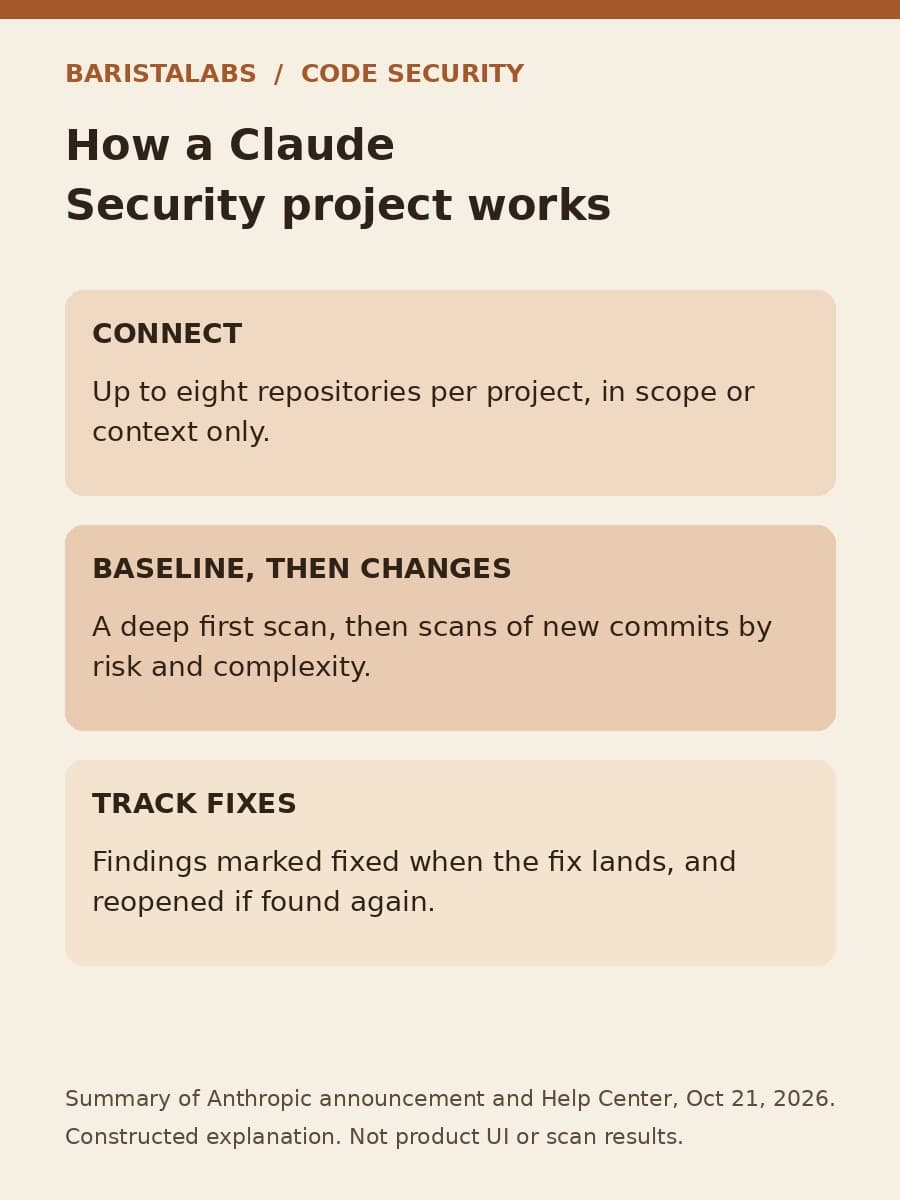
Anthropic announced on October 21, 2026 that Claude Security now keeps scanning connected repositories as code changes, tracks each finding until the fix lands, and exposes findings through an API, webhooks, and an MCP connector. The update is in public beta for Claude Enterprise customers. If your company is on Claude Enterprise, the decision is whether to start a first project now, because the launch credits are already counting down.
According to the Claude Help Center, eligible organizations get up to $25,000 in Claude Security credits in each of two consecutive months. For organizations that already have Claude Enterprise, those months started on October 21, and they run whether or not anyone uses the product. Unused credit does not carry over, and the offer ends at the end of the day on December 31, 2026 (UTC).
What changed in how Claude Security scans
Before this update, a scan ran when someone started it or on a schedule. Anthropic says the new version keeps going on its own. You create a project, connect repositories through the Claude GitHub app (GitHub Enterprise Server included) or with an access token for GitLab and other Git providers, and choose a branch and scope for each repository. Claude runs a deep baseline scan, writes a threat model from the code, and then scans new commits based on their risk and complexity.
The Help Center is direct about two details that affect planning. There is no fixed schedule for follow-up scans. And scans are "stochastic by design," so two scans of the same code can return different results. Teams used to rules-based scanners should expect that, and should not read a missing finding in one run as proof the issue is gone.
Three other changes matter for day-to-day triage:
- Fix tracking. Claude Security checks open findings against code that changed and marks them fixed when the fix lands, whether or not the fix was written in Claude Code. A finding that shows up again reopens automatically.
- Project knowledge. Each project has a knowledge base and an editable threat model. Anthropic says later scans use them to decide what to flag and how to rate severity, and to skip risks your environment already handles.
- Integrations and roles. The API can list, read, resolve, and reopen findings and manage projects. Webhooks can announce new findings to systems such as Slack or Jira. Project roles are Full, Triage, and View, and admins can limit who creates projects.
Requirements, limits, and what the credits cover
The Help Center lists the prerequisites: an active Claude Enterprise plan, a premium seat for each user, and usage credits enabled for consumption billing. An owner turns the feature on in Organization settings.
A project holds up to eight repositories. A repository can be in scope, which means Claude reports findings in it, or context-only, which means Claude reads it but reports nothing there. Both kinds count toward the eight. For a monorepo, Anthropic recommends a folder scope rather than the whole repository. The baseline scan can take minutes or hours depending on size.
Pricing is direct token cost with no separate platform fee. That includes scans, threat-model writing, project chat, and fix checks. You can set a spend limit specific to Claude Security and see each project's cost for the month to date and per day. The launch credits apply only to projects created in the new experience. Existing projects keep running, and owners can migrate them, but migration does not copy members, webhooks, excluded directories, scan history, or scheduled scans. GitHub Enterprise projects cannot be migrated.
Two boundaries could rule the product out for some teams. Claude Security does not support Zero Data Retention. Anthropic points teams with that requirement to a separate Claude Security plugin for Claude Code, which runs on whichever models that Claude Code account can use. And the scope-of-use terms limit scanning to code your company owns, which excludes third-party and open-source repositories outside your codebase.

Why it matters for small engineering teams
BaristaLabs interpretation: the credit terms change the timing more than the product does. A small team with one or two critical services rarely has a security engineer to run scans on a calendar. Continuous scanning with fix tracking removes that chore, and two months of credit gives the team room to measure noise and value at no token cost. Waiting until December still leaves the product available, but the credits will have mostly expired by then.
The comparison with GitHub's AI Scan eligibility rules is useful here. Both products put AI review next to existing scanners. A team that already runs one should judge the other by the findings it adds that the first missed, not by the total count. Our earlier post on Claude Code Security's February research preview covers how Anthropic first described its reasoning-based scanning.
Start with one internet-facing service
BaristaLabs recommends one bounded first project rather than connecting every repository:
- Pick one service that faces the internet, plus up to seven repositories it depends on. Mark the dependencies context-only unless you want findings there.
- Write the knowledge tab before the baseline scan finishes. Note how the service is deployed, who can reach it, and which risks you have already accepted. The threat model drives severity.
- Set a Claude Security spend limit at or below the monthly credit, so usage beyond the offer cannot surprise finance.
- Run it next to your current scanner for the credit window. Record which findings were new, which were false positives, and how many reached a merged fix.
At the end of the window you will have your own evidence on whether continuous scanning earns a place in the budget at direct token cost.
Sources and scope
- Claude Security now scans continuously and tracks fixes, Anthropic, October 21, 2026.
- Use Claude Security, Claude Help Center, updated October 21, 2026, including the launch offer terms.
- Claude Security product page, Anthropic, accessed October 21, 2026.
These sources describe a public beta and Anthropic's own account of how it works. They do not establish detection accuracy, false-positive rates, or typical token cost for a project of a given size. BaristaLabs has not tested the new version.
Code security
Scope one Claude Security project
Bring one internet-facing service, the repositories it depends on, and the scanner you use today. BaristaLabs can help set the project scope, threat model notes, and a comparison plan.
Start with one service and the person who triages its security findings.
Turn this idea into a pilot
Which workflow should go first?
Use the readiness check to compare impact, effort, risk, owner, and next step before requesting a review.
- 3-5 minutes
- Deterministic score
- No sensitive data
Practical AI Workflow Notes
Want more practical AI operations ideas?
Get short notes on applying AI inside real small-business workflows — from document handling and customer follow-up to internal reporting, compliance, and automation guardrails.