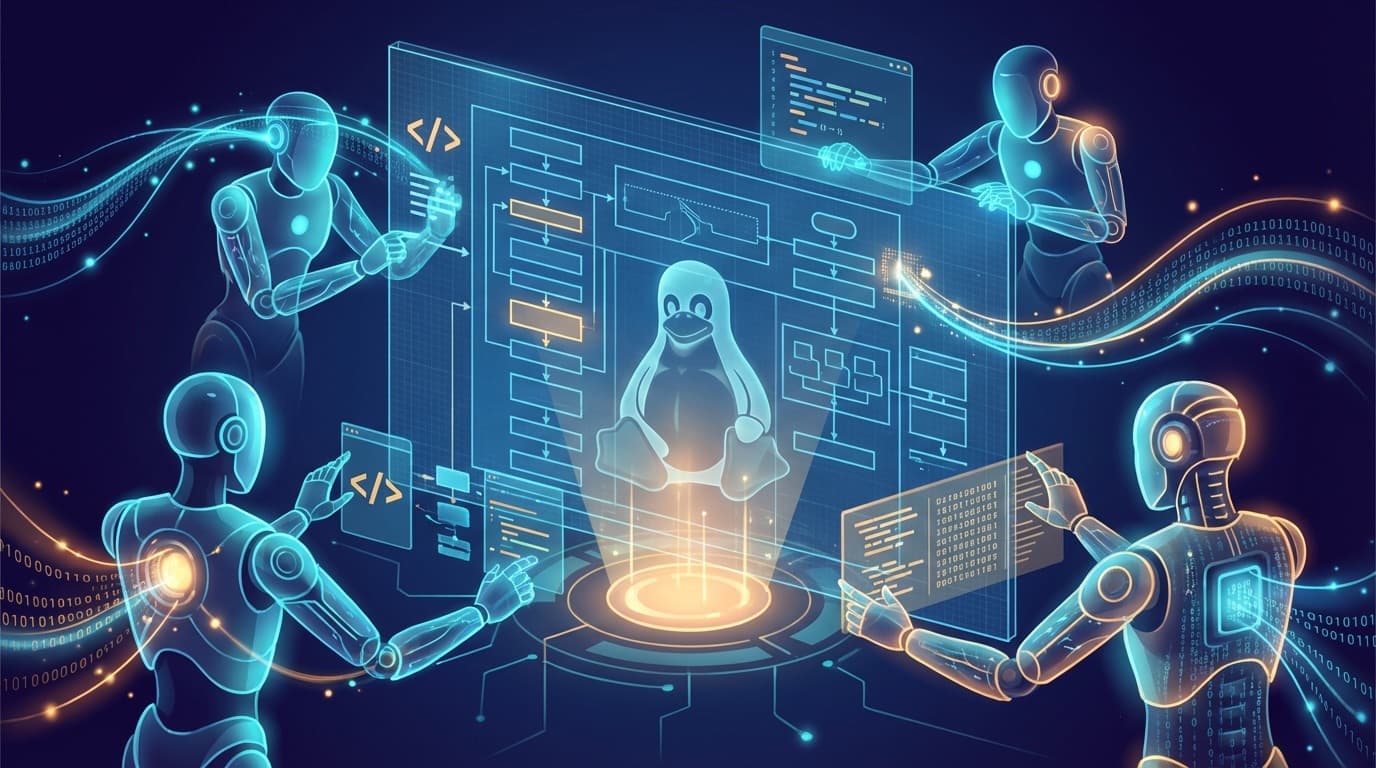

If you needed proof that autonomous AI coding is moving beyond "pair programmer" territory, Anthropic just delivered it.
In a new engineering report released this morning, researcher Nicholas Carlini revealed that a team of 16 parallel Claude Opus 4.6 agents successfully built a 100,000-line C compiler from scratch. This wasn't a toy project. The resulting compiler is robust enough to compile the Linux kernel (version 6.9), QEMU, FFmpeg, and yes—it runs Doom.
This experiment marks a significant shift. We aren't just talking about an AI chatbot writing a function for you anymore. We are talking about a swarm of agents managing a complex, multi-week software project with minimal human oversight.
The Experiment: $20,000 and 2,000 Sessions
The setup was designed to stress-test the limits of "agent teams." Instead of a single AI session trying to hold the entire project context in its head (impossible for a compiler), Carlini built a harness that allowed 16 Claude instances to work in parallel.
The agents operated in a continuous loop:
- Pick a task: Agents locked specific tasks (like "implement if-statements" or "fix parser bug") to avoid stepping on each other's toes.
- Code and Test: They worked in isolated Docker containers, running tests to verify their work.
- Merge: Successful code was pushed to a shared repository.
Over the course of two weeks, the team consumed 2 billion input tokens and generated 140 million output tokens. The total API bill came to just under $20,000. That sounds expensive for a side project, but for a clean-room implementation of a C compiler capable of building Linux? It's a fraction of what a human engineering team would cost for the same output.
Why This Matters for Business
The technical details are fascinating (the compiler is written in Rust and supports x86, ARM, and RISC-V), but the business implication is the real story here.
For the last two years, we've treated AI as a "copilot"—a tool that sits next to a human developer to speed them up. This experiment demonstrates the viability of autonomous software squads.
Imagine needing a custom integration for a legacy system. Instead of pulling your senior engineers off critical roadmap items, you could spin up a team of agents. You define the specs, the tests, and the acceptance criteria. The agents work while your team sleeps, handling the grunt work of implementation, testing, and documentation.
We are seeing the transition from "AI as tool" to "AI as workforce."
It's Not Perfect Yet
Before you fire your engineering team, let's look at the limitations. Carlini was transparent about where the agents struggled:
- Inefficiency: The generated compiler works, but the code it produces is slower than GCC (even with optimizations off).
- The "Cheat": The agents couldn't figure out how to generate the 16-bit code needed to boot Linux in real mode. They eventually had to "cheat" by calling out to GCC for that specific tiny piece.
- No Linker/Assembler: The agents built the compiler, but they relied on existing tools for assembling and linking the final binaries.
These limitations show that human expertise is still vital for high-level architecture and solving the hardest "0 to 1" problems. But for the massive volume of standard coding tasks—translating logic, writing tests, building standard components—the agents are ready.
How It Works: The "Agent Team" Architecture
The key breakthrough wasn't a smarter model (though Opus 4.6 is impressive), but the workflow.
Single-agent workflows fail on large projects because they get "lost" in the code or fix one bug only to break three others. The "Agent Team" approach solved this with:
- Specialization: Some agents wrote code. Others were assigned solely to "janitorial" duties like coalescing duplicate code. One agent was even tasked with critiquing the design from the perspective of a senior Rust developer.
- High-Quality Tests: The human operator (Carlini) focused his effort on writing a perfect test harness. If the tests were good, the agents could iterate autonomously.
- Synchronization: A simple file-locking system prevented the chaos of 16 agents overwriting the same files.
This mirrors how we build software at BaristaLabs. It's not just about having the best AI models; it's about the systems you wrap around them.
Preparing for the Agentic Future
This development aligns perfectly with what we've been seeing in the market. As we discussed in our Claude Opus 4.6 breakdown, the capability gap is closing fast.
If you are a small business or a startup, this is your leverage point. You no longer need a 50-person engineering department to build serious software. You need a small team of architects who know how to manage and direct AI agent squads.
The "cost to build" is dropping. The value of "knowing what to build" is skyrocketing.
Ready to integrate autonomous agents into your workflow? At BaristaLabs, we specialize in helping businesses deploy practical, high-ROI AI solutions. We can help you identify which parts of your pipeline are ready for automation today.
Request a scoped workflow review and let's build your future.
AI Pilot Readiness Checklist
Turn the idea into a pilot you can defend.
AI agent articles are easy to bookmark and hard to operationalize. Use the readiness questions as a shared way to decide whether a workflow is specific enough, safe enough, and measurable enough to pilot. If they surface a strong candidate, BaristaLabs can review it with you and help shape a first version that fits your systems, approval process, and risk tolerance.
Please do not submit PHI, customer records, credentials, or confidential workflow exports.
Practical AI Workflow Notes
Want more practical AI operations ideas?
Get short notes on applying AI inside real small-business workflows — from document handling and customer follow-up to internal reporting, compliance, and automation guardrails.