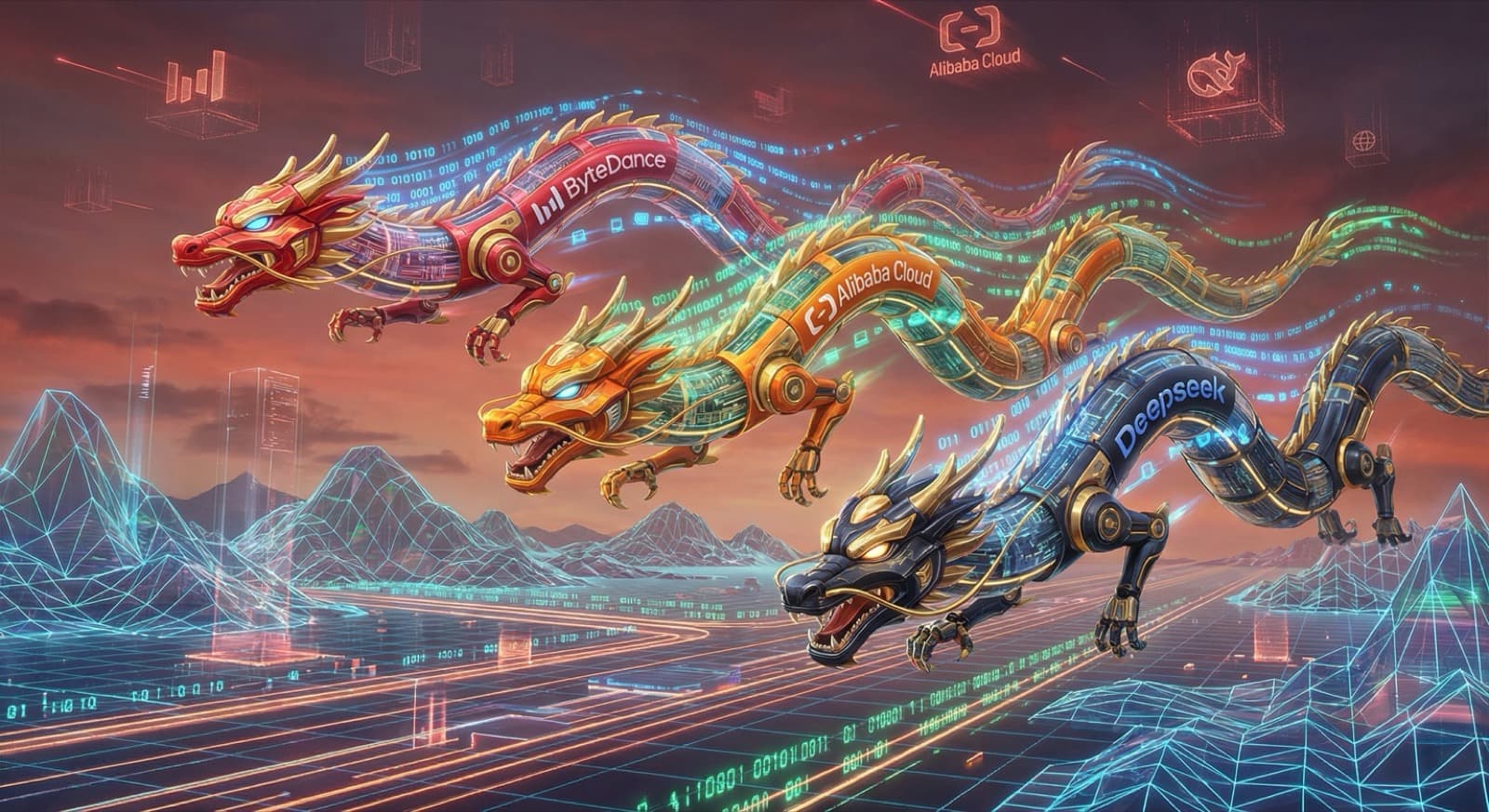

Something unusual happened in the Chinese AI landscape this weekend. Within 48 hours, two of the country's largest tech companies released new flagship models -- and both used the exact same phrase to describe them: built for the "agent era."
ByteDance dropped Doubao 2.0 on Saturday. Alibaba followed with Qwen 3.5 on Monday. And DeepSeek, the startup that shook global markets a year ago, is expected to release its next-generation model within days.
This is not a coincidence. It is a coordinated land grab for the next phase of AI -- and it has direct implications for every business using AI tools today.
What Changed: From Chatbots to Agents
The shift these companies are signaling is fundamental. The chatbot era -- where AI answers your questions -- is giving way to the agent era, where AI completes multi-step tasks on its own. Think of the difference between asking an assistant "What is the weather forecast?" and telling one "Book my travel for next week, optimize for cost, and adjust if the weather changes."
Both Doubao 2.0 and Qwen 3.5 are designed for exactly this kind of autonomous work. Doubao 2.0 focuses on long-chain reasoning and autonomous task completion. Qwen 3.5 includes what Alibaba calls "visual agentic capabilities" -- the ability to independently navigate and take actions across mobile and desktop applications.
These are not incremental improvements. They represent a new category of model behavior that is specifically optimized for the agentic workflows businesses are beginning to adopt.
The Numbers That Should Get Your Attention
The performance claims are impressive, but the pricing is where things get genuinely disruptive.
ByteDance Doubao 2.0:
- Matches GPT-5.2 and Gemini 3 Pro on key benchmarks
- Priced at roughly one-tenth the cost of comparable US models
- Already serving 155 million weekly active users in China
- Optimized for high-volume, multi-step agent tasks
Alibaba Qwen 3.5:
- Outperforms GPT-5.2, Claude Opus 4.5, and Gemini 3 Pro on several benchmarks
- 60% cheaper and 8x faster throughput than its predecessor Qwen3-Max
- 397 billion parameters using a mixture-of-experts architecture
- Open-source release available for self-hosting
DeepSeek (imminent):
- Next-generation model expected to drop within days
- Their previous release triggered a $1 trillion market selloff in US tech stocks
- Known for delivering frontier-level performance at dramatically lower costs
The pattern is clear: frontier-level AI agent capabilities are becoming available at 60-90% less than what US providers charge. That gap is not shrinking -- it is widening.
Why All Three Released at the Same Time
The timing is strategic on multiple levels. China's Lunar New Year holiday creates a massive captive audience of hundreds of millions of people with time on their hands. ByteDance learned this lesson the hard way last year when DeepSeek's viral launch during the holiday period caught every major Chinese tech company off guard.
This year, nobody is taking chances. ByteDance secured a partnership with China's Spring Festival Gala (the most-watched TV event on Earth). Alibaba poured 3 billion yuan ($400 million) into a coupon campaign that drove Qwen's daily active users from 7 million to 58 million in a single week. Tencent committed 1 billion yuan in incentives for its Yuanbao platform.
The domestic competition is fierce. But the global implications matter more for businesses outside China.
What This Means for Your Business
If you are running a small or mid-size business that uses AI, here is why this matters right now:
1. AI Agent Costs Are About to Drop Significantly
When three major players compete aggressively on price while delivering frontier-quality models, the entire market shifts. US-based providers like OpenAI, Anthropic, and Google will face increasing pressure to lower API pricing. Qwen 3.5 being open-source means businesses can self-host agentic models without paying per-token API fees at all.
If you have been holding off on agentic AI workflows because of cost concerns, those barriers are falling faster than anyone predicted.
2. The Agent Era Is Not Future Tense Anymore
When ByteDance, Alibaba, and DeepSeek all independently decide that agentic capabilities are the differentiator for their next generation of models, that tells you something about where the industry consensus is heading. These companies collectively serve hundreds of millions of users. They are not building for a theoretical future -- they are building for demand they already see.
If your business is still using AI primarily as a search tool or content generator, you are using yesterday's paradigm. The models being released now are designed to handle entire workflows autonomously -- from data analysis to customer service to software development.
3. Open-Source Agentic Models Change the Game
Qwen 3.5's open-source release is significant because it means businesses can deploy agentic AI models on their own infrastructure. That means no data leaving your systems, no per-query costs, and no dependence on a single vendor's pricing decisions.
For businesses in regulated industries or those handling sensitive data, self-hosted agentic AI eliminates a major adoption barrier. You get GPT-5.2-level agent capabilities running on hardware you control.
4. Competition Benefits Everyone
A year ago, DeepSeek proved that you did not need billions in funding to build competitive AI models. Now we are seeing the downstream effect: an entire ecosystem of companies competing to deliver better, cheaper, faster agentic AI. That competition directly benefits the businesses that use these tools.
The February model dump was already historic. With Doubao 2.0, Qwen 3.5, and whatever DeepSeek is about to release, February 2026 may end up being the month the agent era officially started.
What To Watch For This Week
DeepSeek's release could drop any day now. Given the global impact of their previous launch, this one will be closely watched by markets and businesses alike. If they deliver another leap in cost-efficiency for agentic tasks -- which is their signature move -- expect another round of pricing pressure across the entire AI industry.
Meanwhile, the India AI Impact Summit running through February 20 will likely produce additional infrastructure and investment announcements that accelerate global AI deployment.
The takeaway is straightforward: the tools for building autonomous AI workflows are getting dramatically better and cheaper, all at once. Businesses that start experimenting with agentic AI now will have a meaningful head start over those waiting for the dust to settle.
Ready to explore how agentic AI can automate your business workflows? Get in touch -- we help small businesses move from chatbot-era AI to real autonomous agents.
AI Pilot Readiness Checklist
Turn the idea into a pilot you can defend.
AI agent articles are easy to bookmark and hard to operationalize. Use the readiness questions as a shared way to decide whether a workflow is specific enough, safe enough, and measurable enough to pilot. If they surface a strong candidate, BaristaLabs can review it with you and help shape a first version that fits your systems, approval process, and risk tolerance.
Please do not submit PHI, customer records, credentials, or confidential workflow exports.
Practical AI Workflow Notes
Want more practical AI operations ideas?
Get short notes on applying AI inside real small-business workflows — from document handling and customer follow-up to internal reporting, compliance, and automation guardrails.