

If you blinked during the first ten days of February, you missed roughly a dozen major AI model launches. Anthropic and OpenAI dropped flagship releases within minutes of each other. China's biggest tech companies unleashed a wave of models timed to Lunar New Year. Mistral shipped real-time transcription. And Elon Musk merged xAI with SpaceX in the largest corporate merger in history.
It is a lot. And if you run a small business, the noise can feel paralyzing. So let us cut through it. Here is what actually happened, what it means for you, and where to focus your attention.
The February 5 Showdown: Anthropic vs. OpenAI
The single most important day was February 5, when Anthropic released Claude Opus 4.6 and OpenAI launched GPT-5.3-Codex within minutes of each other. As TechCrunch reported, Anthropic reportedly moved its release up by 15 minutes to beat OpenAI to the headline.
Claude Opus 4.6 introduced "agent teams" -- the ability for AI to split a complex task into parallel sub-tasks, each handled by a specialized agent. It also brought a million-token context window, meaning it can process entire codebases or lengthy contracts in a single pass. For professional services firms, the BigLaw Bench score of 90.2% signals that legal document review, financial research, and compliance work are approaching production-grade quality. We covered the launch in depth in our Claude Opus 4.6 announcement.
GPT-5.3-Codex is OpenAI's strongest coding model yet, and the first one they openly acknowledge could "meaningfully enable real-world cyber harm" at scale. For small businesses, the practical takeaway is different: this model is dramatically better at building and debugging software. If you are working with a developer or agency, ask whether they are using these new coding models -- the productivity difference is real.
OpenAI also launched Frontier, an enterprise platform for building and managing AI agents. Initial customers include Uber, Intuit, and T-Mobile. While this is aimed at large organizations today, it signals where business AI is heading: orchestrated teams of specialized agents handling workflows end-to-end.
What this means for you: The tools your team uses for writing, research, analysis, and coding just got significantly better. If you have not revisited your AI tooling since late 2025, now is the time.
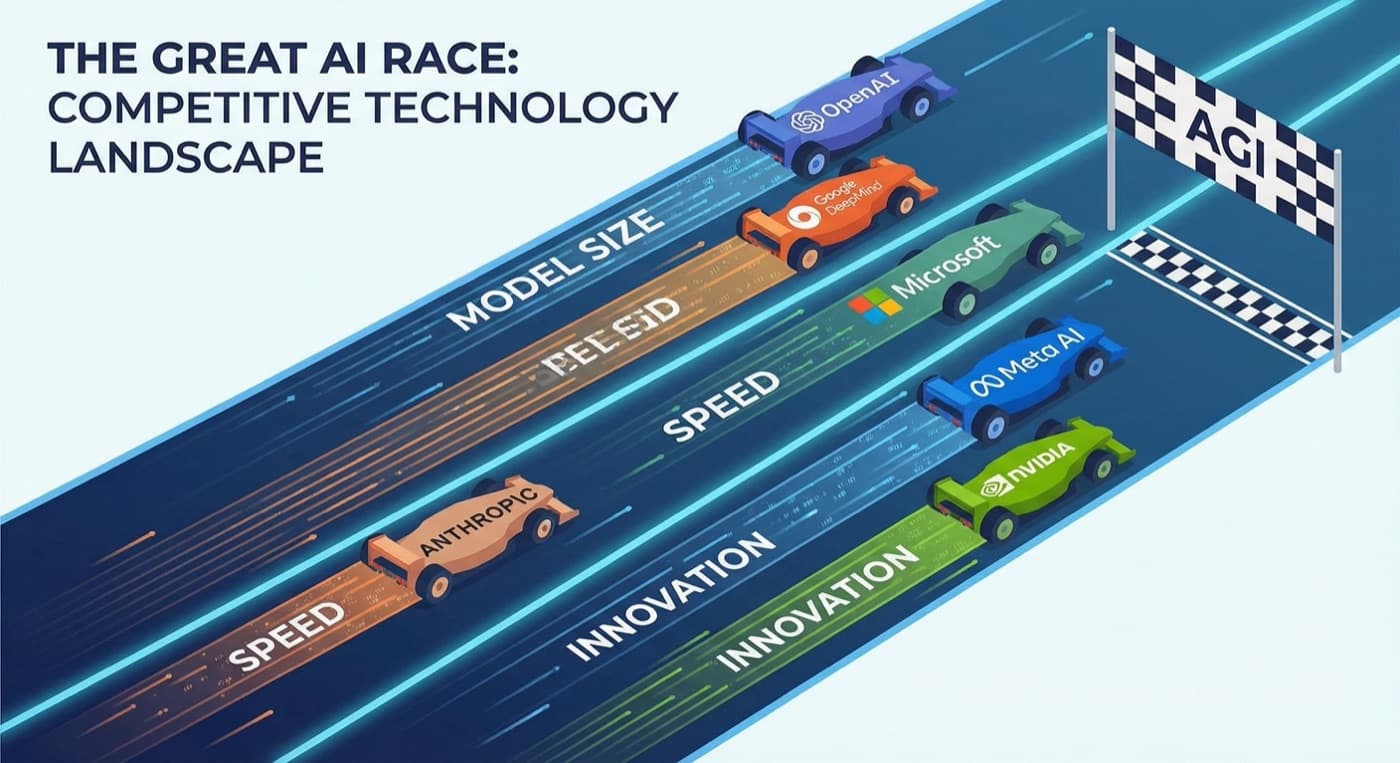
China's Lunar New Year AI Blitz
The week surrounding Lunar New Year (February 17) brought the most concentrated burst of Chinese AI releases ever. Five major companies shipped new models almost simultaneously:
- Kimi K2.5 from Moonshot AI: A trillion-parameter open-weights model that can coordinate up to 100 specialized agents at once. At $0.60 per million input tokens, it undercuts Western frontier models by 90%+.
- Qwen 3.5 from Alibaba: The first natively multimodal model in the Qwen family, with built-in vision understanding.
- GLM-5 from Zhipu AI: A 745-billion-parameter model trained entirely on Chinese Huawei hardware -- no NVIDIA chips required.
- DeepSeek V4 (expected mid-February): The follow-up to DeepSeek R1, which shocked the industry by matching OpenAI o1's performance at a fraction of the cost. V4 targets coding dominance and is expected to run on consumer-grade hardware.
- Doubao 2.0 from ByteDance and MiniMax M2.2: Both pushing aggressive pricing that makes enterprise AI accessible at startup budgets.
What this means for you: Competition is driving prices down fast. Open-weight models like Kimi K2.5 and the upcoming DeepSeek V4 mean you can run powerful AI locally or through low-cost providers without being locked into any single vendor. If cost has been your barrier to AI adoption, that barrier is shrinking by the month. We explored these dynamics in our look at the $600 billion infrastructure boom driving all of this investment.
Google, Mistral, and Cohere: The Specialists
Not every important release was a general-purpose chatbot.
Google's Gemini 3 Deep Think uses iterative multi-hypothesis reasoning that scored 45.1% on ARC-AGI-2, a benchmark designed to test genuine problem-solving ability. Google also launched Project Genie, a world model that generates navigable 3D environments from text -- a glimpse at how product visualization, real estate, and training simulations will work in the near future. We covered Google's growing dominance in our analysis of Gemini 3 reaching 750 million users.
Mistral's Voxtral Transcribe 2 deserves special attention from small businesses. It delivers real-time transcription with sub-200ms latency across 13 languages at $0.003 per minute. The open-weights version runs on-device, meaning your meeting recordings never leave your hardware. If you handle sensitive client conversations in healthcare, finance, or legal, this is the transcription solution to evaluate.
Cohere's Command A Reasoning is a 111-billion-parameter model purpose-built for enterprise tasks like customer service, document analysis, and internal search. It runs on just one or two GPUs and outperforms much larger models on business-specific benchmarks.
What this means for you: The age of one-size-fits-all AI is ending. Specialized models now outperform generalists at specific tasks while costing less to run. Match the tool to the job.

The xAI-SpaceX Merger: Bigger Than It Looks
On February 2, SpaceX officially acquired xAI in a $1.25 trillion deal -- the largest merger in history. Musk also confirmed that Grok 3 will be open-sourced, making another frontier model available for anyone to use.
The strategic play is "orbital data centers" -- compute infrastructure in space, powered by SpaceX's satellite and launch capabilities. That is years away from affecting your day-to-day, but the open-sourcing of Grok 3 matters now. It adds another high-quality option to the growing ecosystem of models you can self-host or access cheaply through third-party providers.
So What Should You Actually Do?
Here is our honest advice, informed by the investment dynamics we track and the real-world business impact we have seen since Anthropic's tools started reshaping markets:
-
Audit your current AI stack. If you are still on models from mid-2025, you are leaving significant capability on the table. The February releases represent a generational jump in coding, reasoning, and agent-based workflows.
-
Try the specialists. Mistral Voxtral for transcription. Cohere for customer service search. You do not need the most expensive frontier model for every task.
-
Watch the pricing race. Chinese open-weight models are pushing costs down industry-wide. If you are paying premium rates for basic text generation or summarization, cheaper alternatives now exist at comparable quality.
-
Think in agents, not prompts. The defining theme of February's releases is autonomous AI agents that coordinate to complete complex work. Start experimenting with agent-based workflows for repetitive multi-step tasks in your business.
-
Do not panic. More choices is good. You do not need to adopt everything at once. Pick one area of your business where AI could save meaningful time, choose the best-fit model for that task, and start there.
February 2026 will be remembered as the month AI competition hit a new gear. For small businesses, that competition translates directly into better tools at lower prices. The question is not whether to engage -- it is where to start.
Ready to figure out which of these models fits your business? Reach out to BaristaLabs -- we help small businesses cut through the noise and implement AI that actually delivers results.
Sources: Anthropic, OpenAI, TechCrunch, Mistral AI, Google DeepMind, CNBC, VentureBeat, Fortune
Back-Office Automation ROI Worksheet
Choose the first automation with evidence, not vibes.
AI tools can make almost any workflow look automatable. The ROI worksheet helps you pick the one most likely to pay back quickly. If one workflow rises to the top, BaristaLabs can help decide whether a lightweight tool, integration, or custom pilot is the best next step.
Use broad workflow categories in the form; save specifics for a scoped conversation.
Turn this idea into a pilot
Which workflow should go first?
Use the readiness check to compare impact, effort, risk, owner, and next step before requesting a review.
- 3-5 minutes
- Deterministic score
- No sensitive data
Practical AI Workflow Notes
Want more practical AI operations ideas?
Get short notes on applying AI inside real small-business workflows — from document handling and customer follow-up to internal reporting, compliance, and automation guardrails.