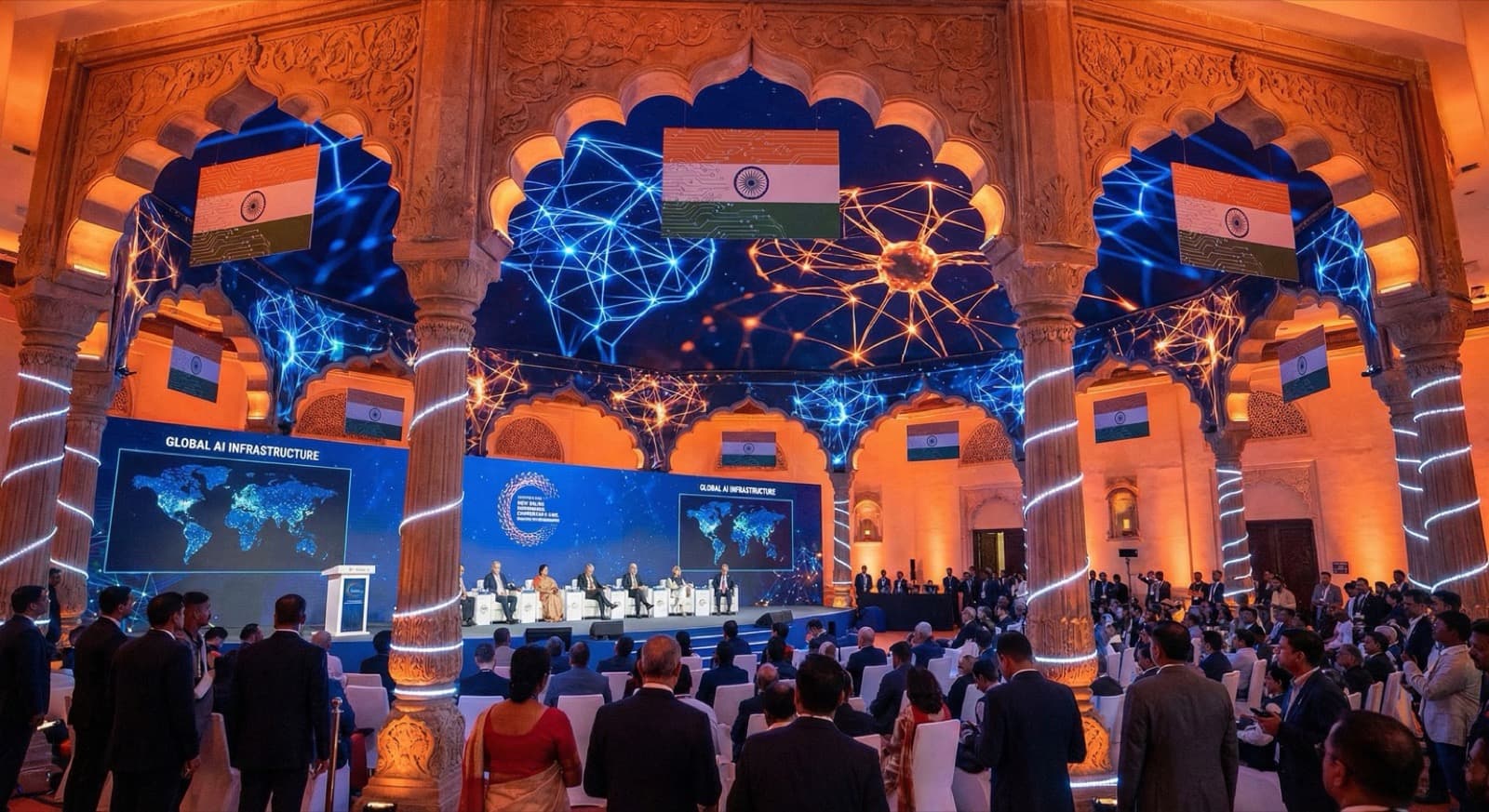

The India AI Impact Summit 2026 kicked off today in New Delhi, and it is already shaping up to be the most consequential AI gathering of the year. With 250,000 expected visitors, CEOs from every major AI lab in attendance, and billions of dollars in deals being announced on day one, this is not just another tech conference. It is a preview of where the entire AI industry is heading -- and there are clear signals that matter for businesses of every size.
Who Showed Up (and Who Did Not)
The attendee list reads like a who's who of AI leadership. OpenAI CEO Sam Altman, Alphabet CEO Sundar Pichai, Anthropic CEO Dario Amodei, and Google DeepMind CEO Demis Hassabis all made the trip to New Delhi. Reliance Chairman Mukesh Ambani and venture capitalist Vinod Khosla were also in the mix.
One notable absence: NVIDIA CEO Jensen Huang pulled out at the last minute citing "unforeseen circumstances." Given NVIDIA's current positioning around US export controls on high-end AI chips, the withdrawal raises questions about how chip supply dynamics may shift in the coming months.
The summit runs through February 20, featuring over 3,250 speakers across 500+ sessions. French President Emmanuel Macron is scheduled to speak alongside PM Modi on Thursday.
Massive Infrastructure and Investment Deals
The biggest news from day one centers on infrastructure spending. Here is what dropped:
-
AMD and TCS partnership: AMD is teaming up with Tata Consultancy Services to develop rack-scale AI infrastructure based on AMD's "Helios" platform. This is a direct challenge to NVIDIA's dominance in enterprise AI compute.
-
Blackstone backs Neysa: Private equity giant Blackstone acquired a majority stake in Indian AI startup Neysa as part of a $600 million equity round, with plans to deploy over 20,000 GPUs and raise another $600 million in debt.
-
India's $1.1 billion AI venture fund: The Indian government earmarked $1.1 billion for a state-backed VC fund targeting AI and advanced manufacturing startups.
-
Anthropic opens Bengaluru office: Anthropic announced its first office in India, noting that the country is the second-largest user of Claude after the United States.
These are not small moves. They signal a fundamental shift in where AI infrastructure and talent are concentrating globally.
Why India Matters for AI Right Now
India is not just hosting this summit as a diplomatic gesture. The numbers tell a compelling story:
100 million weekly ChatGPT users. Sam Altman revealed that India now has more than 100 million weekly active ChatGPT users -- second only to the US. Indian students are also the largest group of ChatGPT users globally.
AI talent pipeline. Over 60% of Global Capability Centers (GCCs) established in the last two years are focused on AI, data, or digital engineering, according to CNBC. More than 80% of upcoming GCCs are projected to be AI-led. The role of "Chief AI Officer" is increasingly being filled from India-based talent pools.
Sovereign AI models. Indian startups like Sarvam AI and Bharatgen are building domestically developed language models, reducing dependency on US-based AI providers.
For businesses watching the AI landscape, India's emergence as an AI powerhouse means more competition in AI services, potentially lower costs for AI talent and compute, and new market opportunities.
The IT Services Disruption Warning
Not everything at the summit was optimistic. Some of the most striking comments came from industry leaders warning about AI's impact on traditional business models.
HCL CEO Vineet Nayyar said bluntly that Indian IT companies "will focus on turning profits and not being job creators." Vinod Khosla went further, predicting that IT services and BPO industries could "almost completely disappear" within five years because of AI.
These are not fringe predictions -- they come from people running and funding the companies that would be affected. For small businesses that outsource development or support work, this is a signal to start thinking about how agentic AI workflows might replace traditional outsourcing relationships sooner than expected.
What This Means for Small and Mid-Size Businesses
You do not need to attend a summit in New Delhi to benefit from these shifts. Here is what matters for your business:
1. AI compute costs are heading down. The AMD-TCS partnership, Blackstone's GPU investments, and India's infrastructure push all point to more AI compute supply hitting the market. More competition means lower prices for the API calls and cloud services your business depends on.
2. Talent geography is shifting. If you are hiring AI talent or working with AI consultants, India's growing talent pool means more options and competitive pricing. The rise of AI-focused GCCs is creating a deep bench of experienced practitioners.
3. Open-source and sovereign models are proliferating. Between India's sovereign AI push and the ongoing open-source model releases from labs worldwide, businesses have more choices than ever for deploying AI without being locked into a single provider.
4. The outsourcing model is evolving. If your business relies on traditional IT outsourcing or BPO services, start exploring how AI agents and automated workflows could handle those functions. The executives running those service companies are already planning for this transition.
Looking Ahead
The India AI Impact Summit runs through February 20, and more announcements are expected -- particularly around healthcare AI initiatives (India's Health Ministry is launching AI frameworks tomorrow) and additional data center investments.
What makes this summit different from previous AI events in the UK, South Korea, and France is the scale of practical, commercial commitments being made. This is not a policy discussion -- it is a land grab. The companies and countries positioning themselves now will define the AI infrastructure layer for the next decade.
For businesses navigating their own AI strategy, the takeaway is clear: the ecosystem is expanding rapidly, costs are coming down, and the window for competitive advantage through early AI adoption is still open -- but it is narrowing.
Need help figuring out how AI infrastructure changes affect your business strategy? Get in touch -- we help small businesses cut through the noise and build practical AI solutions.
Back-Office Automation ROI Worksheet
Choose the first automation with evidence, not vibes.
AI tools can make almost any workflow look automatable. The ROI worksheet helps you pick the one most likely to pay back quickly. If one workflow rises to the top, BaristaLabs can help decide whether a lightweight tool, integration, or custom pilot is the best next step.
Use broad workflow categories in the form; save specifics for a scoped conversation.
Turn this idea into a pilot
Which workflow should go first?
Use the readiness check to compare impact, effort, risk, owner, and next step before requesting a review.
- 3-5 minutes
- Deterministic score
- No sensitive data
Practical AI Workflow Notes
Want more practical AI operations ideas?
Get short notes on applying AI inside real small-business workflows — from document handling and customer follow-up to internal reporting, compliance, and automation guardrails.
Related Posts