


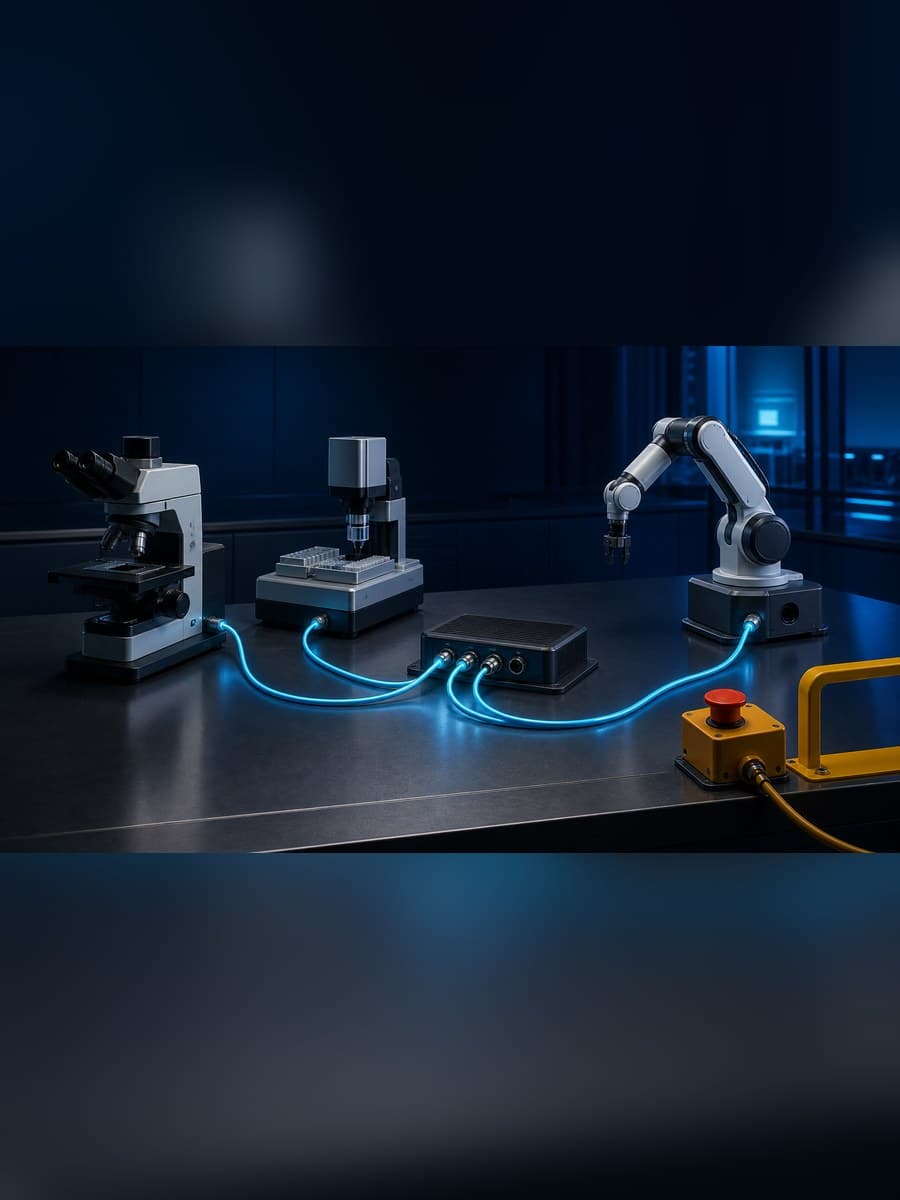
Anthropic opened a research preview of the Model Hardware Standard, or MHS, on August 27. The shared specification is meant to let AI agents operate programmable lab and manufacturing equipment through a common control layer instead of a separate bespoke integration for every instrument.
That could compress expensive integration work, but it also concentrates authority. A common driver can make a microscope, liquid handler, or robotic arm easier for an agent to reach; it does not make every command safe. This article explains the MHS mechanism, the limits of the preview, and the control boundary an operations team should define before putting one physical workflow behind an agent.
What does MHS standardize?
Anthropic says MHS development began with HHMI Janelia Research Campus. The preview is open to an initial group of scientific labs and advanced manufacturers, with partners across biotech, robotics, electronics, quantum computing, and manufacturing. Anthropic plans to make the standard open source later, but the announcement does not give a general-availability date.
The core abstraction is an MHS driver. It translates a device's own programming interface into a smaller set of common primitives, including operations such as read a temperature and write a temperature setting. It also publishes the device in a standard format so agents and equipment can discover and communicate with one another across a network.
The driver carries more than callable functions. Anthropic says operators can add natural-language tags for characteristics that code alone may not reveal, such as a robot arm's weight. The driver then produces a reference file describing what the device can measure, which values can be adjusted, and which safety limits will be enforced.
After that description exists, an agent can control the equipment through MCP, a command-line interface, or code files and APIs. For long-running work or operations faster than online model reasoning, Anthropic says the agent can assemble driver commands into deterministic code so the equipment runs the sequence without another model decision at every step.
Why does a common driver change the business case?
Most facilities do not have one vendor, one interface, or one clean equipment generation. Every custom translator adds commissioning time, specialist dependency, and another component to maintain when a device or workflow changes.
Anthropic says labs and manufacturers typically spend weeks or months integrating hardware, and that MHS can reduce this work to hours or minutes. It also reports faster iteration and assistance with live machine operation and fault detection in early partner projects. Those are vendor claims from an early preview, not independent benchmarks or a guarantee for a particular facility.
The defensible opportunity is narrower. A shared driver contract may let a team reuse discovery, command, and evidence plumbing across supported devices. That can make one bounded orchestration pilot cheaper to test before the organization commits to a larger automation platform.
Where should the safety boundary sit?
The MHS reference file can describe permitted settings and enforced limits. That is useful application policy. It should not be treated as a substitute for a hardwired interlock, emergency stop, certified safety controller, guarded work area, or site-specific risk assessment.
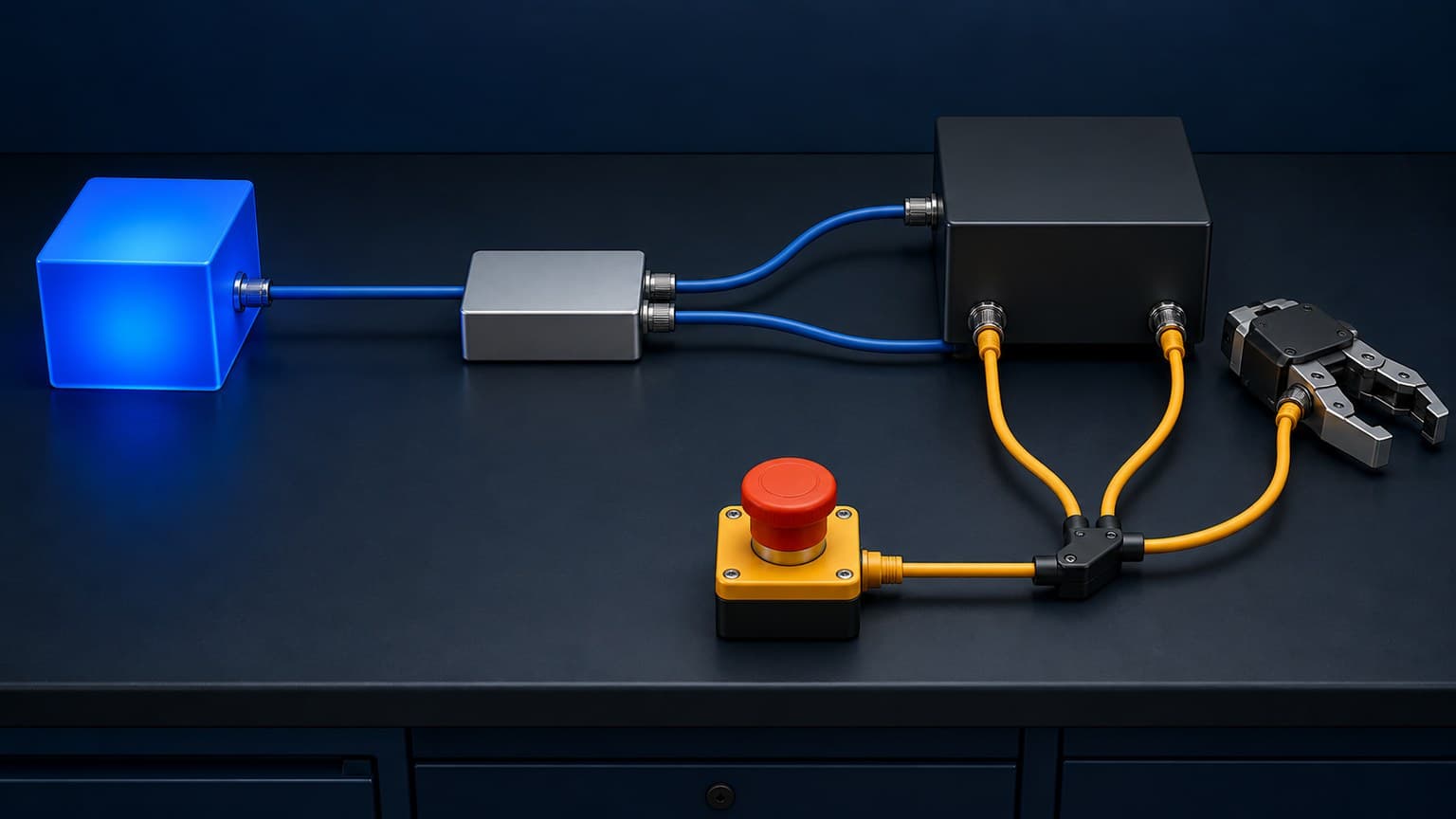
A software limit travels through the same broad control path as the agent's command. A defect in units, driver mapping, credentials, network state, or orchestration logic can affect that path. Independent protective controls should still stop or constrain the equipment when the agent, model, driver, or network is wrong or unavailable.
BaristaLabs recommends separating three responsibilities. The driver should expose only the commands the workflow needs and validate units, types, and ranges. The orchestration layer should manage sequence, authorization, logging, timeouts, and recovery. The physical safety layer should enforce hazardous-motion, energy, temperature, pressure, access, and emergency-stop conditions without depending on a model response.
That separation also clarifies stop authority. An agent may be able to retry a harmless read after a transient error. It should not decide by itself that a tripped protective control can be reset or that a person may re-enter a guarded area. Restart approval belongs to a named operator and the facility's existing safety procedure.
What should one MHS pilot prove?
Start with one programmable device and one economically useful task. Prefer a workflow with constrained commands, observable state, and a safe fallback, such as reading an instrument, preparing settings for approval, or running a non-hazardous sequence inside an established enclosure.
Before connecting an agent, record the exact device and firmware, driver version, allowed primitives, units, valid ranges, credential scope, network boundary, and physical protective controls. Define what happens when the reference file is incomplete, a reading is stale, a command times out, state conflicts with the agent's expectation, or the network disappears during execution.
Then exercise the boundary rather than only the happy path. Send an out-of-range value, a wrong unit, an unsupported command, a repeated write, and a command after the stop condition. Confirm which layer rejects each case, what the equipment actually does, what evidence is preserved, and who can authorize a restart.
For code files assembled by an agent, preserve the generated file, driver versions, approved parameters, reviewer decision, execution identity, device response, and final equipment state. A deterministic script reduces repeated model reasoning; it does not remove the need to inspect the program before consequential execution.
Approval should remain local. The preview does not publish a final stable specification, independent safety certification, universal compatibility results, pricing, or broad production evidence. “Model-agnostic” describes Anthropic's intended interface; it does not establish that every model, harness, and device combination behaves safely.
What is the decision now?
MHS is evidence that physical AI is moving from one-off demos toward reusable integration contracts. The immediate decision is not whether to let an agent run a lab or factory overnight. It is whether one device can be placed behind a narrow driver contract while the controls that protect people, equipment, and materials remain independent.
Apply to the preview or fund a pilot only when the team can name the command boundary, the separate protective controls, the evidence captured for every run, and the person who can stop and restart the work. BaristaLabs can review one equipment-control boundary before live control access is introduced.
Source
- Anthropic: “Previewing the Model Hardware Standard”, published August 27, 2026.
Anthropic controls preview access, implementation details, compatibility, rollout, and future open-source timing. BaristaLabs supplies the control-boundary, pilot, evidence, and stop-authority recommendations.
Physical automation review
Make one equipment-control boundary testable
BaristaLabs can help scope one bounded pilot around supported commands, independent protective controls, evidence capture, and stop and restart authority.
Bring a sanitized device diagram and operating limits; do not send credentials, proprietary procedures, regulated data, or live control access.
Turn this idea into a pilot
Which workflow should go first?
Use the readiness check to compare impact, effort, risk, owner, and next step before requesting a review.
- 3-5 minutes
- Deterministic score
- No sensitive data
Practical AI Workflow Notes
Want more practical AI operations ideas?
Get short notes on applying AI inside real small-business workflows — from document handling and customer follow-up to internal reporting, compliance, and automation guardrails.