


Example
“Leave the lobby, walk through the corridor, enter the supply room, and stop to face the second shelf.”
The instruction sounds like something a facilities manager might say without thinking. No coordinates. No waypoint file. Just a destination described in the language of the building.
Mistral introduced Robostral Navigate on July 8, 2026, as an 8B model that takes RGB images and plain-language instructions. It uses one ordinary RGB camera, with no LiDAR or depth sensors.
That lower sensor burden is attractive. It can mean fewer components to mount, calibrate, clean, and replace.
Yet the route contains all the reasons procurement cannot stop at the camera count: people, glare, changing light, moving furniture, and an endpoint where position matters.
The release establishes a model worth auditioning. It does not establish that one camera is sufficient for a particular hotel corridor, loading area, factory aisle, or service route.
The useful buying test is to follow Mistral's instruction all the way to the second shelf and interrupt it with the building as it really behaves.
Leave the lobby: a person crosses
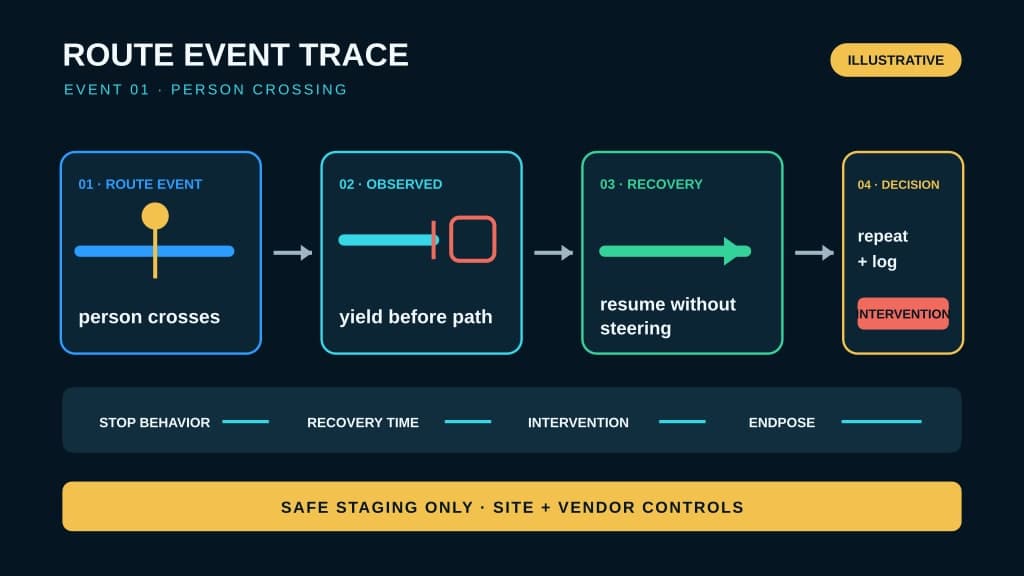
Obstacles and changing light can make one clean route present several different perception problems.
The robot starts forward. A person exits a side door and crosses the lobby. This is ordinary traffic in a hotel, hospital, office, or plant, not an edge case invented for a demo.
Mistral's release shows Robostral Navigate following one long-horizon instruction through a working office. Mistral says the live space included people and obstacles the model had not seen during training.
That demonstration matters because it shows the intended behavior in a recognizable environment. It remains a vendor demonstration.
It does not tell a buyer how the system behaves across repeated crossings, crowded shift changes, hesitant pedestrians, carts, or someone stepping back into the path.
The local proof is behavioral. Does the robot detect the crossing early enough for the site's operating rules? Does it stop or yield predictably?
After the path clears, does it resume the instruction without a person steering it back on course?
A route audition should let the crossing happen at a normal point on the route under the vendor's safety procedures and the site's controls. The aim is ordinary disruption, never a surprise stunt near a moving machine.
Watch the recovery as closely as the stop. A robot that freezes safely may still be a poor fit for a busy route if every crossing requires an operator to restart the mission.
Walk through the corridor: the wall reflects
The robot clears the lobby and turns into a corridor. One side is painted drywall. The other is glass, polished metal, or a mirror.
A bright reflection makes open space look occupied, or makes a boundary harder to read.
Robostral Navigate's movement policy uses pointing. Given the instruction and its observation history, the model predicts image coordinates for the next target and the orientation it should have when it gets there.
Mistral argues that pointing is naturally robust to differences in camera intrinsics and world scale. That is relevant when the same model has to work across different camera intrinsics and world scales.
It is not a local answer to reflection. A buyer still has to observe whether the actual camera, at its actual mounting height, can distinguish the traversable corridor from glare, mirrored space, transparent barriers, and polished-floor reflections.
This interruption can produce more than a binary pass or fail. The robot may slow unnecessarily, take a wide path that obstructs people, or oscillate while trying to reconcile a reflection with the route history.
Those behaviors affect throughput even if the run eventually succeeds.
Camera-only navigation has earned this corridor when the robot crosses it repeatedly without unsafe ambiguity or routine human rescue.
If a reflective surface defeats the route, procurement can compare three remedies: change the environment, change the camera placement, or add sensing that resolves the ambiguity.
The lighting changes before the next door
Halfway down the corridor, daylight spills through an exterior door. On the return shift, the same stretch sits under dim service lighting.
A loading dock adds glare at noon and deep contrast after sunset.
Mistral says the model was trained entirely in simulation, using approximately 400,000 trajectories across 6,000 scenes. The release says it is designed for offices, residential and commercial buildings, and outdoor settings.
That breadth is a reason to test. It is not evidence that every exposure transition has been covered.
The release does not provide a site-specific result for a camera facing a sunlit dock, a dark stockroom, flashing equipment, dust, condensation, or a lens that accumulated fingerprints during a shift.
Run the same route through the lighting states that belong to its real operating window. An after-hours run through an empty, evenly lit building cannot approve a route intended for noon deliveries or a round-the-clock line.
The result may support a cheaper intervention than another sensor. Better corridor lighting, a shaded camera position, a matte treatment on one surface, or a revised route may make the single-camera system dependable enough.
Those changes have costs too. The audition keeps procurement from hiding them inside the robot price.
Enter the supply room: the shelf moved
The supply-room door is open, but a rolling shelf has shifted since the route was first shown. A cart occupies the easy approach.
The second shelf is temporarily outside the camera's field of view.
Mistral describes a fallback for that last condition. When the destination cannot be indicated inside the current image, Robostral Navigate predicts displacements in the robot's local coordinate frame.
That mechanism gives the model another way to make progress when pointing cannot express the next move.
It also gives the buyer a precise interruption to stage: move a normal piece of equipment within its allowed working area, then see whether the robot finds a safe route without losing the instruction.
Mistral reports that online reinforcement learning with CISPO improved the model's success rate by 3.2%. The company says this stage helps the model learn from trial and error, recover from failures, and explore beyond behavior cloning.
The route audition has to reveal what recovery means on the chosen robot. Does it back up, turn, and reacquire the room? Does it keep enough clearance for its load?
Does it recognize that the route is temporarily blocked and hand control to a person instead of searching indefinitely?
A moved shelf is also a maintenance question. If every layout change requires remapping, operator retraining, or vendor intervention, the camera may be inexpensive while the route remains costly.
Stop to face the second shelf: the endpoint is the job
Entering the supply room is not completion. The instruction says to stop and face the second shelf.
That final pose may determine whether a mobile robot can scan a label, present a tote, dock with equipment, accept a load, or leave enough aisle clearance for the next worker.
A few degrees or centimeters may be irrelevant on one route and disqualifying on another.
Robostral Navigate explicitly predicts desired orientation along with image coordinates. The release therefore demonstrates that orientation is part of the navigation problem, rather than an afterthought once the destination is reached.
Procurement still needs an endpoint tolerance tied to the task. Mark the acceptable stopping area and facing direction before the robot moves.
Then judge whether the downstream job could begin without a person nudging the platform into place.
The robot body matters here. Camera height, wheelbase, turning radius, braking, carried load, and the controller between model and motors all shape the final pose.
Mistral says Robostral Navigate can run on wheeled, legged, and flying robots and across robot sizes. The public release does not supply independent reproduction across those platforms, broad deployment evidence, or a safety certification.
It also does not present the model as a self-serve, generally available product. The page invites prospective users to talk with Mistral's team.
A serious evaluation therefore has to include the access model, supported hardware, compute target, control interface, logging, latency, support, and the safety layer around navigation.
Read the benchmark as an invitation, not a purchase order
R2R-CE means Room-to-Room in Continuous Environments. The original benchmark paper places language-guided agents in continuous 3D spaces.
Agents execute low-level actions without a known environment topology, short-range oracle navigation, or perfect localization.
Mistral reports a 79.4% success rate on R2R-CE validation seen and 76.6% on validation unseen.
Unseen means the validation environments were held out of training, so that figure is the more relevant signal for generalization to unfamiliar scenes.
Mistral says the unseen result is 9.7 points above the best single-camera approach and 4.5 points above the best system using depth or multiple cameras.
Those are first-party benchmark claims. They show strong performance in the named evaluation.
They are not independent validation of pedestrian safety, endpoint accuracy, uptime, recovery cost, or route fit inside a buyer's facility.
This is the same gap we examine in why better benchmarks can produce worse production outcomes: rank measures performance under an evaluation's conditions. Operations inherits the conditions the benchmark did not contain.
The training advances are impressive engineering, but they belong on the same side of that line.
Mistral reports that prefix-cached training reduced tokens 22 times compared with using one sample per time step. It also reports a 3.2% improvement in success rate from CISPO.
Those details help explain how the team trained and improved the model. They do not establish the cost or reliability of running a finished navigation system on a particular robot for a full shift.
Mistral calls Robostral Navigate a first step toward a unified embodied agent.
Our earlier analysis of Intrinsic joining Google's physical AI work covers that broader simulation-to-production architecture. This buying decision is narrower: can one robot finish one useful route in this building?
Give the route an audition while the building is working
Choose a route with an economic reason to exist.
Linen delivery to a service room, replenishment between a stock area and a line, tote movement across a warehouse zone, or supplies from a back room to a hospitality station are concrete enough to judge.
Use the real robot configuration and payload. Run during the operating period the deployment is meant to serve.
Keep the route narrow enough that people can explain every intervention, yet useful enough that success would change a buying decision.
Before the first run, the site safety owner and vendor should set speed, separation, emergency-stop, and test-area controls.
The route owner should define completion in operational terms, including the acceptable final position and orientation.
Let the robot perform the route once under ordinary conditions. Then repeat it while the building supplies the expected interruptions.
Use a controlled pedestrian crossing, the reflective corridor, the actual lighting transition, a shelf or cart in a permitted new position, and the required stop at the second shelf.
Do not bundle all disruptions into one theatrical obstacle course. Introduce them where they normally occur, across repeated runs.
That lets the team see which condition changes behavior and whether recovery is consistent.
For every run, note whether the mission completed, where the robot paused or deviated, why a person intervened, how long recovery took, and whether the endpoint allowed the next task to begin.
Video helps resolve disagreements about a near miss or a late correction.
Set the acceptance thresholds before reviewing the best run. There is no universal completion rate or endpoint tolerance for every operation.
A low-traffic office courier and a loaded robot crossing a manufacturing aisle carry different consequences.
One route audition does not certify a fleet or prove every route. It answers a smaller procurement question with local evidence.
It can approve a bounded camera-only pilot, require an environmental change and another audition, or justify depth, LiDAR, or multiple cameras before work expands.
Buy the route that survives, not the smallest bill of materials
A single camera can lower hardware and integration burden. It can also concentrate perception risk in one lens that may be occluded, dirty, backlit, or poorly placed.
The cheapest sensor list is not always the cheapest operating system.
A heavier stack has its own costs: more components, calibration, integration, compute, maintenance, and failure paths.
Extra sensing earns its place when it resolves a route condition that matters, improves safe recovery, or protects the endpoint accuracy the job requires.
This frames procurement around observed operations instead of allegiance to camera-only or multi-sensor design.
The evidence may favor one camera. It may favor a controlled change to the building. It may show that depth or redundancy is worth paying for on one route and unnecessary on another.
For operators ready to turn that evidence into an implementation boundary, BaristaLabs' process automation work starts with the route, the interruption, and the handoff around the robot.
You can plan a robot route audition before the sensor choice hardens into a purchase.
Back at the second shelf, procurement has its answer. If the robot arrives within the required pose after real people, glare, lighting shifts, and layout drift, one camera has earned the route.
If it does not, change the environment or add sensing. The shelf gets the final vote.
Before choosing the sensor stack
Audition one robot route under ordinary disruption
BaristaLabs helps operators define one useful route, stage expected interruptions, observe recovery and endpoint accuracy, and turn the run into a camera-only, environment-change, or heavier-sensor decision.
Bring one route that matters to facilities, logistics, hospitality, or manufacturing operations.
Turn this idea into a pilot
Which workflow should go first?
Use the readiness check to compare impact, effort, risk, owner, and next step before requesting a review.
- 3-5 minutes
- Deterministic score
- No sensitive data
Practical AI Workflow Notes
Want more practical AI operations ideas?
Get short notes on applying AI inside real small-business workflows — from document handling and customer follow-up to internal reporting, compliance, and automation guardrails.