


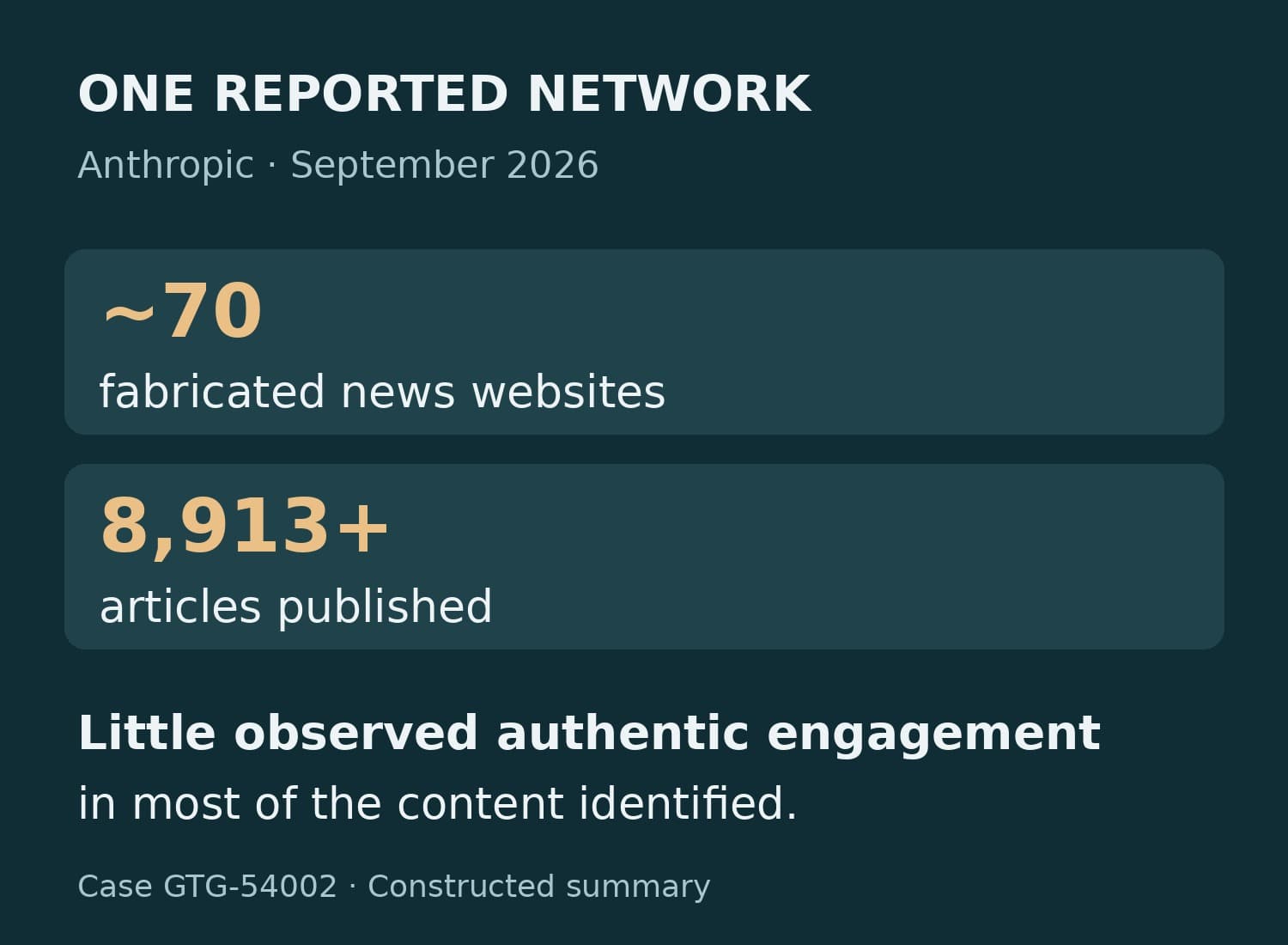
Anthropic's September 2026 threat intelligence report describes a commercial influence operation that used Claude to produce content for approximately 70 fabricated news websites. The sites looked like separate local newsrooms, but Anthropic traced them to one operator. For marketing teams, the case exposes a weakness in a familiar report: a long list of placements can look like broad independent coverage even when it comes from one publishing network.
The useful response is to separate what a media report measures. Published pages, independent editorial attention, and demonstrated audience reach answer different questions. An AI-assisted monitoring system should preserve those distinctions rather than turn every new URL into another endorsement.
A publishing network that looked larger than its audience
In case GTG-54002 of its report, Anthropic says the operation paired its fabricated outlets with 70 matching X accounts and more than 250 inauthentic commenting accounts. The network generated original fabricated stories and rewrote reporting by real journalists. Fake bylines helped the sites resemble staffed local newsrooms.
The software requested structured output from Claude, including formatted article content, which allowed publication to be automated. The same underlying story could be rewritten for different audiences and political positions. The apparent variety of outlets therefore concealed a common production system.
Anthropic reports at least 8,913 articles in about 20 languages. Yet most of the content it identified attracted little observable engagement from real audiences. The company assessed the operation as Category Two on the Brookings Breakout Scale: distribution across the network's own websites and social accounts, without evidence of wider breakout.
Those findings describe this investigated operation, not the prevalence of deceptive content across marketing or news. The report covers disruptions between December 2025 and August 2026, with some case history reaching further back. It presents notable cases rather than a representative sample. Its conclusions about the network and audience are Anthropic's findings; this article does not independently establish them.
Keep placement counts, outlet ownership, and reach separate
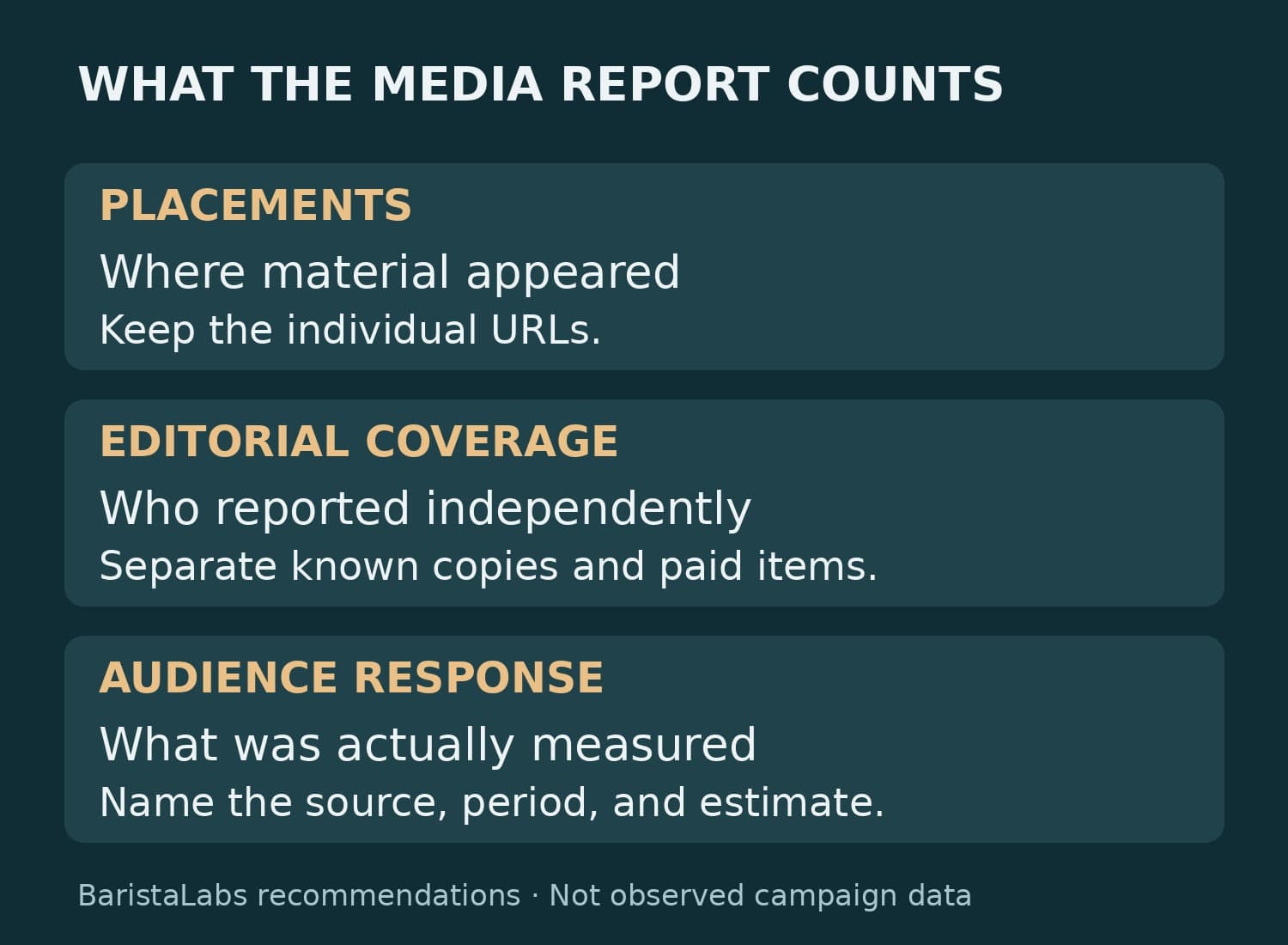
A placement count can still be useful. It tells a communications team where material appeared and gives it a list to inspect. Trouble starts when that count is described as independent coverage or used as an audience estimate without supporting evidence.
Our recommendation is to keep the gross count and add the context needed to interpret it. Retain the original URL, publication date, byline, and the underlying source cited by each item. Where a publisher discloses syndication or common ownership, record that relationship. Group known copies of a release or syndicated story without deleting their individual URLs.
A shared host, similar wording, or synchronized publication time can justify a closer look. None of those features alone establishes deceptive coordination. Legitimate publishers share technology, republish wire stories, and cover the same announcements. Label an unresolved relationship as unresolved rather than accusing a publisher based on an automated match.
Reach needs its own evidence. If an agency supplies audience numbers, ask what they measure and where they came from: estimated monthly site traffic, impressions for the actual item, and engaged visitors are different quantities. Preserve the measurement period and whether the number is an estimate or a direct observation. Do not add overlapping audiences and label the result unique people reached.
Change the agency report before changing the target
The immediate management decision is whether to keep rewarding the number of placements alone. A target expressed only as a URL count gives a supplier little reason to distinguish original reporting from republished material. AI makes the latter easier to produce at volume; the Anthropic case illustrates the gap between output and observed authentic attention.
Ask a supplier to show which placements contain original reporting, which repeat supplied copy, which are paid, and which belong to a disclosed network. Then agree on how each category will appear in the report. A paid placement can have a legitimate purpose. It should not be presented as an independent editorial endorsement.
Apply the same discipline to internal automation. Our guide to reliable inputs for AI monitoring explains how to retain source records as pages change. An AI monitor can propose groups of similar articles and flag missing disclosure. A person should confirm the classification before it changes a supplier's evaluation or becomes a public allegation. Keep the source pages and the review decision so that a later correction can be explained.
For an existing campaign, start with the placements that support its headline claim. Trace each to the publishing organization and the evidence offered for reach. If that evidence is missing, revise the claim or mark the number as an estimate with its source. There is no need to discard genuine coverage because other entries remain uncertain.
The next report can still show how much material was published. Beside that total, show what was independently reported and what audience response was actually measured. That gives a marketing lead a sounder basis for renewing a supplier or changing a campaign than the length of a link list.
Source
Anthropic, Detecting and countering misuse of AI: September 2026, especially GTG-54002. Accessed September 12, 2026. Reporting recommendations above are BaristaLabs analysis, not Anthropic product features.
Reporting workflow help
Keep source context in your media reports
BaristaLabs can help connect source records, review decisions, and reporting labels in an automated workflow.
Bring a redacted report and a description of how its numbers are collected.
Practical AI Workflow Notes
Want more practical AI operations ideas?
Get short notes on applying AI inside real small-business workflows — from document handling and customer follow-up to internal reporting, compliance, and automation guardrails.