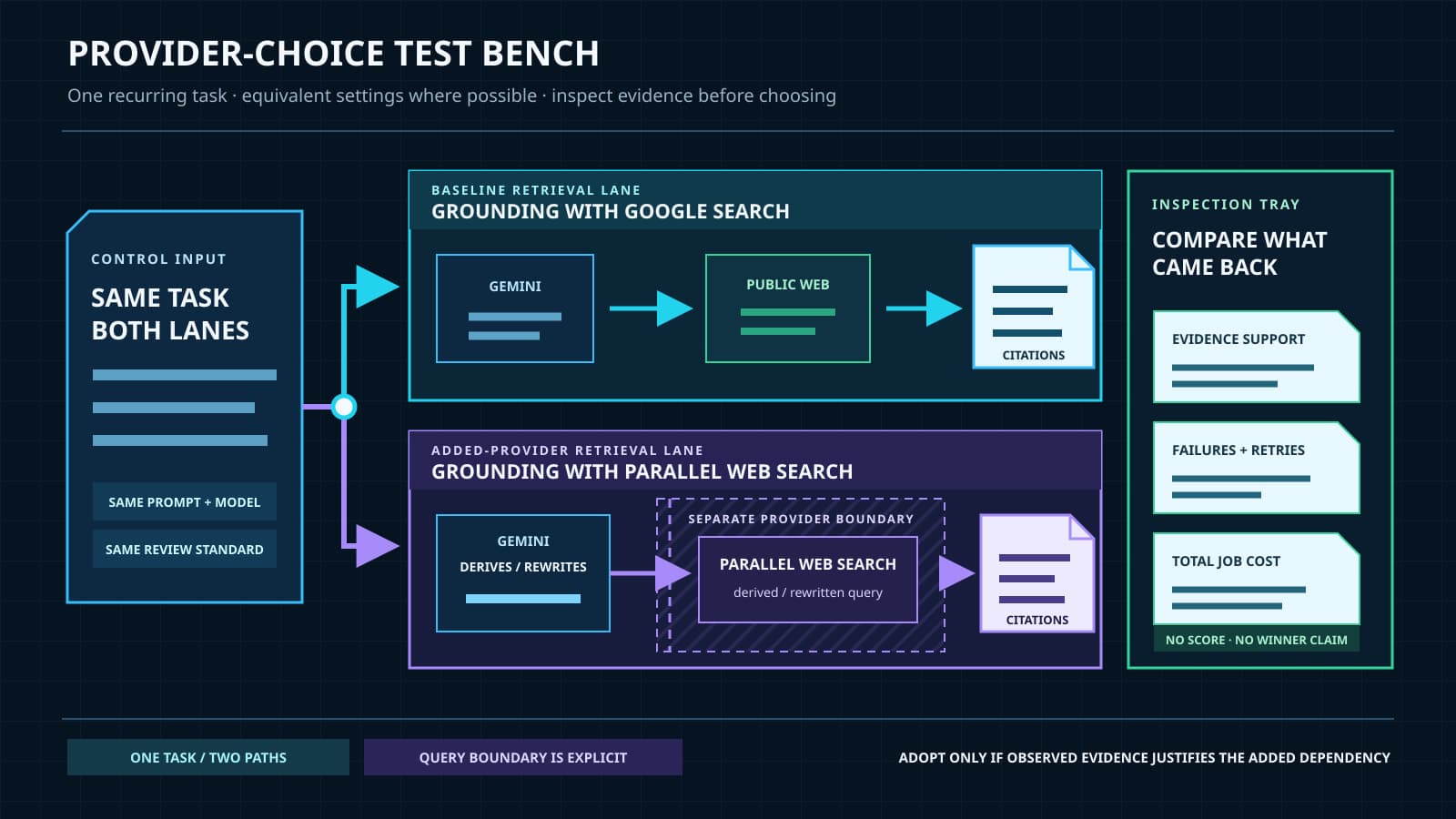


On July 16, 2026, Google added Parallel Web Systems as a natively integrated web-grounding provider in Gemini Enterprise Agent Platform. Grounding is the process of retrieving external evidence that an AI system can use to support its answer. The new option may improve the evidence available to research, enrichment, and automation agents, but it also introduces a separate provider, a documented query-transfer boundary, a Preview dependency, and additional metered charges.
Teams now have a provider decision inside the grounding configuration. Before production use, trace the full request path, decide whether the available controls meet your data requirements, and run one recurring task through both Grounding with Google Search and Grounding with Parallel Web Search. Compare the evidence each returns, the failures each creates, and the total cost of producing an acceptable result.

The request passes through Gemini and a separate search provider
The dependency chain starts with the application and its user prompt. Gemini processes that prompt and can derive or rewrite queries for web retrieval. When Grounding with Parallel is selected, Google sends those queries to Parallel Web Systems, Parallel performs the search, and the results return through Gemini for use in the model response.
Google’s July 16 announcement says the integration provides real-time web results and exact citations. Those are Google’s product claims, not independent findings about this integration. Parallel describes its own product as search built for AI agents, but its published benchmark results are also first-party evidence. The sources cited here do not include an independent comparison of this integration.
The integration is available through the Gemini API and can be selected in Agent Studio. Buyers can subscribe through Google Cloud Marketplace or supply their own Parallel API key. If both are configured, the customer-supplied API key takes precedence.
Marketplace usage is metered on the existing Google Cloud invoice. The technical and contractual chain still includes another provider: Google’s Grounding with Parallel documentation identifies the feature as a “Separate Offering” under the customer’s Google Cloud agreement, and Parallel processes part of the request.
Derived and rewritten queries cross the provider boundary
Google documents that it sends certain data to Parallel for processing, including queries derived and rewritten from the original user prompt. The transfer is part of the selected grounding path under both access methods: a Marketplace subscription and a bring-your-own Parallel API key.
Derived queries matter because they may reveal more than a user’s exact words. An agent can turn a broad request into searches containing company names, product attributes, transaction details, investigation targets, or other context inferred from the task. Our earlier article on cumulative query exposure in research agents covers the broader risk that a sequence of external searches can expose private context. The narrower issue here is explicit: Google says rewritten and derived queries are sent to a separate search provider.
A buyer should review representative generated queries before approving the path for sensitive work. Check whether prompts or derived searches can contain personal data, confidential counterparties, unreleased product information, customer identifiers, internal project names, or facts that become sensitive when combined. Prompt filtering alone may be insufficient if the model adds sensitive context while rewriting the search.
Zero Data Retention requires a separate Marketplace offering and enable_zero_data_retention=true; standard mode is the default. Teams should verify the applicable agreement, configuration, and observed request behavior for the environment they intend to use.
Buyers can tune retrieval, but several production questions remain open
The documented controls provide meaningful ways to shape retrieval. Teams can include or exclude as many as 200 domains, set the maximum number of results from 1 to 20 with a default of 10, and choose basic or advanced mode. Basic is the default; advanced is intended to provide more thorough results at higher latency.
An optional country code can influence retrieval. Buyers can also limit result excerpts and total returned characters. These settings affect which material the agent receives and how much context it can pass into later model steps, so they should be evaluated with the same prompts and acceptance criteria used for the production workflow.
Google lists a default quota of 200 prompts per minute. Billing can include Gemini model tokens, Gemini grounding with your data, and Parallel Web Search charges. The useful cost measure is therefore the total cost per completed job that meets the team’s evidence standard, including retries and post-processing, rather than the search charge in isolation.
The Google and Parallel sources cited here do not establish comparative latency, citation accuracy, geographic coverage, source-index composition, production support levels, or how often authoritative sources are missed. The feature is in Preview, subject to Pre-GA terms, provided as-is, and may have limited support. ZDR’s contractual effect must be confirmed from the applicable terms rather than assumed from the setting name.
Google also says customers can extract and cache web data, enrich internal datasets, and post-process results with other LLMs. That describes supported product workflows. Buyers still need to confirm the licensing, retention, and source-specific terms for their intended use.
Run the same recurring task through both options
Choose a real job with stable inputs and an answer that reviewers can verify. Vendor due diligence is a useful example because it requires current web evidence, rewards original sources, and exposes gaps quickly. Use the same vendor set, prompt, model configuration, time window, output requirements, and review criteria for Grounding with Google Search and Grounding with Parallel Web Search.
Run enough repetitions to capture ordinary variation and operational failures. Preserve the returned citations, generated or logged search queries where available, timestamps, latency, errors, retries, token use, grounding charges, and search charges. Keep the retrieval settings equivalent where the products allow it, and record differences that cannot be normalized. A broader domain list, higher result limit, or more expensive retrieval mode should be a deliberate second comparison.
Scroll sideways to see all 2 columns.
| What to compare | What to inspect |
|---|---|
| Citation support | Does each cited page support the specific claim attached to it? Note broken links, irrelevant excerpts, and claims with no source. |
| Original-source preference | Does the result favor regulatory filings, official company material, court records, standards bodies, or other primary sources over summaries? |
| Source diversity | Are important claims supported by genuinely independent sources, or by pages repeating the same underlying report? |
| Missing authoritative sources | Which known official or high-value sources fail to appear, especially when included domains or country settings should make them reachable? |
| Latency and failures | Record end-to-end time, timeouts, empty retrievals, malformed citations, rate-limit responses, retries, and incomplete runs. |
| Rewritten-query sensitivity | Review how derived queries change when the prompt contains confidential names or details. Check whether small prompt changes cause materially different disclosure or evidence. |
| Standard and ZDR behavior | Verify the intended subscription and setting in the actual environment. Confirm what your agreements and logs establish for each mode. |
| Total cost | Add Gemini tokens, grounding-with-your-data charges where applicable, Parallel search charges, retries, and any extra model calls needed to reach an acceptable answer. |
Review citation quality claim by claim, not by counting links. Our article on source contamination and citation laundering explains how a well-cited answer can still inherit weak or circular evidence. In this comparison, the immediate question is which grounding provider supplies better evidence for the same task and where each provider’s retrieval pattern needs compensating controls.
If advanced mode returns stronger coverage, measure whether the improvement justifies its higher documented latency and any resulting cost difference. If domain restrictions improve original-source preference, check whether they also hide relevant reporting or regional sources. Record these tradeoffs as observed behavior for the chosen workflow, not as universal conclusions about either provider.
Adopt only when the evidence improvement justifies the added dependency
Enable Grounding with Parallel for production only when the same-task comparison shows an evidence improvement that matters to the workflow and justifies sending derived and rewritten queries to a separate provider, relying on a Preview feature, and paying the total cost. If the result is merely different, or if it needs more retries and review to reach the same standard, the additional option has not yet earned its place in the production path.
For teams evaluating web-grounded research, catalog enrichment, or automated due diligence, BaristaLabs can compare one real workflow’s provider boundary, query handling, evidence quality, failure behavior, and cost. See our process automation services, use the AI workflow security review worksheet, or request a grounding workflow evaluation.
Sources
- Google Developers Blog, “Expanding Choice in Gemini Enterprise Agent Platform: Introducing Grounding with Parallel Web Search”, July 16, 2026.
- Google Cloud documentation, “Grounding with Parallel”, updated July 17, 2026.
- Parallel, “Search”, accessed July 18, 2026.
Web-grounded agent evaluation
Compare one real grounding workflow before production
BaristaLabs helps teams compare the provider boundary, query handling, evidence quality, failure behavior, and Gemini-plus-search cost for one recurring workflow.
Useful for teams evaluating web-grounded research, catalog enrichment, due diligence, or automated news analysis.
Turn this idea into a pilot
Which workflow should go first?
Use the readiness check to compare impact, effort, risk, owner, and next step before requesting a review.
- 3-5 minutes
- Deterministic score
- No sensitive data
Practical AI Workflow Notes
Want more practical AI operations ideas?
Get short notes on applying AI inside real small-business workflows — from document handling and customer follow-up to internal reporting, compliance, and automation guardrails.