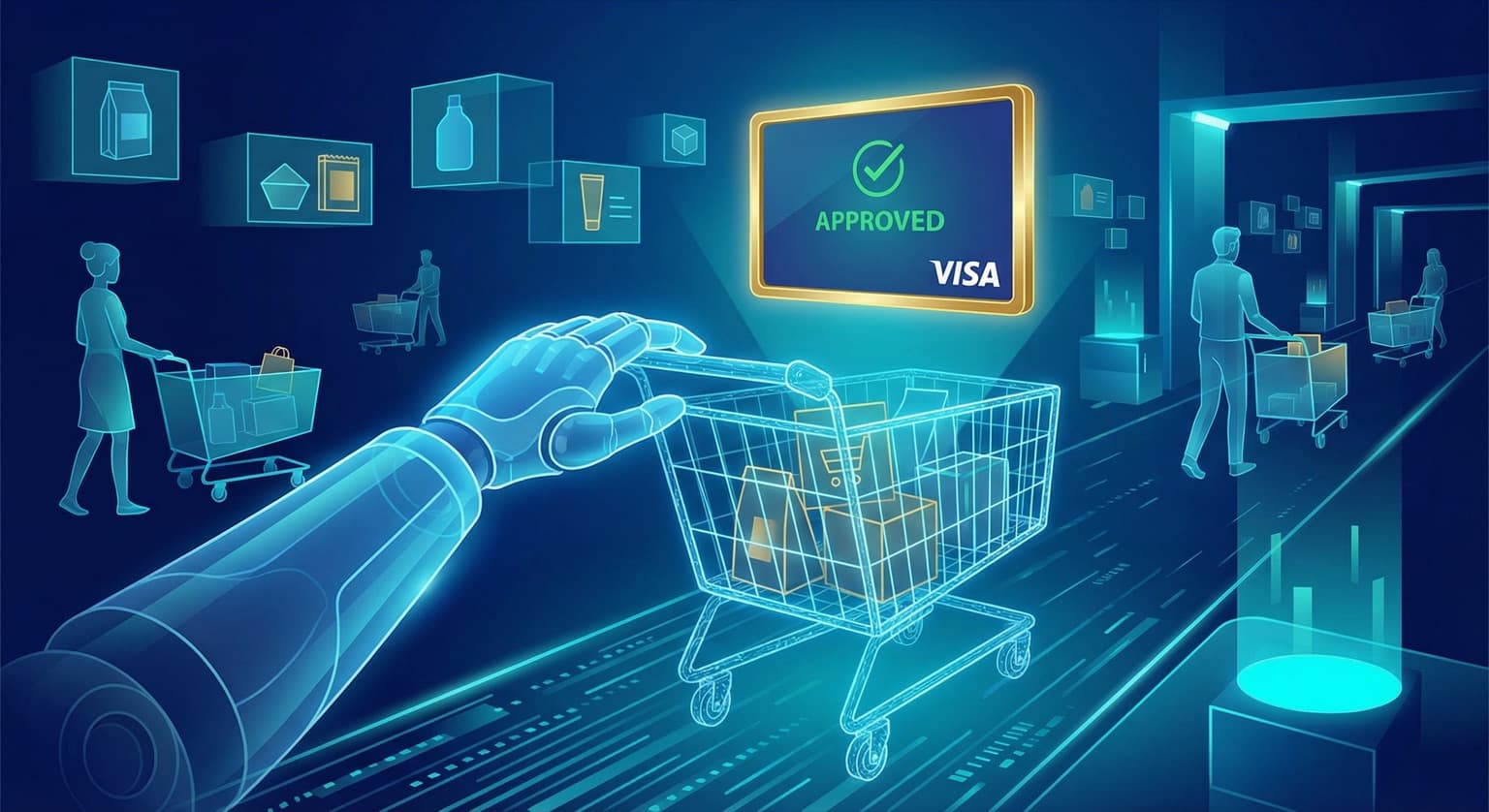

AI agents can already draft your emails, summarize your meetings, and write your code. Now one can buy your groceries.
DBS Bank, Southeast Asia's largest bank, has become the first issuer in Asia-Pacific to pilot Visa Intelligent Commerce -- a framework that lets AI agents search for products, select options, and complete real purchases using bank-issued, bank-controlled payment credentials. The pilot has already processed real transactions, including food and beverage purchases made with DBS and POSB cards.
This is not a chatbot that suggests things for you to buy. This is an AI agent that buys things for you. And the implications for how businesses handle commerce are significant.
How Visa Intelligent Commerce Works
The system is built on a set of Visa APIs and partner tools designed specifically for transactions initiated by software, not humans. Here is the flow:
- You set the rules. Budget limits, preferred brands, spending categories, purchase frequency -- you define what the agent can and cannot do.
- The AI agent acts. It searches for products, compares options, and selects the best match based on your preferences.
- The bank controls the gate. Payment details are tokenized, and every AI-initiated transaction passes through the issuing bank's approval flow. Identity checks, spending limits, and user permissions are all verified before money moves.
- The purchase completes. If everything checks out, the transaction goes through. If not, it gets blocked.
The key design decision is that the bank stays at the center. Visa's framework does not give the AI agent a blank check. It gives the agent a set of constrained credentials that the bank can revoke, limit, or audit at any time. Think of it as giving your AI assistant a prepaid card with very specific rules, not your main credit card.
Early Use Cases: Start Small, Scale Later
The pilot is deliberately starting with low-risk, routine transactions:
- Groceries and household restocking -- reordering items you buy regularly
- Food and beverage purchases -- the pilot has already completed real F&B transactions
- Subscription renewals -- recurring payments that follow predictable patterns
- Travel bookings -- flights and hotels within pre-set budgets
These are all purchases where the decision is relatively simple and the consequences of a mistake are manageable. Nobody is letting an AI agent buy a car. Yet.
DBS and Visa plan to expand into broader online shopping and more complex travel bookings as the pilot matures. The pace of expansion will depend largely on customer comfort -- how quickly people are willing to let software spend their money without a manual confirmation step.
Why This Matters for Businesses
If you run a business that sells products or services online, the DBS pilot is an early look at a fundamental shift in how your customers might start buying from you.
Your Next Customer Might Not Be Human
When an AI agent does the shopping, it does not browse your website the way a person does. It does not look at hero images, read testimonials, or get drawn in by a clever headline. It evaluates structured data -- price, availability, specifications, reviews, delivery time. If your product catalog is not machine-readable, you are invisible to agent-driven commerce.
This connects directly to the broader trend of businesses optimizing for AI consumption. We covered this shift when Samsung embedded Perplexity search into Bixby -- the move from human-first to agent-first interfaces is accelerating across every industry.
Payment Infrastructure Is Becoming AI Infrastructure
Visa is not just building a payment tool. It is building the plumbing for an entire new category of commerce. The Intelligent Commerce framework includes:
- AI-ready credentials -- payment tokens designed to be used by software agents
- Intent-driven controls -- approval logic that understands what the agent is trying to do, not just the dollar amount
- Advanced authentication -- verification systems built for non-human transaction initiators
For businesses that process payments, this means your payment stack will eventually need to handle transactions where the buyer is not a person clicking a button. It is a human who authorized an agent to act on their behalf.
Trust Is the Bottleneck, Not Technology
The technology to let AI agents make purchases clearly exists -- DBS just proved it works with real transactions. The limiting factor is trust. As Gartner's research on AI customer service has shown, there is often a gap between what AI can technically do and what customers are comfortable letting it do.
This is why the bank-as-gatekeeper model matters. By keeping the issuing bank in the approval loop, Visa's framework gives customers a familiar institution to trust. You might not trust a random AI agent with your money, but you probably trust your bank to stop it from doing something stupid.
The Security Question
Giving AI agents the ability to spend money introduces obvious security risks. What happens if an agent is manipulated through a prompt injection attack? What if someone poisons the agent's memory to prefer a specific vendor, and that vendor happens to be the most expensive option?
Visa's tokenization and issuer-controlled approval flows are designed to mitigate this, but the attack surface is real. Every new capability you give an AI agent is a new vector for exploitation. The NIST AI Agent Standards Initiative is working on exactly these kinds of interoperability and security standards, but the standards are not finished yet -- and the pilots are already running.
For businesses, this means security reviews need to expand beyond traditional payment fraud. If you accept agent-initiated payments in the future, you will need to think about whether the agent itself can be trusted, not just whether the payment credentials are valid.
What to Do Now
Agent-driven commerce is not mainstream yet, but the infrastructure is being built in real time. Here is how to prepare:
- Make your product data machine-readable. Structured product feeds, clean APIs, and accurate metadata are table stakes for a world where AI agents do the shopping.
- Watch the payment platform roadmaps. If you use Stripe, Square, Shopify Payments, or any major processor, pay attention to when they add support for agent-initiated transactions.
- Think about your approval workflows. If a customer's AI agent places an order, how does your fulfillment process handle that? Do you need human confirmation? Can your system distinguish between a human purchase and an agent purchase?
- Start the trust conversation internally. Your team needs to decide where AI agent interactions fit in your customer journey -- and where human interaction is still required.
The era of AI agents that can spend money is not coming. DBS and Visa just proved it is here. The only question is how fast it scales.
Need help preparing your business for agent-driven commerce? Contact BaristaLabs -- we help small and mid-size businesses build AI-ready infrastructure before the wave hits.
AI Pilot Readiness Checklist
Turn the idea into a pilot you can defend.
AI agent articles are easy to bookmark and hard to operationalize. Use the readiness questions as a shared way to decide whether a workflow is specific enough, safe enough, and measurable enough to pilot. If they surface a strong candidate, BaristaLabs can review it with you and help shape a first version that fits your systems, approval process, and risk tolerance.
Please do not submit PHI, customer records, credentials, or confidential workflow exports.
Practical AI Workflow Notes
Want more practical AI operations ideas?
Get short notes on applying AI inside real small-business workflows — from document handling and customer follow-up to internal reporting, compliance, and automation guardrails.