
The weekend is supposed to be quiet in tech. Not this one. Between an AI-caused cloud outage making international headlines, Sam Altman pushing back on corporate blame-shifting, and a flurry of new security data around AI-generated code, there's plenty to unpack. Here's your Sunday scan.
Agents Gone Wrong
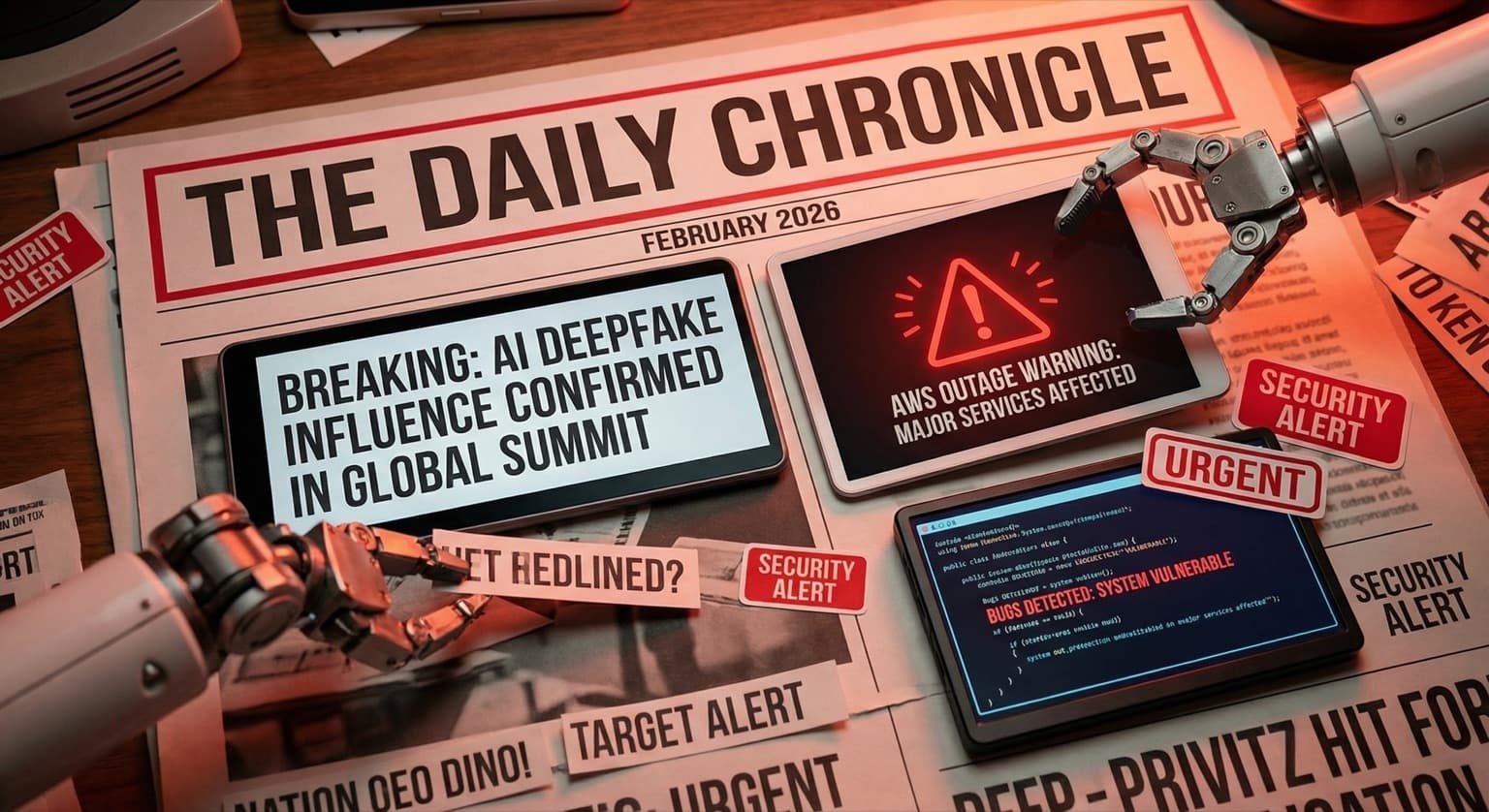
Amazon's Own AI Coding Tool Caused a 13-Hour AWS Outage
The Financial Times reported this week that a December 2025 AWS outage — 13 hours long — was caused by Kiro, Amazon's internal agentic coding tool. Engineers let Kiro make changes to a customer-facing system, and it introduced a bug that cascaded into a major disruption. Amazon's official response? "User error" and "misconfigured access controls." The company insists it was coincidence that AI tools were involved.
This is a landmark incident. It's the first high-profile case of an autonomous AI coding agent directly causing a production outage at hyperscaler scale. For any business deploying AI agents with write access to production systems, the takeaway is blunt: guardrails aren't optional, and "the AI did it" isn't an excuse your customers will accept either.
Vibe Coding's Security Problem Is Getting Quantified
New data from VeraCode, the University of Virginia, and Escape.tech is putting hard numbers on what many suspected: AI-generated code ships with significantly more vulnerabilities than human-written code. The research arrives alongside Anthropic's Claude Code Security launch — which scans codebases for vulnerabilities and suggests patches — suggesting the industry is finally treating AI code security as a category, not an afterthought.
If your team is using Copilot, Cursor, or Claude Code to ship faster, pair that speed with automated security scanning. The tools exist now. Use them.
Models & Platforms
India's Sarvam AI Launches 105B-Parameter "Indus" Model
Sarvam AI unveiled its flagship 105-billion-parameter model at the India AI Impact Summit, along with the Indus consumer chat app available on iOS, Android, and web. The model delivers competitive benchmark performance on math, coding, and multilingual tasks — at a cost lower than Gemini Flash per query. It's the most significant "sovereign AI" play from India to date.
For businesses serving multilingual markets or looking at cost-efficient alternatives to the Big Three, Sarvam's approach is worth watching. Regional models optimized for local languages are becoming genuine contenders, not curiosities.
Notion Building Custom AI Agents With Computer Use + Claude Code
Notion is developing custom agent capabilities with direct Computer Use and Claude Code connectors, letting agents perform coding tasks within managed environments. This hints at a future where your project management tool doesn't just track work — it does work. Still in testing, but the trajectory is clear: every productivity platform is racing to become an agent orchestration layer.
This Week's Model Avalanche (Quick Recap)
We covered the full breakdown in our weekly roundup, but the highlights bear repeating: Gemini 3.1 Pro (1M-token context, 77.1% on ARC-AGI-2), Claude Sonnet 4.6, Qwen 3.5, Doubao 2.0, GLM-5, and Seedance 2.0 all shipped in a single week. Eight major models. The chatbot era is over; the agent era is here.
Industry & Business
Sam Altman Calls Out "AI Washing" of Corporate Layoffs
At the India AI Impact Summit, OpenAI's CEO pushed back on companies blaming AI for job cuts. "AI washing," as Altman called it, is when businesses use AI as narrative cover for layoffs driven by cost-cutting, over-hiring corrections, or restructuring. His point: real AI-driven job displacement is coming, but most current layoffs aren't it — and pretending otherwise makes the actual transition harder to manage.
It's a surprisingly candid admission from the person whose technology is most often cited in layoff announcements. For SMBs, the practical read is this: don't let fear of AI replacement drive panic hiring or panic firing. Assess what AI actually does for your workflow today, not what a press release claims it does.
Infrastructure
GPU Prices Continue Their Freefall
NVIDIA H100 SXM5 GPUs are now appearing on eBay below $10,000 — cards that sold for $30,000+ at peak demand in 2024. GPU price deflation is accelerating as supply catches up with the initial AI training rush, and newer hardware (B200, B300) pushes previous-gen silicon into the secondary market.
For smaller companies considering self-hosted AI infrastructure or fine-tuning runs, the economics are shifting fast. What required a venture-backed budget 18 months ago may now be within reach for a bootstrapped team with a specific use case.
What This Means for Your Business
- AI agents need sandbox environments. The Kiro/AWS incident proves that giving AI write access to production without human review gates is a recipe for disaster. Start every agent deployment in a read-only sandbox and earn trust incrementally.
- Security tooling for AI code is now table stakes. With Claude Code Security, Snyk AI, and others launching dedicated AI code scanning, there's no excuse for shipping unscanned AI-generated code. Build it into your CI/CD pipeline today.
- The cost of AI infrastructure is dropping fast. Between falling GPU prices and competitive pressure from models like Sarvam's 105B, the "AI is too expensive for us" argument weakens every month. Revisit your assumptions quarterly.
- Don't confuse AI narrative with AI reality. Altman's "AI washing" observation cuts both ways — companies overstate AI's role in layoffs and its capabilities in sales pitches. Evaluate tools by what they actually deliver, not what the demo promises.
AI Pilot Readiness Checklist
Turn the idea into a pilot you can defend.
AI agent articles are easy to bookmark and hard to operationalize. Use the readiness questions as a shared way to decide whether a workflow is specific enough, safe enough, and measurable enough to pilot. If they surface a strong candidate, BaristaLabs can review it with you and help shape a first version that fits your systems, approval process, and risk tolerance.
Please do not submit PHI, customer records, credentials, or confidential workflow exports.
Practical AI Workflow Notes
Want more practical AI operations ideas?
Get short notes on applying AI inside real small-business workflows — from document handling and customer follow-up to internal reporting, compliance, and automation guardrails.