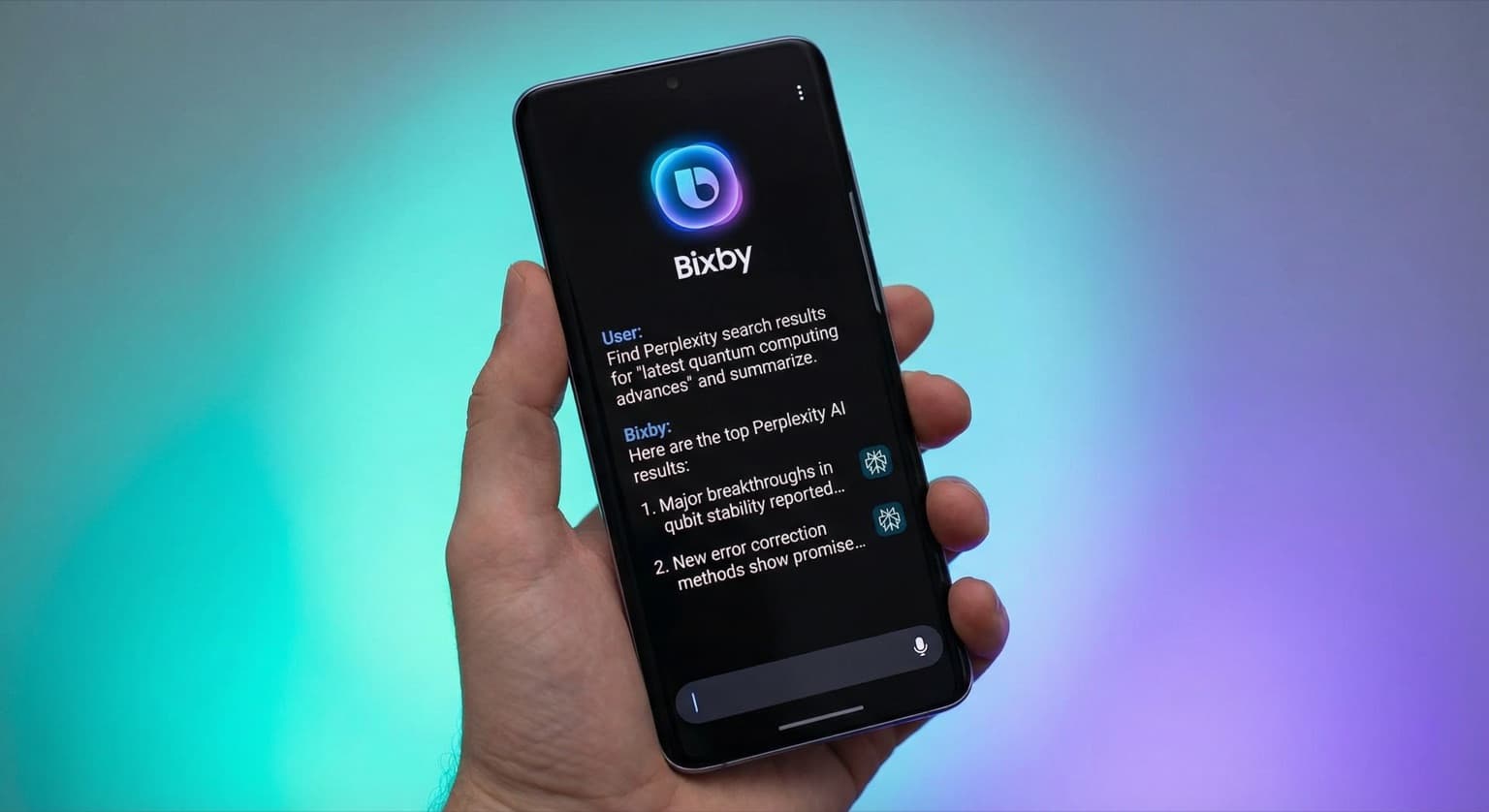

Bixby has been a punchline for years. Samsung's voice assistant launched in 2017, spent most of its life as a glorified settings menu, and became the button everybody wanted to remap. That era is over.
On February 20, Samsung officially relaunched Bixby as a conversational AI device agent inside the One UI 8.5 beta. The update fundamentally changes what Bixby does: it understands natural language intent, controls your phone without requiring exact menu names, and pulls real-time web results through a Perplexity integration -- all without leaving the Bixby interface.
The beta is live now for Galaxy S25 users in the US, UK, Germany, India, Korea, and Poland. The stable version is expected to ship next week with the Galaxy S26.
What Actually Changed
The old Bixby required you to know exactly what to ask for. "Turn on Keep Screen on While Viewing" would work. "Stop my screen from going dark when I'm reading" would not. That gap between human language and device commands made the assistant nearly useless for most people.
The new Bixby closes that gap. Samsung redesigned it to parse intent, not commands. Tell it "I don't want the screen to time out while I'm still looking at it," and it identifies the correct setting and toggles it. Ask "Why does my phone screen stay on in my pocket?" and it diagnoses the issue, suggests enabling Accidental Touch Protection, and lets you apply the fix in one step.
Won-Joon Choi, Samsung's MX Business COO, described the philosophy directly: "We redesigned Bixby to enable more natural interactions and intuitive device control, reducing friction in everyday tasks."
This is not a chatbot bolted onto a phone. It is a device agent that understands your phone's current state and acts on it.
The Perplexity Integration Matters
The second major change is real-time web search powered by Perplexity. Previous versions of Bixby would punt web queries to a browser. Now, search results appear directly inside the Bixby interface with a conversational UI that includes a side menu for tracking previous threads.
Ask "Find me hotels in Seoul with swimming pools for kids" and you get curated results inside Bixby -- no browser redirect, no context switch. The experience borrows the conversational thread format from ChatGPT and Gemini but stays focused on actionable answers rather than open-ended chat.
For business users, this means your phone's assistant can now function as a quick research tool during calls, meetings, or field work without pulling you out of whatever you are doing. It is the difference between an assistant that answers questions and one that makes you open four apps to find the answer yourself.
Why This Signals a Bigger Shift
Samsung's Bixby reboot is not happening in isolation. It sits alongside Apple's Gemini-powered Siri upgrade, Google's own on-device Gemini integration, and the broader push toward agentic AI that we have been tracking through NIST's AI Agent Standards Initiative.
The pattern is clear: every major platform is racing to turn phone assistants from voice-activated search bars into genuine AI agents that understand context, take actions, and learn from your behavior. Samsung chose to partner with Perplexity for search rather than building its own LLM-powered answer engine. That is a pragmatic move -- Perplexity has proven it can deliver accurate, citation-backed answers at speed, and Samsung gets to focus on device integration instead of competing in the foundation model arms race.
This also explains Samsung's earlier move to rebrand the Galaxy S26 as an "AI phone". The hardware is the vehicle, but Bixby-as-agent is the product. The phone is just the thing the agent runs on.
What This Means for Small Businesses
If your team uses Samsung devices, the new Bixby creates immediate practical value:
Faster device management across a fleet. If you manage phones for employees, natural language device control means less time training people on settings and fewer IT support tickets. "Make my phone stop vibrating during meetings" is something anyone can say. Finding the Do Not Disturb schedule settings is not.
Research without context switching. Sales reps checking competitor pricing, field workers looking up specifications, managers verifying availability -- all of these become single-step voice queries instead of multi-app workflows. The Perplexity backend means the answers are sourced and relatively current.
Accessibility improvements. Natural language intent parsing is inherently more accessible than navigating nested settings menus. For employees who are less tech-savvy or who have accessibility needs, being able to describe what they want in plain language is a meaningful upgrade.
The assistant ecosystem is fragmenting. Samsung phones now have both Google Gemini and the revamped Bixby competing for assistant duties. Small businesses should decide which assistant handles what -- Bixby for device control and quick search, Gemini for deeper AI tasks -- rather than letting employees default to whatever pops up first.
The Catch
Bixby is still in beta. The supported languages are limited to English (US, UK, India), French, German, Italian, Japanese, Korean, Mandarin, Spanish, and Portuguese. Accent and dialect support varies. And Samsung's track record with Bixby means healthy skepticism is warranted until the stable release proves reliable at scale.
The Perplexity search integration also raises a question about data handling. Samsung states that location data used for responses is deleted immediately after the response is generated. But businesses with strict data policies should evaluate the privacy implications before rolling it out across company devices.
The Bottom Line
Samsung just turned its weakest software product into potentially its strongest AI differentiator. Whether it delivers depends entirely on execution -- but the architecture is right: natural language understanding for device control, Perplexity for real-time search, and a clear separation from the foundation model competition.
For businesses already invested in the Samsung Galaxy ecosystem, this is worth testing the moment the stable One UI 8.5 release lands. For everyone else, it is another signal that the AI agent era on mobile is here -- and your business workflows should be ready for it.
Want to integrate AI-powered mobile workflows into your business operations? Get in touch. We help small businesses build AI strategies that work across every device their team already uses.
AI Pilot Readiness Checklist
Turn the idea into a pilot you can defend.
AI agent articles are easy to bookmark and hard to operationalize. Use the readiness questions as a shared way to decide whether a workflow is specific enough, safe enough, and measurable enough to pilot. If they surface a strong candidate, BaristaLabs can review it with you and help shape a first version that fits your systems, approval process, and risk tolerance.
Please do not submit PHI, customer records, credentials, or confidential workflow exports.
Practical AI Workflow Notes
Want more practical AI operations ideas?
Get short notes on applying AI inside real small-business workflows — from document handling and customer follow-up to internal reporting, compliance, and automation guardrails.