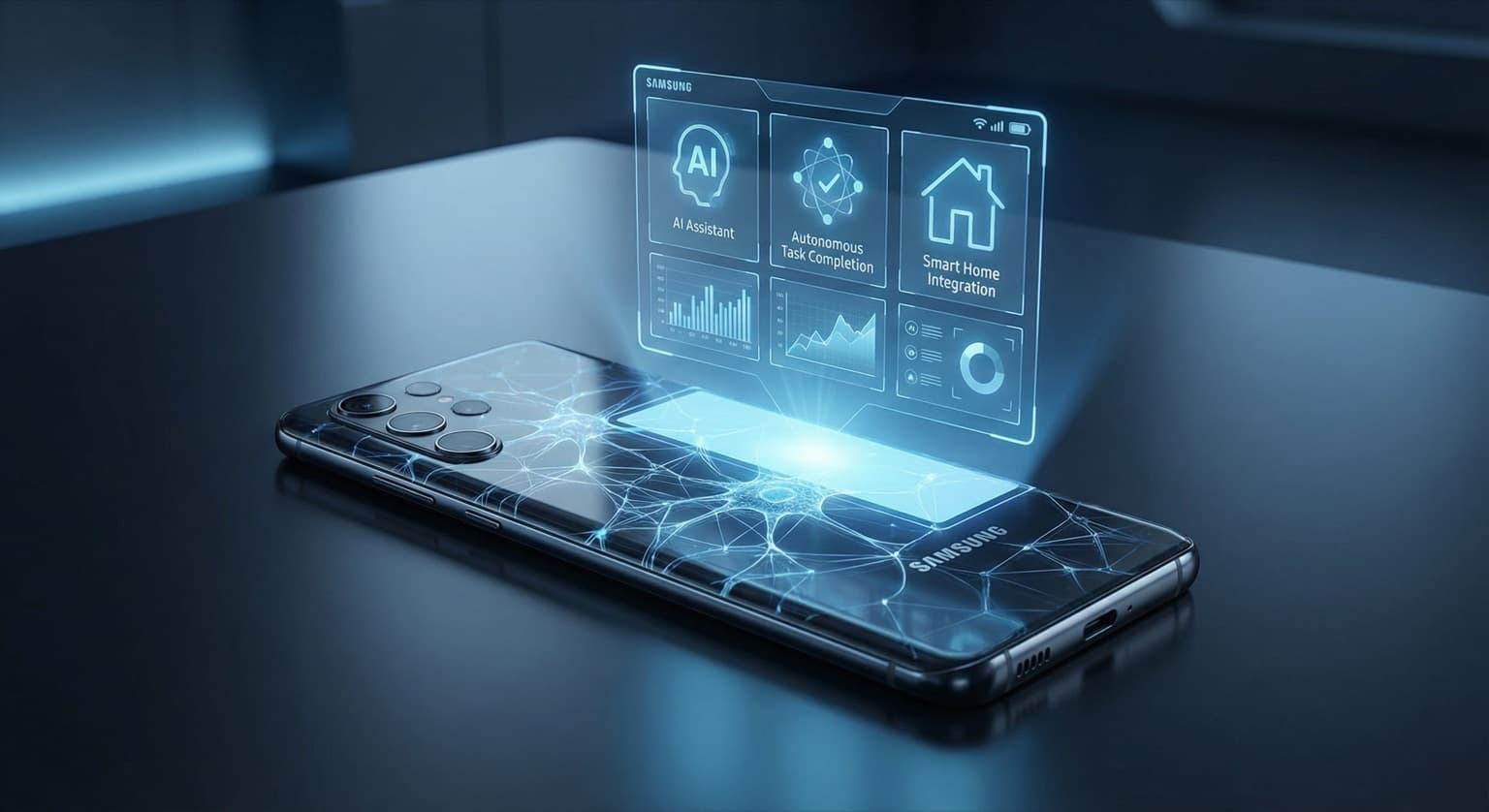

Samsung just did something unusual. In its teaser videos for the upcoming Galaxy Unpacked event on February 25, a short animation circles the word "smart" in "smartphone" and replaces it with "AI." The Galaxy S26 will not be marketed as a smartphone. It will be marketed as an AI phone.
That is not just branding. Buried in Samsung's Q4 2025 earnings report was a line about delivering an "agentic AI experience" through the Galaxy S26. This signals a fundamental shift in how phones work -- and if you run a business that depends on mobile tools, you should be paying attention.
What Samsung Actually Means by "AI Phone"
The Galaxy S26, set to launch February 25 in San Francisco, ships with One UI 8.5 and a stack of AI features that go well beyond the voice assistants and smart suggestions we have seen before. Samsung is making three big bets:
Agentic AI. This is the headline feature. Rather than responding to individual commands, Samsung's AI will be able to chain together multi-step tasks autonomously. Think of it as the difference between asking an assistant to "look up flights" versus saying "book me two rooms at a beachside hotel for these dates" and having the AI navigate booking sites, compare options, and complete the reservation. Google's Gemini agentic capabilities are expected to power much of this under the hood.
AI-powered creativity tools. The S26 introduces natural object movement, instant background reshaping, and scene transformations -- all running on-device. These are not cloud-dependent filters. They are computational tools that let you produce professional-grade visual content without leaving the phone's native camera app.
Enhanced Nightgraphy. Samsung's low-light photography system now uses AI-driven computational photography for sharper detail, smarter noise reduction, and automatic scene optimization. The improvements are software-driven, meaning the real gains come from the model, not the sensor.
Why This Matters More Than Spec Sheets
Every year, flagship phones get incrementally better cameras, slightly larger batteries, and marginally faster chips. The Galaxy S26 follows this pattern too -- a 50MP ultrawide upgrade, a 4,300mAh battery, and up to 512GB of storage. None of that is remarkable.
What is remarkable is Samsung's explicit pivot from hardware-first marketing to software-first positioning. The company is betting that the next wave of phone differentiation will come from what AI can do with the hardware, not from the hardware itself. That mirrors a broader industry trend: the DRAM shortage driving up hardware costs is actually accelerating the push toward software-driven value.
For businesses, this means the phone in your pocket is becoming a more capable work tool, not because it has a better processor, but because it has a smarter one.
The Agentic AI Angle -- What It Means for Business Workflows
If Samsung delivers on its agentic AI promises, the Galaxy S26 could change how mobile workers operate in a few key areas:
Customer service. Imagine your field reps using their phone's AI to pull up a customer's history, draft a follow-up email, and schedule the next meeting -- all from a single voice command, without opening three different apps. That is the agentic AI promise.
Content creation. Small businesses that rely on social media and visual marketing can now produce polished images and edited video directly on the device. The AI editing tools reduce the gap between a professional studio and a phone in your hand.
Operations. Multi-step workflows like expense reporting, inventory checks, or appointment scheduling could be condensed into single AI-directed tasks. Instead of switching between apps, you describe the outcome and let the AI handle the routing.
This is the same agentic AI shift we have been tracking across the enterprise space, but now it is landing in consumer hardware. Samsung is not the only company making this bet -- China's AI labs are racing to build agent capabilities too -- but the Galaxy S26 will put agentic AI directly into millions of pockets.
The Edge AI Advantage
There is a technical reason this matters beyond convenience: on-device AI processing. The Galaxy S26's AI features run locally on the phone's neural processing unit (NPU), which means they work without a cloud connection, respond faster, and keep your data on the device.
For businesses handling sensitive information -- financial data, customer records, proprietary designs -- this is significant. On-device AI means you get the benefits of intelligent automation without routing your data through someone else's servers.
This aligns with a larger industry movement. NVIDIA's Blackwell Ultra architecture is pushing AI compute to the edge for enterprise deployments, and Samsung's HBM4 chips are powering the next generation of AI hardware. The Galaxy S26 is the consumer-facing version of the same trend.
What to Watch For
Samsung Unpacked is February 25. Here is what business leaders should be evaluating:
- Agentic AI reliability. Can the phone actually complete multi-step tasks without human intervention, or does it stall at the first unexpected screen? Early agentic AI tools like OpenAI's Operator struggled with this.
- Enterprise integration. Does Samsung's Knox security platform support the new AI features? Can IT departments manage and audit AI-driven actions on company devices?
- App ecosystem support. Agentic AI is only as useful as the apps it can control. Watch for developer announcements about third-party app integration with Samsung's agent framework.
- The Galaxy S26 Edge. Samsung may replace the Plus model with a 5.5mm-thick Edge variant. If it ships with the same AI capabilities in a slimmer form factor, it could become the preferred business phone for mobile-first teams.
The Bottom Line
Samsung is making a calculated bet that the smartphone era, as we have known it, is ending. The Galaxy S26 is not just another annual upgrade -- it is a statement that AI is now the primary value proposition of a phone, not the screen, camera, or battery.
For businesses, the takeaway is practical: the tools your team carries in their pockets are about to get meaningfully smarter. Whether Samsung nails the execution remains to be seen, but the direction is clear. The age of the AI phone has officially arrived.
The Samsung Galaxy S26 series launches at Galaxy Unpacked on February 25, 2026. Barista Labs helps small businesses evaluate and integrate AI tools into their workflows. Contact us to discuss how emerging AI capabilities can fit your business.
AI Pilot Readiness Checklist
Turn the idea into a pilot you can defend.
AI agent articles are easy to bookmark and hard to operationalize. Use the readiness questions as a shared way to decide whether a workflow is specific enough, safe enough, and measurable enough to pilot. If they surface a strong candidate, BaristaLabs can review it with you and help shape a first version that fits your systems, approval process, and risk tolerance.
Please do not submit PHI, customer records, credentials, or confidential workflow exports.
Practical AI Workflow Notes
Want more practical AI operations ideas?
Get short notes on applying AI inside real small-business workflows — from document handling and customer follow-up to internal reporting, compliance, and automation guardrails.