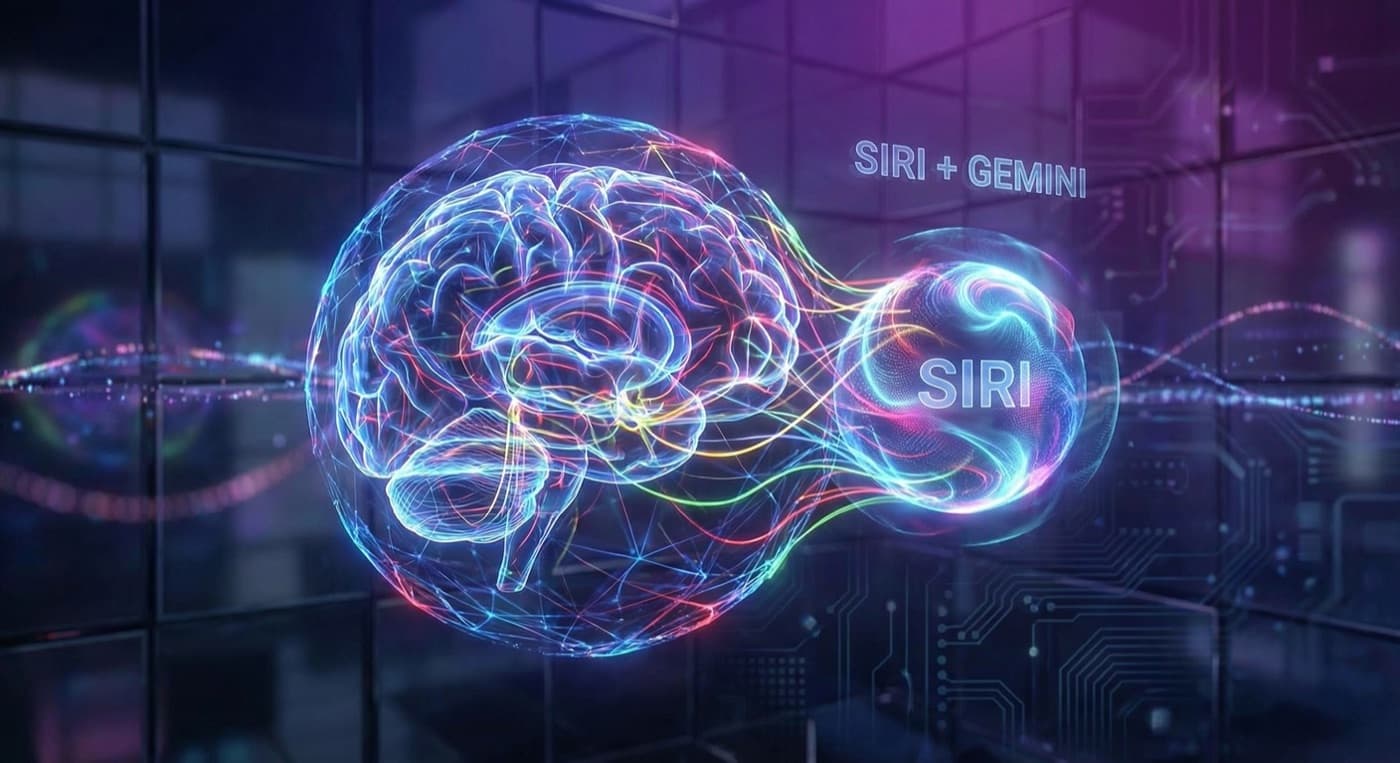

For years, the running joke in tech has been Siri. While ChatGPT was passing the Bar Exam and Claude was writing code, Siri was still struggling to set a timer for pasta.
But during this week's earnings call—where Apple shattered expectations with $143 billion in revenue—CEO Tim Cook quietly signaled the end of the joke.
Reports confirm that Apple has inked a "substantial" licensing deal with Alphabet (Google) to use its Gemini models as the backbone for Siri's upcoming reboot. This isn't just an update; it is a brain transplant. And for the millions of small businesses that run on iPhones, it changes everything.
The Deal: Competitors by Day, Partners by Necessity
The partnership, which analysts describe as a "surprise" move in Apple's record-breaking quarter, marries Apple's massive hardware install base with Google's superior AI infrastructure.
According to CNBC, the Gemini-powered Siri is expected to arrive as soon as late February with the beta release of iOS 26.4.
This move signals a pragmatic shift from Apple. Known for its "not invented here" culture, Cupertino recognized that building a frontier-class LLM from scratch would take years it didn't have. Instead, it is outsourcing the "reasoning engine" to its biggest rival while keeping the "interface" (Siri) for itself.
Why This Matters for Your Business
If you use an iPhone for work, you know the frustration of having a "smart" phone with a "dumb" assistant. You have to open the ChatGPT app to draft an email, then copy-paste it into Mail. You have to open the Perplexity app to find a supplier, then switch to Notes.
The Gemini integration promises to fix this fragmentation.
1. The "App Launcher" Becomes an Agent
With Gemini's reasoning capabilities, Siri will reportedly be able to take complex actions across apps. Instead of just opening a spreadsheet, you could say, "Ask these three suppliers for quotes based on this inventory sheet," and Siri—powered by Gemini's agentic capabilities—would handle the drafting and sending.
2. Apple's "Private Cloud" vs. Google's "Public Brain"
The biggest question for business owners is privacy. Apple has built its brand on "what happens on your iPhone, stays on your iPhone." Google... hasn't.
Tim Cook emphasized that Apple is building its own Private Cloud Compute infrastructure. The likely implementation will be a hybrid model:
- On-Device: Simple tasks (alarms, app opening) are handled by a small, local Apple model.
- Private Cloud: Sensitive but complex requests go to Apple's secure servers.
- Public Cloud (Gemini): "World knowledge" queries go to Google, likely with anonymization layers.
We recommend businesses watch the iOS 26.4 release notes closely for data-sharing opt-outs.
3. The End of the "AI App" Era?
For the past two years, we have trained ourselves to "open the AI app." This integration pushes AI back into the background. It becomes a utility, like Wi-Fi or GPS.
For your employees, this lowers the barrier to entry. They don't need to be "prompt engineers" to get value from AI; they just need to ask their phone a question.
The Timeline: Spring 2026
While initial reports hoped for a holiday 2025 release, the "brain transplant" is now slated for Spring 2026. This aligns with the "late February" beta testing mentioned in recent reports.
This delay is actually good news. It suggests Apple is taking the time to get the integration right—specifically the "hand-off" between its private, on-device models and Google's powerful cloud models.
The Bottom Line
Apple's $143 billion quarter proves that people still love the hardware. But the Google deal proves that hardware is no longer enough.
By swallowing its pride and partnering with Google, Apple is ensuring that the iPhone remains the premier business tool for the AI era. The "dumb assistant" days are numbered.
Is your business ready to talk to a Siri that actually talks back?
Need help securing your mobile workforce for the AI era? BaristaLabs helps small businesses configure, secure, and optimize their Apple fleets for the next generation of AI tools. Contact us to get started.
Turn this idea into a pilot
Which workflow should go first?
Use the readiness check to compare impact, effort, risk, owner, and next step before requesting a review.
- 3-5 minutes
- Deterministic score
- No sensitive data
Practical AI Workflow Notes
Want more practical AI operations ideas?
Get short notes on applying AI inside real small-business workflows — from document handling and customer follow-up to internal reporting, compliance, and automation guardrails.