


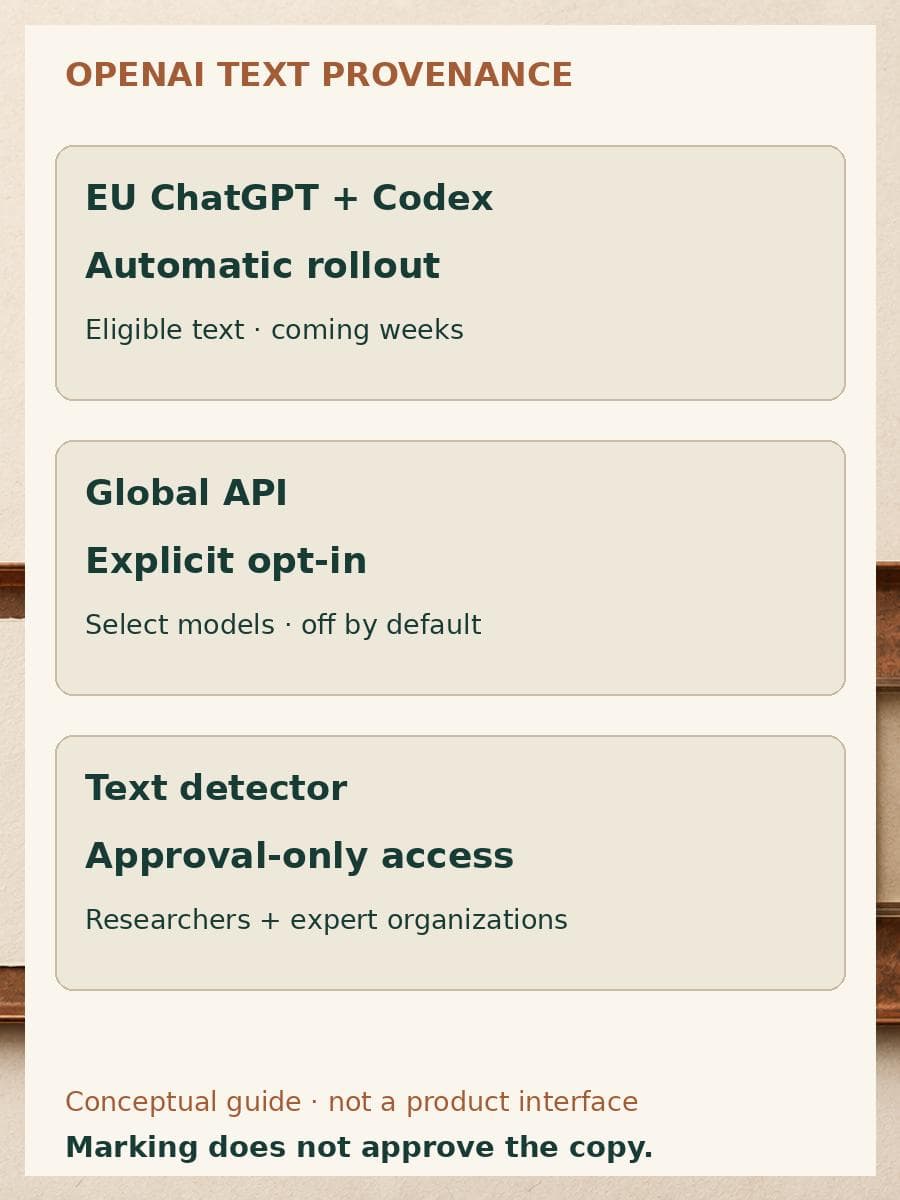
OpenAI’s October 5 text provenance announcement does not give every business the same watermarking setup. Eligible ChatGPT and Codex text in the EU will be marked automatically over the coming weeks. API customers globally can opt in for select models now, with watermarking off by default. Access to the text detector initially requires approval.
Those three states matter more to a content team than the broad claim that AI text can carry a watermark. The same business may use ChatGPT for drafting, an API integration for customer replies, and an agency for website copy. A provider name alone will not tell the approver whether any particular output was marked—or whether the team can test it.
EU product rollout is not a global API default
OpenAI says eligible ChatGPT and Codex text in the EU will receive invisible watermarking across all plans over the coming weeks. That is a rollout commitment, not evidence that every EU output already carries the signal. It is also not an announcement of automatic marking worldwide.
For a team using those products, record the product and region used for the work, and distinguish an announced rollout from confirmed availability. Do not replace a content review with the assumption that a regional launch has already covered every draft.
The API follows a different rule. Starting October 5, customers globally can opt in for select models. Watermarking remains off by default. An existing integration does not become marked simply because its provider announced EU provenance support.
If you own an API workflow, the immediate decision is whether to enable supported watermarking for that route. First check model eligibility and the current configuration instructions. Record the selected model, the setting, its effective date, and who controls changes. This article does not supply an API parameter: the verified announcement establishes availability and default behavior, not an implementation recipe.
If a supplier runs the integration, ask for the output route and marking configuration rather than asking only whether it uses OpenAI. Keep “unknown” separate from “off.” A supplier’s silence is not proof of either marked or unmarked output.
Detector access is a separate permission
OpenAI’s initial text detector access is for approved researchers and expert organizations. The company provides a content provenance API application, not a general public text-checking promise. Its existing public image and audio verification tools should not be treated as a public text detector.
A small business can therefore have marked output without having access to the tool that checks the mark. Enabling API watermarking and obtaining detector access are different steps, with different availability rules.
That makes “we will scan everything at approval” an unreliable operating plan unless detector access is actually confirmed. Keep the generation record and the human approval process usable without a scan. If access is granted later, detection can add evidence; it should not become the sole source of production history.
OpenAI says it plans to open-source the approach. A plan to release it is not a release, and it does not establish that a business can run a public detector today.
An invisible signal is not a disclosure label
The system, called textGrain, adds a statistical signal through word choices. It does not put a visible label on the prose. A customer reading a marked product description would not receive an ordinary on-page disclosure simply because that signal exists.
Treat the watermark as one technical provenance mechanism. Whether you need a visible disclosure, permission to use a source, a correction, or a named approver remains a separate question. Detection does not identify the user, measure human contribution, establish ownership or responsibility, or demonstrate that a statement is true or lawful.
Our text detection boundary article covers the broader distinction between detecting a statistical signal and proving authorship. The new OpenAI decision is narrower: identify which production routes receive the signal, which require a setting change, and which teams can inspect it.
Keep the route with the copy
For business operations, the useful record belongs beside the draft or asset version—not only inside the model account. Preserve the product or integration, region and model where known, marking state and effective date, supplier, material edits, and the person who approves publication. These are BaristaLabs workflow recommendations, not fields mandated by OpenAI.

The record answers a question that a later detector result cannot reconstruct on its own: what route did this version take before approval? If copy moves between an employee, an agency, and a publishing tool, carry that record forward. Our creative-origin handoff guide explains the same handoff problem for ad assets; here the route and API setting are especially important because defaults differ.
Keep the output version and edits identifiable. A watermark setting recorded today does not establish that an older draft used the same setting. Nor does the presence of a mark certify the final edited version’s factual claims. The approver still checks accuracy, confidentiality, rights, and suitability for the audience.
Do not turn detection rates into an acceptance rule
OpenAI’s reported performance varies with passage length and subject. At a target false-positive rate of 1%, its psychology evaluation reports approximately 80% detection for 200-token passages and 95% for 400-token passages. Mathematics performs substantially worse. These are reported evaluation conditions, not a guaranteed detection rate for your copy.
A separate editing evaluation uses 400-token passages. It reports approximately 92% baseline detection, falling to 66% after replacing 10% of words with synonyms and 17% after replacing 25%. That baseline belongs to the editing experiment; it should not be merged with the passage-length figures.
For a business, the practical implication is to preserve production records rather than trying to infer the whole history from a final scan. A short reply, constrained text, or edited draft may not retain a detectable signal. Missing detection does not prove human authorship. A positive result does not approve the content.
Start with the output route you already use most often. If it is an API integration, establish who controls opt-in and which model is eligible. If it is EU ChatGPT or Codex, distinguish the announced rollout from actual availability. If the approval process depends on scanning text, confirm detector access before promising that control. None of those checks removes the named person responsible for the copy you publish.
One content route
Check how your AI copy reaches approval
BaristaLabs can help trace one content workflow and identify where product settings, supplier records, and human approval need to stay attached.
Bring a sanitized workflow outline, not confidential drafts or customer records.
Turn this idea into a pilot
Which workflow should go first?
Use the readiness check to compare impact, effort, risk, owner, and next step before requesting a review.
- 3-5 minutes
- Deterministic score
- No sensitive data
Practical AI Workflow Notes
Want more practical AI operations ideas?
Get short notes on applying AI inside real small-business workflows — from document handling and customer follow-up to internal reporting, compliance, and automation guardrails.