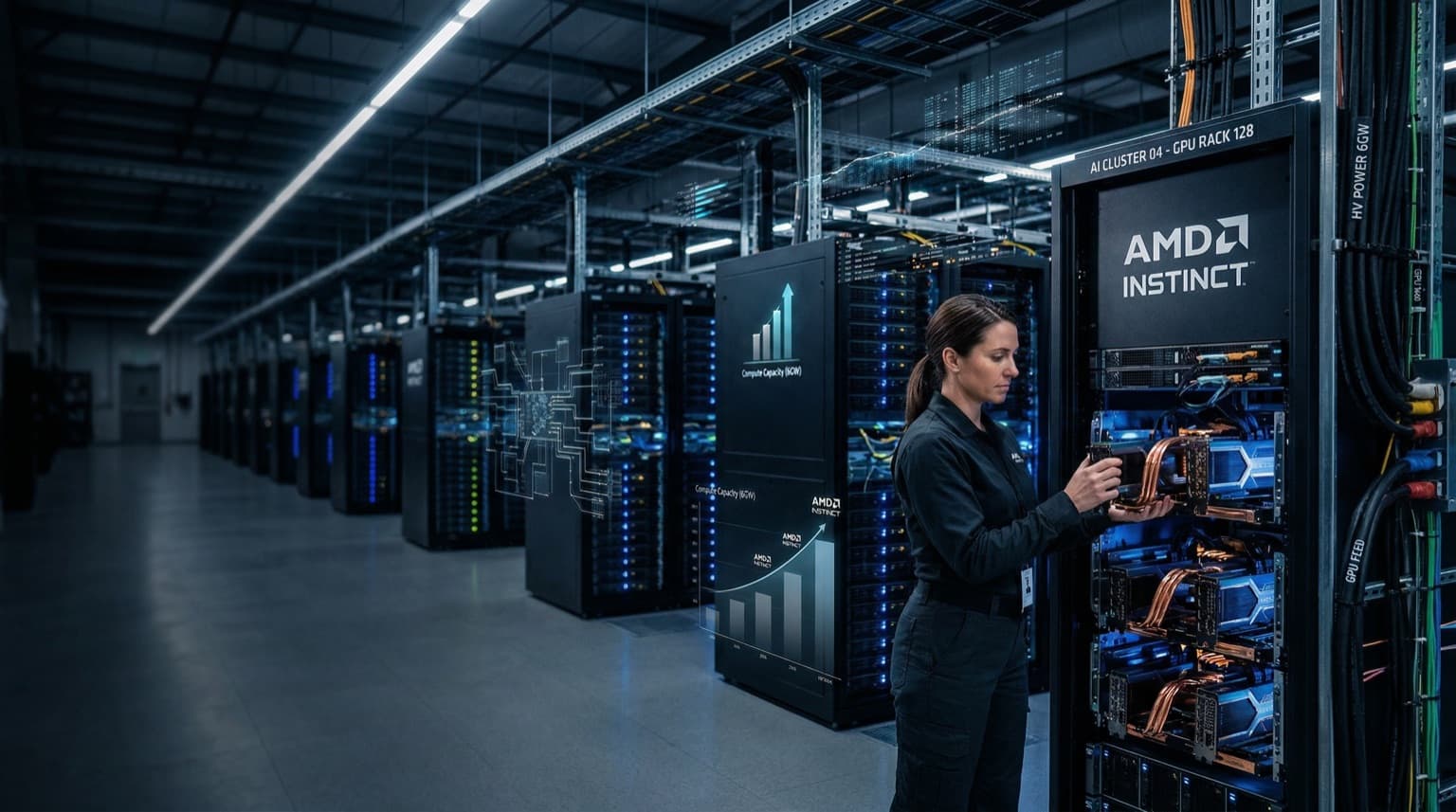

The Deal That Just Reshaped AI Compute
This morning, AMD and Meta announced a definitive multi-year agreement to deploy up to 6 gigawatts of AMD Instinct GPU capacity across Meta's global data center fleet. To put that number in perspective, 6 gigawatts is roughly the energy consumption of six million homes. Industry analysts estimate the deal is worth between $60 billion and $100 billion over the next five years.
Mark Zuckerberg called it "an important step for Meta as we diversify our compute," while AMD CEO Dr. Lisa Su described it as placing "AMD at the center of the global AI buildout." The first gigawatt of shipments begins in the second half of 2026, powered by a custom AMD Instinct GPU based on the MI450 architecture paired with 6th Gen AMD EPYC "Venice" CPUs.
This is not a speculative press release. AMD issued Meta performance-based warrants for up to 160 million shares of AMD common stock, structured to vest as shipment milestones are hit. Both companies have skin in the game.
Why This Matters Beyond the Hyperscalers
If you run a small or mid-sized business, you might look at a deal denominated in gigawatts and wonder how it possibly affects you. The answer comes down to three forces that shape the cost and availability of every AI tool you touch.
GPU Competition Drives Prices Down
For the past three years, Nvidia has held a near-monopoly on high-end AI accelerators. That dominance translated into premium pricing that cascaded through the entire stack, from cloud GPU instance rates to the subscription fees of AI-powered SaaS tools. Meta committing 6 gigawatts to AMD hardware is the clearest signal yet that the era of single-vendor dependence is ending.
When two vendors compete at this scale, cloud providers gain leverage to negotiate better rates. Those savings eventually flow downstream. If you are paying for AI-powered customer support, marketing automation, or code generation tools, real competition at the hardware layer is what keeps those costs from spiraling.
More Compute Capacity Means Faster, Cheaper AI Services
The sheer volume of new compute coming online matters. Meta has already committed $135 billion to AI infrastructure, and this AMD deal layers additional capacity on top of that. Combined with Big Tech's collective $600 billion AI infrastructure buildout, the global supply of AI compute is expanding at a pace that will reduce the marginal cost of running inference and training workloads.
For businesses, that translates to practical outcomes: lower API costs for AI models, faster response times from AI-powered tools, and more providers competing for your dollar. If you have been waiting for the economics of AI to make sense for your use case, the infrastructure wave building right now is what makes that happen.
Supply Chain Diversification Reduces Risk
Relying on a single GPU vendor creates concentration risk that extends well beyond the hyperscalers. When Nvidia chips are constrained, cloud GPU availability tightens, wait times grow, and costs spike. Every business running AI workloads feels that pressure indirectly.
Meta's move to AMD diversifies the global supply chain. More silicon pathways mean more resilient cloud infrastructure, and more resilient infrastructure means more predictable pricing and availability for the AI services your business depends on.
What the MI450 Architecture Signals
The deal centers on a custom AMD Instinct GPU based on the MI450 architecture, purpose-built for Meta's workloads. This is not a generic chip order. AMD and Meta co-developed the Helios rack-scale architecture through the Open Compute Project, designing integrated systems that optimize power delivery and cooling at massive scale.
That level of hardware-software co-design matters because it validates AMD's ROCm software ecosystem at production scale. The biggest historical knock against AMD in AI was that Nvidia's CUDA ecosystem was too entrenched for customers to switch. Meta successfully running its Llama model family on AMD hardware eliminates that objection for other cloud providers and enterprises considering dual-vendor strategies.
AMD shares jumped roughly 10% in pre-market trading on the news, reflecting investor confidence that this is not a one-off arrangement but a structural shift.
The "Personal Superintelligence" Angle
Meta described the deal as supporting its goal of delivering "personal superintelligence to billions around the world." That phrasing signals where the company is heading: persistent, personalized AI agents that operate continuously on behalf of individual users.
Running billions of concurrent AI agents requires staggering amounts of inference compute, far beyond what periodic chatbot queries demand. That is why the deal is measured in gigawatts rather than chip counts. Power capacity has become the primary metric for AI infrastructure scale in 2026.
For small businesses, this trend toward always-on AI agents is worth watching. As these systems become available through platforms like Meta's apps and third-party integrations, they will change how customers discover, evaluate, and interact with businesses. Being prepared for that shift means understanding AI integration now rather than scrambling later.
What Small Businesses Should Do Now
You do not need to deploy your own GPU cluster. But you should be thinking about how the expanding compute landscape affects your operations.
Evaluate your AI tool costs. If you locked in rates during the GPU shortage era, renegotiate. Competition is creating downward pricing pressure across the board.
Diversify your own stack. If your AI workflows depend on a single provider, explore alternatives. The vendor landscape is shifting rapidly, and portability gives you leverage.
Build AI fluency now. The infrastructure race is not slowing down. Companies that understand how to leverage AI tools effectively will capture the benefits of falling compute costs first. Those still evaluating whether AI is relevant will find themselves playing catch-up against competitors who moved sooner.
The Meta-AMD deal is not just a corporate headline. It is a structural change in the economics of AI compute, and those economics determine the cost of every AI-powered tool your business will use for years to come.
If your team has several AI ideas but no defensible first workflow, see what happens in scoped AI discovery. The article explains what the team brings, what the roadmap contains, what remains unknown, and how discovery differs from a pilot.
AI Pilot Readiness Checklist
Turn the idea into a pilot you can defend.
AI agent articles are easy to bookmark and hard to operationalize. Use the readiness questions as a shared way to decide whether a workflow is specific enough, safe enough, and measurable enough to pilot. If they surface a strong candidate, BaristaLabs can review it with you and help shape a first version that fits your systems, approval process, and risk tolerance.
Please do not submit PHI, customer records, credentials, or confidential workflow exports.
Practical AI Workflow Notes
Want more practical AI operations ideas?
Get short notes on applying AI inside real small-business workflows — from document handling and customer follow-up to internal reporting, compliance, and automation guardrails.