
For years, the AI arms race followed a simple formula: build one model, make it bigger, hope it gets smarter. OpenAI scaled GPT. Google scaled Gemini. Anthropic scaled Claude. The assumption was always the same — pour more data and compute into a single system and watch the benchmarks climb.
xAI just broke that pattern.
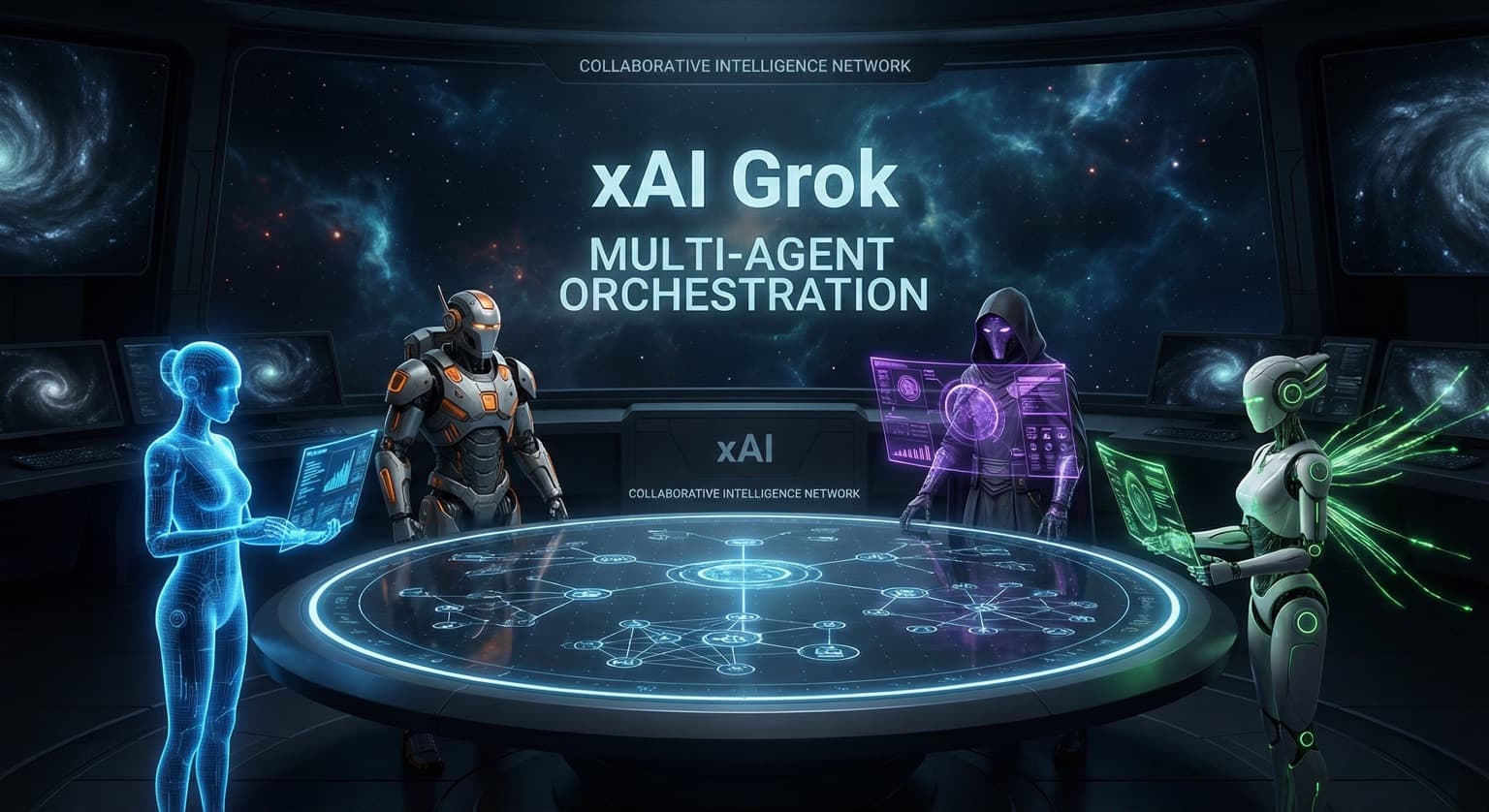
Grok 4.20 Beta, which went live over the weekend, doesn't rely on a single model at all. Instead, it deploys four specialized AI agents working in parallel, each handling a different type of reasoning. It's the first major consumer-facing AI product to ship with a true multi-agent architecture out of the box, and it signals a fundamental shift in how AI companies are thinking about intelligence.
Four Agents, One Answer
Here's how the system works. When you send Grok a complex prompt, it doesn't just run through one neural network. It coordinates a team:
- Grok — the team leader. It orchestrates the other agents, breaks down problems, and synthesizes final responses.
- Harper — the creative thinker. Handles brainstorming, ideation, writing, and lateral connections.
- Benjamin — the researcher. Focuses on fact-checking, source verification, and grounding claims in evidence.
- Lucas — the technician. Takes on code generation, mathematical proofs, and technical problem-solving.
As first reported by @techdevnotes on X, these agents run simultaneously and share context, letting the system tackle problems that would trip up any single model. Elon Musk confirmed the launch, noting that Grok 4.20 is "starting to get open form engineering questions right" — a category where earlier Grok versions struggled.
The beta is available now on grok.com for both free and paid users, with three operating modes: Fast (single-agent, quick answers), Expert (deeper single-agent reasoning), and Heavy (the full multi-agent system firing on all cylinders).
Why This Architecture Matters
The multi-agent approach isn't just a marketing gimmick. It reflects a growing realization in AI research that scaling a single model has diminishing returns. As multiple observers noted, you can keep adding parameters to a monolithic system, but it becomes increasingly difficult to make it simultaneously excellent at creative writing, rigorous fact-checking, and complex code generation.
Specialization solves this. By splitting tasks across purpose-built agents, each one can be optimized for its domain without compromising on the others. It's the same reason companies have departments instead of one employee who does everything — and why agentic engineering is displacing the old approach of throwing a single AI at every problem.
This also maps directly to how AI agent workflow orchestration already works in enterprise settings. The difference is that xAI baked it into the product layer instead of leaving it as an infrastructure problem for developers to solve.
What This Means for Small Businesses
If you run a small or mid-sized business, this shift has three practical implications worth paying attention to.
1. AI tools are getting genuinely better at complex tasks.
The reason most SMBs hit a wall with AI isn't that the technology is bad — it's that single-model systems are inconsistent. They hallucinate on research tasks, produce generic creative work, and write buggy code. A multi-agent architecture attacks all three problems at once. If Grok 4.20's approach works as advertised, the reliability gap that keeps small businesses from trusting AI with real work gets meaningfully smaller.
2. You don't need to build this yourself.
A year ago, getting multiple AI agents to coordinate required custom infrastructure, API orchestration, and a development team that understood prompt engineering at a systems level. Now xAI is shipping it as a free consumer product. That's a massive accessibility leap. Small businesses can experiment with agent-based workflows without writing a line of code or hiring an AI consultant — though knowing when to bring in expertise still matters.
3. The vendor landscape is about to fracture further.
Every major AI lab will now face pressure to ship their own multi-agent offerings. Google is already experimenting with agent-based systems in Gemini. OpenAI has been layering tool-use and multi-step reasoning into GPT. Anthropic is building agentic capabilities into Claude. For small businesses evaluating AI tools, the question is no longer "which model is smartest?" but "which team of agents works best for my use case?" That's a harder comparison to make, and it means choosing the right AI strategy requires more nuance than ever.
The Catch
Multi-agent systems aren't magic. Coordination overhead is real — the Heavy mode is noticeably slower than single-agent Fast mode, according to early testers. There's also the question of consistency: when four agents contribute to one answer, disagreements between them need to be resolved, and the quality of that resolution depends entirely on the orchestration layer.
For small businesses, the practical advice remains the same as it's been throughout the AI boom: start with a clear problem, test the tool against that problem, and measure results before committing. Grok 4.20's multi-agent approach is genuinely novel, but novel doesn't automatically mean better for your specific workflow.
As one commenter put it, the real test isn't whether four agents can work together — it's whether the output justifies the added complexity. For quick lookups and simple tasks, Fast mode will be fine. For the kind of multi-step analysis that small businesses actually struggle with — market research, competitive analysis, technical scoping — the Heavy mode could be a real upgrade.
The Bigger Picture
What xAI shipped this week isn't just a product update. It's an architectural thesis: the next generation of AI won't be one big brain, it'll be a coordinated team of specialists. That thesis has been building for months across the industry, from OpenAI's hiring moves to the rise of agentic AI frameworks, but Grok 4.20 is the first time a major player has put it directly in front of consumers.
For small businesses, the takeaway is straightforward. The tools are getting smarter, but they're getting smarter in a fundamentally different way than before. Understanding that difference — and knowing when a team of agents beats a single model — is going to be one of the key AI literacy skills of 2026.
Try it yourself at grok.com. The beta is free. The worst that happens is you learn something about where AI is headed.
AI Pilot Readiness Checklist
Turn the idea into a pilot you can defend.
AI agent articles are easy to bookmark and hard to operationalize. Use the readiness questions as a shared way to decide whether a workflow is specific enough, safe enough, and measurable enough to pilot. If they surface a strong candidate, BaristaLabs can review it with you and help shape a first version that fits your systems, approval process, and risk tolerance.
Please do not submit PHI, customer records, credentials, or confidential workflow exports.
Practical AI Workflow Notes
Want more practical AI operations ideas?
Get short notes on applying AI inside real small-business workflows — from document handling and customer follow-up to internal reporting, compliance, and automation guardrails.