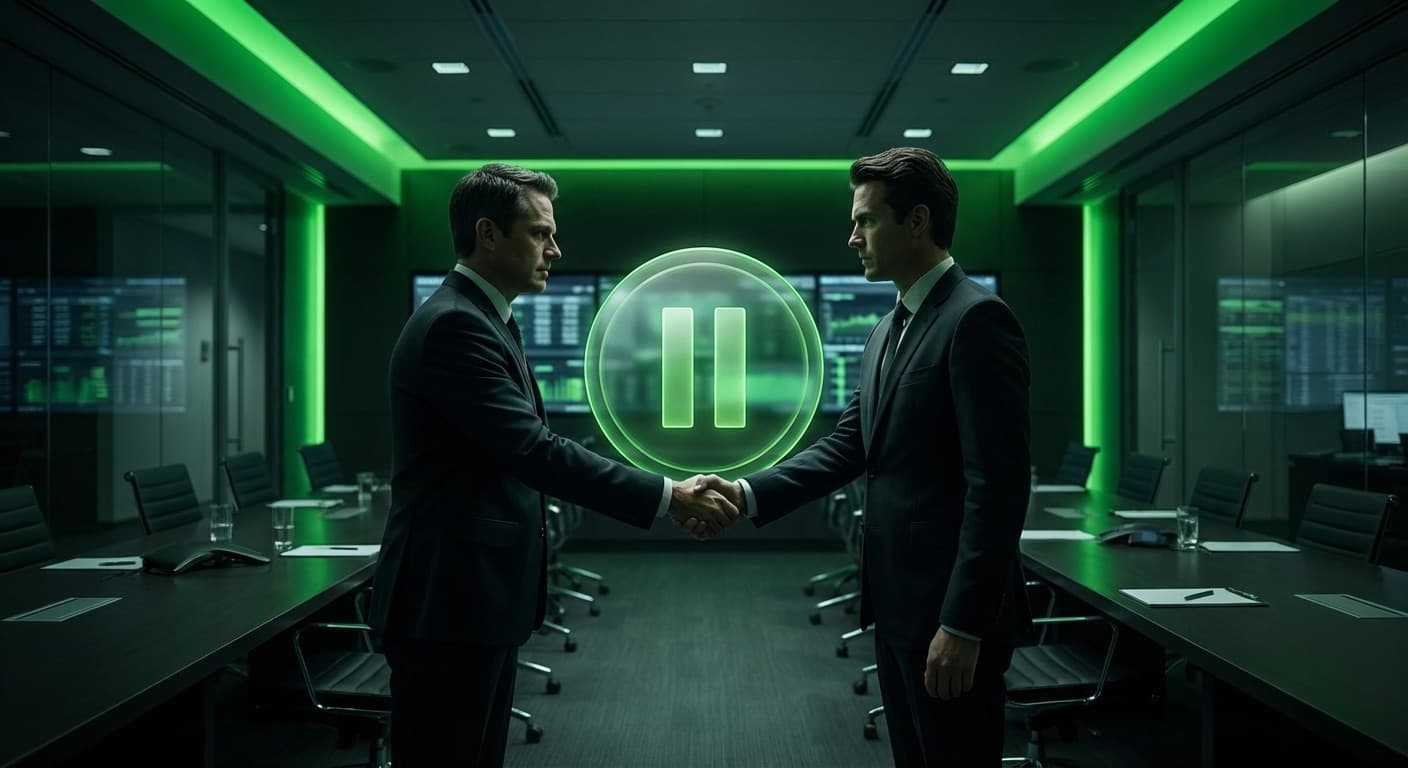

The tectonic plates of the AI industry just shifted again, and this time, the tremor is coming from the top. Just days after reports surfaced about a massive $100 billion investment round for OpenAI, the deal has hit a sudden, screeching halt. Nvidia, the chipmaker that effectively powers the entire modern AI economy, has reportedly pressed pause on its participation.
Jensen Huang, Nvidia's CEO, has expressed significant concerns about OpenAI's financial discipline and the intensifying competition from rivals like Google and Anthropic. While OpenAI is still seeking funding from other sources—including a potential $50 billion from Amazon—the hesitation from its most important hardware partner sends a clear signal: the era of blank checks is over.
For a tech giant, a delayed deal is just another Tuesday of negotiations. But for a small business owner whose operations increasingly rely on these tools, this kind of instability at the top can be unsettling. If the companies building the foundation of our new economy are shaking, is the house we are building on top of them safe?
The Signal in the Noise
First, let's look at why this is happening. Nvidia isn't walking away because AI is failing. They are pausing because the market is maturing.
For the last three years, the AI industry has been in a "growth at all costs" phase. The strategy was simple: buy as many GPUs as possible, build the biggest models you can, and figure out the business model later. Nvidia's hesitation signals that the adults have entered the room. They want to see sustainable business models, not just impressive benchmarks and user growth charts.
This is actually good news for the ecosystem. It means the industry is moving from an experimental bubble to a practical business phase where ROI matters more than hype.
The Google and Anthropic Factor
Part of Nvidia's hesitation stems from a simple reality: OpenAI is no longer the only game in town. Jensen Huang pointed specifically to competition from Google and Anthropic.
For a long time, OpenAI felt like the default option. But in 2026, we are living in a multipolar world. Google's Gemini and Anthropic's Claude have caught up, and in some specific use cases, surpassed GPT-4. Nvidia, which supplies chips to all of them, knows this better than anyone. They see the order volumes. They see the performance metrics.
If the hardware supplier is hedging its bets, that is a strong indicator that we are heading toward a fragmented future where no single AI company dominates everything.
What This Means for Your Business
When the titans clash, the ground shakes. Here is how this specific tremor affects the small business world:
1. The End of Subsidized Intelligence
If OpenAI had secured an easy $100 billion, they might have continued to subsidize the cost of intelligence to capture market share. With investors demanding "financial discipline," we might see the era of artificially cheap API calls come to an end.
The Takeaway: If your business model relies on dirt-cheap AI costs, you need to stress-test your margins. What happens if your AI provider raises prices by 20% to satisfy their investors? Build buffers into your pricing now. Don't assume today's prices are forever.
2. The "One Model" Risk is Real
Nvidia's concern about competition highlights that building your entire business on top of a single provider is risky. If you have built your entire workflow hard-coded to OpenAI's specific quirks, you are exposed.
The Takeaway: Diversify your AI stack. Use tools that allow you to swap models. If ChatGPT goes down or raises prices, can you switch to Claude or Gemini? The "multi-model" approach is the only safe insurance policy for a modern business.
3. Innovation Might Decelerate (But Reliability Will Improve)
Financial discipline usually means fewer moonshots and more focus on efficiency. We might see a slight slowdown in the release of mind-bending new features as companies focus on making existing models more profitable and stable.
The Takeaway: Stop waiting for the "next big thing" to solve your problems. The tools available today are powerful enough to transform your business. Focus on mastering the current generation rather than betting your strategy on features that haven't shipped yet.
Should You Be Worried?
In a word: No.
This is standard industry consolidation. We saw it with the dot-com boom, we saw it with mobile, and we are seeing it with AI. The underlying technology isn't going anywhere. Nvidia still needs to sell chips, and OpenAI still needs to build models.
The "pause" is a negotiation tactic, not an existential crisis. Nvidia wants better terms, or perhaps they want to see OpenAI clean up its balance sheet before they commit billions. This is business as usual at the enterprise level.
However, it is a reminder that these companies are businesses, not public utilities. They will make decisions based on their balance sheets, not your convenience.
Practical Steps for Small Business Owners
So, what should you do on Monday morning?
Audit Your Dependency How much of your daily operation stops if OpenAI has a bad week? If the answer is "everything," it is time to build redundancies. Document your prompts. Save your system instructions. Make sure your "AI Brain" exists in a text file you own, not just in a chat history you rent.
Own Your Data The most valuable asset you have isn't the AI—it is your data. Ensure that whatever platform you use, you can export your customer history, prompts, and workflows. Don't build your castle on rented land without a moving plan.
Stay Agnostic Look for software layers that sit between you and the model providers. Tools that aggregate different AI models give you leverage. If one provider becomes difficult, you can route your traffic elsewhere. This is how you future-proof your operations against silicon valley boardroom drama.
The Bottom Line
Nvidia's hesitation is a sign of a maturing market. The wild spending spree is cooling off, and rational business metrics are taking over. For small businesses, this is a signal to do the same. Move past the hype, focus on ROI, and build a resilient strategy that doesn't depend on any single tech giant's handshake deal.
The AI revolution isn't over. It is just getting a budget. And that is probably the healthiest thing that could happen to it.
Back-Office Automation ROI Worksheet
Choose the first automation with evidence, not vibes.
AI tools can make almost any workflow look automatable. The ROI worksheet helps you pick the one most likely to pay back quickly. If one workflow rises to the top, BaristaLabs can help decide whether a lightweight tool, integration, or custom pilot is the best next step.
Use broad workflow categories in the form; save specifics for a scoped conversation.
Turn this idea into a pilot
Which workflow should go first?
Use the readiness check to compare impact, effort, risk, owner, and next step before requesting a review.
- 3-5 minutes
- Deterministic score
- No sensitive data
Practical AI Workflow Notes
Want more practical AI operations ideas?
Get short notes on applying AI inside real small-business workflows — from document handling and customer follow-up to internal reporting, compliance, and automation guardrails.