


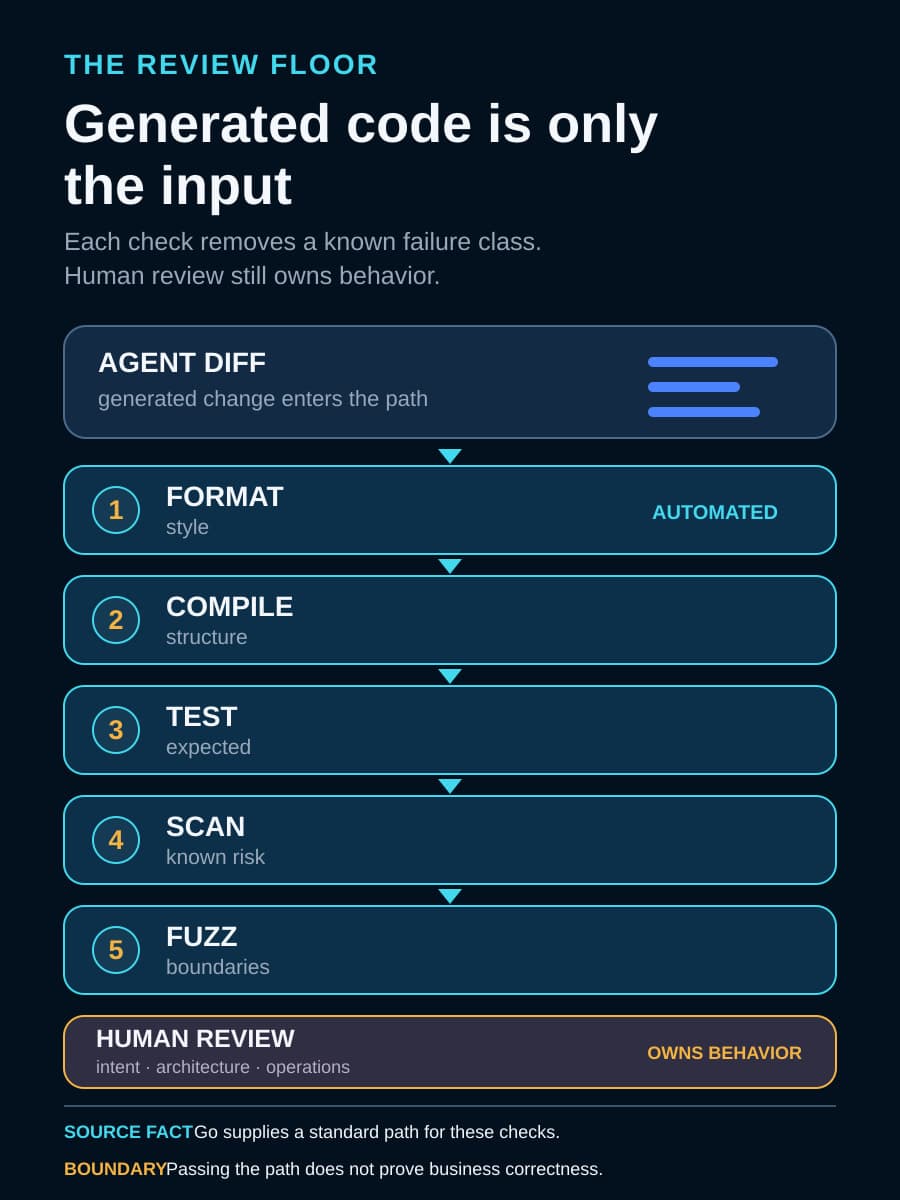
Google’s Go team argued on August 11 that AI-assisted software changes the programming-language question. When agents can generate large amounts of syntactically valid code quickly, human effort shifts toward reviewing, verifying, and maintaining that output. The language and toolchain therefore matter less as typing aids and more as the floor under the review process.
That is a useful lens, but it is not a case for rewriting a working system in Go. Google’s post presents a language-team argument, not a comparative production study. Engineering leaders should use it to inspect the verification path around generated code: which failures become deterministic checks, which remain human judgments, and whether the resulting path actually shortens safe delivery.
What is Google claiming about Go and AI coding?
In Why Go is an Ideal Language for AI-Assisted Software Engineering, Google highlights five related properties: a standard formatter, a fast compiler and static type system, built-in tests and fuzzing, integrated vulnerability tooling, and a strong compatibility promise. It also argues that Go’s limited syntax and common idioms make code more predictable for both models and reviewers.
The mechanism is straightforward. gofmt removes formatting as a local choice. The compiler rejects unresolved names, invalid types, and other structural errors. go test gives projects a standard command for executable checks. Native fuzzing can explore inputs around a defined target, while govulncheck reports known vulnerabilities in dependencies that affect functions the program calls.
Those tools can give an agent quick feedback before a person reads the change. They can also give reviewers a consistent set of results across repositories. Go’s compatibility promise further reduces one source of long-term churn by defining how Go 1 programs should continue to compile and run across later Go 1 releases.
Which claims stop at the tool boundary?
A successful compile proves that the program satisfies the compiler’s rules. It does not prove that the code implements the requested business behavior, preserves an authorization boundary, handles a partial failure correctly, or uses an existing internal abstraction instead of creating a duplicate.
Tests and fuzzing inherit the same boundary. A test can only enforce an assertion somebody wrote. A fuzz target can discover crashes or violated properties among the inputs it reaches, but it cannot invent the missing business invariant. The Go documentation describes vulnerability management around known vulnerability data and called code; that is useful, but it is not a complete security review of the new logic.
Google also says unvalidated iterative refactoring can compound errors and token cost. Its article does not publish a workload, comparison table, independent benchmark, or production defect study to establish how Go performs against another language. Treat the broader efficiency claims as the Go team’s engineering position, not measured savings available to every organization.
Should an existing system migrate to Go because of AI?
No—not on this evidence. A migration replaces known application behavior with a large new body of code, changes operational knowledge, and creates its own review burden. Faster generation does not remove the cost of proving behavioral equivalence or retraining the people who will operate the service.
For an existing Go service, the announcement supports a narrower action: make the standard toolchain an unavoidable part of the coding-agent path. For a service in another mature stack, ask whether its formatter, type checker or compiler, test runner, dependency scanner, and boundary-testing tools already provide equivalent deterministic feedback. The branded command names matter less than whether every generated change runs them consistently.
For a genuinely new service, verification ergonomics can be one language-selection criterion alongside team capability, libraries, runtime characteristics, hiring, deployment environment, and integration constraints. The relevant comparison is not “Which language lets the agent write the most code?” It is “Which stack lets this team reject bad changes and understand acceptable ones with the least hidden work?”
How do you test a generated-code verification path?
Choose one representative change that is large enough to cross files but small enough for a reviewer to understand. Run it through the current agent and toolchain without changing the language, model, prompt, and review policy at the same time.
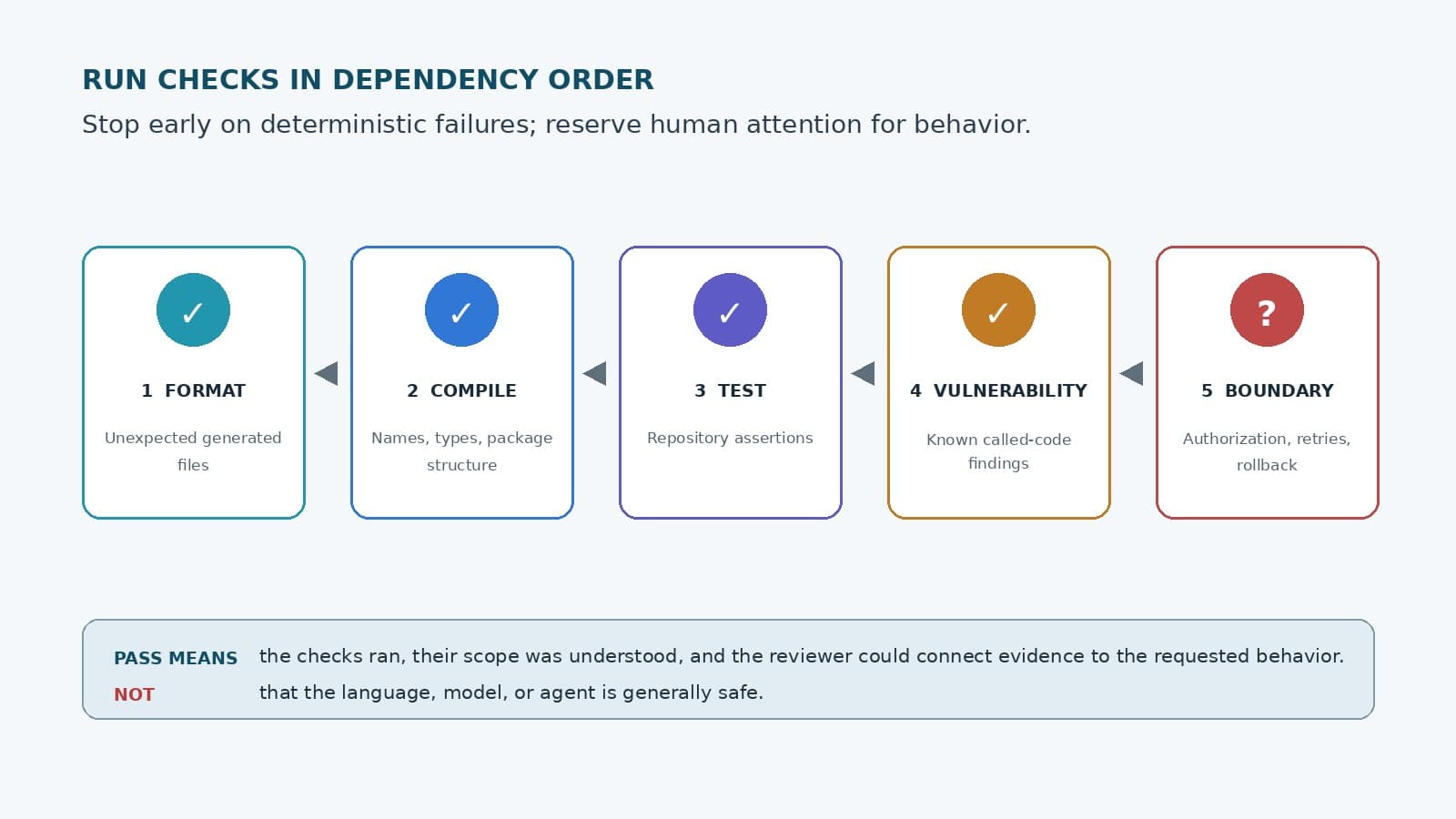
Make the checks execute in dependency order:
- Format the change and reject unexpected generated-file or dependency edits.
- Compile or type-check the affected packages.
- Run targeted tests, then the wider regression suite required by the repository.
- Run applicable dependency and vulnerability checks; review what each scanner can and cannot observe.
- Exercise one business boundary the compiler cannot prove, such as authorization, retry safety, data isolation, or rollback behavior.
Preserve the diff, check output, review comments, elapsed review time, and final disposition. A passing path means the automated checks ran and the human reviewer could connect their results to the requested behavior. It does not mean the language or agent is generally safe.
Then compare a small sample of representative agent-assisted changes with the team’s normal baseline. Look for review time, rework after review, escaped defects, dependency additions, and check failures caught before a human invested attention. If the toolchain catches failures earlier but total review and rework do not improve, the bottleneck sits above syntax and types.
Make language choice answer to verification
The current development is not that Go suddenly became an AI language. It is that a major language team is explicitly optimizing the language decision around generated code that humans must verify. That reframing matters even for teams that never adopt Go.
Use Go’s integrated path as a concrete reference: standardized source, fast structural feedback, executable tests, vulnerability evidence, boundary exploration, and compatibility expectations. Then demand an equally visible path from the stack you already run. Change languages only when that verification advantage survives a real comparison and outweighs migration and operating cost.
BaristaLabs helps teams build AI-assisted delivery around executable checks and clear review boundaries. Explore AI-assisted website development, or bring one representative generated change to a focused review.
AI-assisted engineering
Test one generated-code verification path
Bring one representative change from your current stack. BaristaLabs will help define the automated checks, human review boundary, and evidence needed before faster generation becomes faster delivery.
Useful for teams deciding how coding agents should enter an existing development and review process.
Turn this idea into a pilot
Which workflow should go first?
Use the readiness check to compare impact, effort, risk, owner, and next step before requesting a review.
- 3-5 minutes
- Deterministic score
- No sensitive data
Practical AI Workflow Notes
Want more practical AI operations ideas?
Get short notes on applying AI inside real small-business workflows — from document handling and customer follow-up to internal reporting, compliance, and automation guardrails.