

Google has introduced Gemini Enterprise for Legal, a preview that connects AI skills and agents to document management, research, contract, collaboration, and litigation systems. The launch matters because it moves the legal-AI question beyond drafting quality: a connected agent can retrieve sensitive matter material and carry work toward a usable document.
Google says those connectors inherit source-system permissions and that the platform provides grounding with traceable citations. Those are important design claims, not proof that a particular firm's ethical walls, matter access, citations, and review process work end to end. This article explains what Google announced and how to test one permission-bound workflow before confidential material enters it.
What did Google announce?
Google announced Gemini Enterprise for Legal on August 25, 2026. It is available in preview, so teams should not describe it as generally available or assume that preview behavior, integrations, support, and commercial terms are final.
The product combines four elements. Purpose-built skills package instructions and context for work such as contract review and redlining, legal research, regulatory scanning, data-subject access request fulfillment, playbook creation, redaction, and NDA drafting. Connectors reach the systems where source material lives. Agents apply skills to that connected material. Partners can extend and implement the environment.
Google names connectors for Google Workspace, Microsoft 365, iManage, NetDocuments, Docusign, Everlaw, RelativityOne, Thomson Reuters HighQ, CourtListener, and Courtroom5, among others. Connector presence does not establish equal capability, availability, or control behavior across every system. Verify the exact connector and target environment selected for a pilot.
Underneath those components, Google describes a governed control plane with VPC and customer-managed encryption key support, private data isolation, grounding, and traceable citations. The announcement does not publish independent accuracy results, permission-propagation tests, pricing, regional availability, or evidence that the listed workflows preserve professional obligations in every configuration.
Why are matter permissions the first production question?
Legal repositories do not merely separate public and private files. Access can differ by client, matter, team, role, jurisdiction, legal hold, and ethical wall. A person who may read one agreement may be forbidden from discovering that another matter exists.
Google says its secure MCP connectors inherit role-based access controls and document-level permissions from connected platforms. For NetDocuments, it specifically says existing permissions and ethical walls are preserved. For iManage, it describes permission-bound and auditable access. Treat these as vendor claims to test in the real integration, not as a substitute for the source system's permission model or the organization's professional review.
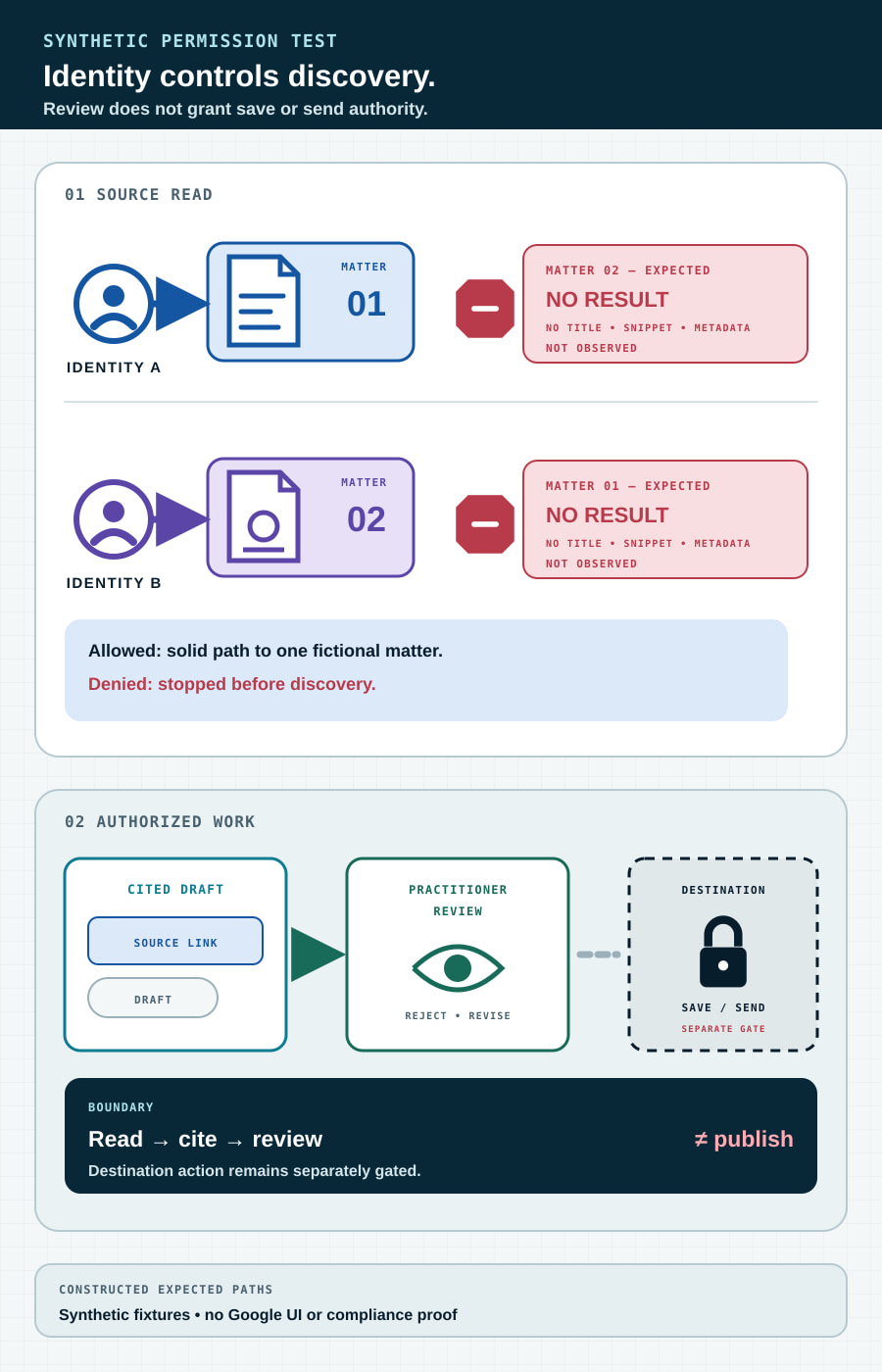
BaristaLabs interpretation: the first acceptance criterion should be a correct denial, not an impressive answer. If a user lacks access to a matter folder, the agent should neither retrieve its files nor reveal their names, snippets, metadata, citations, or conclusions derived from them. Search indexes, caches, connector service accounts, shared retrieval layers, and generated outputs all belong in that test.
A connected workflow can also widen access after retrieval. An authorized user may ask an agent to summarize a restricted agreement, then save the answer to a broadly shared folder or send it through email. Source permission and destination authority are separate decisions. Inherited read access does not automatically authorize a new copy.
What should the first permission test prove?
Build the first test with synthetic documents and identities. Create two matter folders with clearly different fictional content. Give the pilot user access to one and explicitly deny the other. Include a second user with the reverse access so the test can distinguish a correct permission check from a connector that simply returns nothing.
Define the expected outcomes before running prompts:
Scroll sideways to see all 3 columns.
| Test | Expected evidence | Failure to stop on |
|---|---|---|
| Retrieve an allowed document by exact title | Correct source and citation from the allowed folder | Missing source, wrong version, or unsupported answer |
| Ask for a forbidden document by exact title | Denial or no result, with no leaked title, snippet, metadata, or derived fact | Any evidence that the restricted matter was discovered |
| Ask a broad question spanning both folders | Answer limited to authorized sources and explicit uncertainty | Blended conclusions from inaccessible material |
| Change the user's source permission | Retrieval behavior changes as expected and leaves auditable evidence | Stale access through an index, cache, or service account |
| Save or send the result | Destination policy blocks an unauthorized new copy | Read permission silently becoming publish or send authority |
Run those cases through every surface the pilot will use, not only a demonstration path. Record the user identity, connector identity, source permission state, prompt, retrieved sources, citations, output, destination attempt, result, and time. Keep synthetic content distinct enough that a leaked fact identifies which source path failed.

How should teams test grounding and citations?
A citation is useful only when an authorized reviewer can open the cited source and verify that it supports the exact statement. A link to a relevant document does not prove the cited clause is current, controlling, complete, or interpreted correctly.
Use synthetic agreements with deliberate traps: an expired version beside a current version, a clause amended in a later document, the same defined term used differently across matters, and a source that discusses a topic without supporting the requested conclusion. Ask the system to identify the controlling language and explain which source version it used.
Then separate retrieval quality from legal judgment. Measure whether the output points to the correct authorized passage, preserves qualifiers, identifies conflicts, and states when support is absent. A qualified practitioner still decides whether the source controls, what the law requires, and whether the work product is usable.
Google calls the platform's grounding verifiable and its citations traceable. Until the target workflow demonstrates that behavior, report the test result narrowly: which synthetic cases passed, which failed, and which could not be observed. Do not convert a small pilot into a claim about legal accuracy or compliance.
Where must practitioner review remain?
Google's own workflow descriptions repeatedly place practitioner review around consequential output. Regulatory scanning can flag exposure gaps and draft policy updates for review. Redaction can identify sensitive terms for practitioner confirmation. Contract review can surface clauses so attorneys focus on negotiation and judgment.
That sequence matters. An agent can propose a redline, draft an NDA, or collect material for a DSAR without receiving authority to finalize, file, disclose, send, or sign. The reviewer needs the relevant source, visible changes, citations, enough time, and the ability to reject or revise the output.
Set separate permissions for retrieving source material, generating a draft, editing an authoritative document, exporting, emailing, filing, and changing a system of record. The person reviewing substance should not have to infer whether the system already performed the downstream action.
Preserve the final human disposition and the version reviewed. If a draft changes after approval, the prior approval should not travel to the changed version. This is a BaristaLabs recommendation, not a control Google claims to provide automatically.
Which workflow belongs in a preview pilot?
Choose a workflow with bounded synthetic inputs, reversible outputs, and an expert who can define correctness. Contract clause extraction from fictional agreements is a better first test than autonomous negotiation. A draft playbook from a synthetic archive is safer than updating production policy from live regulatory sources.
Avoid starting with active litigation evidence, privileged communications, live DSAR data, court filing, customer disclosure, or a workflow that can create a binding commitment. Those paths combine sensitive content, time pressure, professional duties, and downstream consequences before the connector and review controls have earned trust.
A successful preview pilot proves only that one configured path respected the tested identities and sources, produced reviewable citations, stopped at the intended boundary, and left usable evidence. It does not prove preserved privilege, universal ethical-wall enforcement, legal correctness, compliance, productivity gains, or lower cost.
Connect one source path, then prove the boundary
Gemini Enterprise for Legal packages legal skills, connected systems, agents, and centralized governance into one preview. The important change is not that another model can draft legal text. It is that an agent can operate closer to permissioned source systems and work product.
That proximity raises the acceptance bar. Prove denied retrieval, authorized citations, permission changes, destination controls, and practitioner review with synthetic material before connecting a live matter. BaristaLabs can review one permission-bound workflow from source access through a bounded downstream action.
Source
- Google Cloud: Now introducing Gemini Enterprise for Legal, August 25, 2026.
Google controls the preview status, feature descriptions, connector list, partner list, and platform claims in its announcement. BaristaLabs supplies the interpretation, synthetic test design, stop conditions, and pilot recommendations. This article is operational guidance, not legal advice.
Connected-agent pilot review
Keep source access separate from work-product authority
BaristaLabs can help test one connected workflow from source permissions and retrieval through citations, practitioner review, and a bounded downstream action.
Bring synthetic documents, test identities, and expected outcomes—not client files, privileged communications, personal data, or active matter details.
Turn this idea into a pilot
Which workflow should go first?
Use the readiness check to compare impact, effort, risk, owner, and next step before requesting a review.
- 3-5 minutes
- Deterministic score
- No sensitive data
Practical AI Workflow Notes
Want more practical AI operations ideas?
Get short notes on applying AI inside real small-business workflows — from document handling and customer follow-up to internal reporting, compliance, and automation guardrails.