

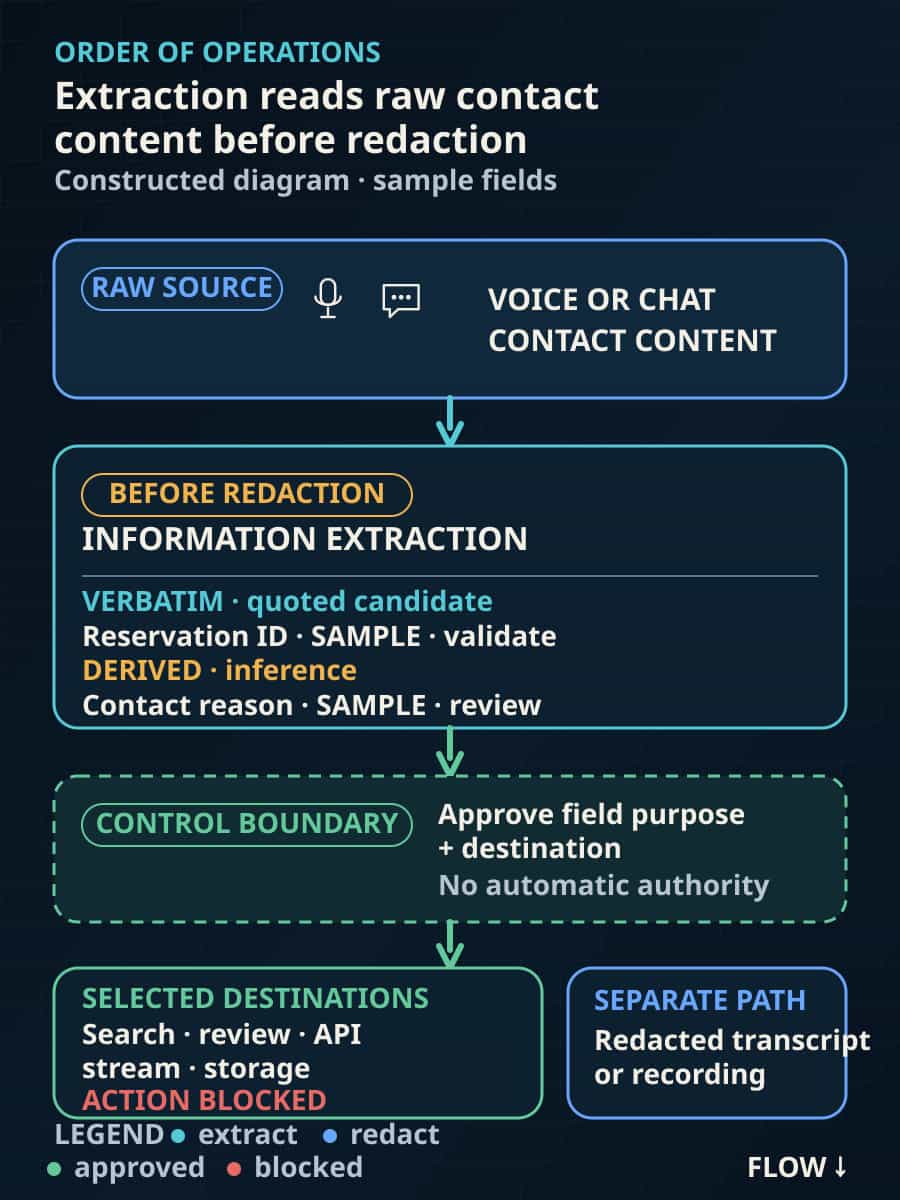

Amazon Connect Customer can now convert parts of agent-handled voice and chat conversations into structured fields. The feature can capture words spoken in the contact, such as a reservation ID, and infer fields such as the reason for contact or next steps promised.
Those outputs can travel beyond the transcript: AWS exposes them during after-contact work, in search, S3, APIs, and Kinesis, and as variables in rules that can create tasks or cases and send emails or notifications. The consequential detail is ordering. AWS says extraction processes raw contact content before redaction, so a field can preserve sensitive material even when the recording or transcript later hides it. This article explains how to separate field collection from permission to act.
What did AWS release?
AWS announced information extraction for Amazon Connect Customer on August 24, 2026. It applies to voice and chat contacts with human agents in Connect Customer instances where conversational analytics is enabled.
The administrator guide describes a two-part mechanism. An extraction definition says what to return. A conversational analytics rule says when to run that definition for matching contacts. A large language model then processes the contact and associates the result with it as structured data.
AWS distinguishes two result types. A verbatim result should reproduce content from the conversation, such as an invoice number or preferred name. A derived result is an inference about the exchange, such as its primary reason, the resolution provided, or a promised follow-up. Both arrive as fields, but they do not carry the same evidentiary weight.
The configuration guide says a definition's name and prompt hint become extraction input. An optional display label does not. Changes affect contacts processed after the edit, which means definition versions matter when teams compare historical results or investigate why the same conversation pattern produced a different field later.
Why does extraction before redaction change the review?
AWS explicitly warns that information extraction operates on raw contact content before redaction. Its example says a team could redact a credit-card number from a recording and transcript while extracting its last six digits.
That behavior can be useful, but redaction no longer describes every retained copy. The recording may hide a value while the extracted field appears in the contact record, an S3 analytics file, a Kinesis event, an API response, or a rule action. Each destination has its own permissions, retention, deletion, and downstream-access path.
BaristaLabs interpretation: treat every extraction definition as a new data field, not as a viewing convenience attached to a redacted transcript. Before enabling it, record the field's business purpose, allowed source content, sensitivity class, destinations, readers, retention period, and deletion behavior. If the organization would not deliberately add that field to its customer system, it should not create it indirectly from a call.
The permission model reinforces this separation. AWS documents distinct permissions for managing definitions and viewing results, alongside permissions for conversational analytics, rules, and generative-AI rules. Do not give the same role definition design, result access, and action authority merely because one administrator can configure all three.
When is an extracted field evidence, and when is it a guess?
A verbatim field still needs validation. A reservation ID can be misheard, repeated, corrected later in the call, or returned more than once. AWS says multiple matches for one definition are returned as a list. A downstream system must decide whether a list is acceptable, which value is current, and what to do when the format is invalid.
Prompt hints can describe format constraints. AWS's example for a reservation ID specifies six characters using A–Z and digits 0–9. That helps identify a candidate; it does not prove the identifier exists in the reservation system or belongs to the caller. Validate format first, then existence and ownership through the system of record before an update or disclosure.
Derived fields need a higher bar. “Next steps promised” summarizes meaning across a conversation. It can be useful for review or queueing, but it is not the same as a logged commitment made by an authorized employee. A model may omit a condition, merge two statements, or interpret a tentative suggestion as a promise.
Keep the source contact reference, extraction-definition version, result, processing time, and reviewer disposition together. If a derived field affects a customer-facing deadline, refund, service entitlement, compliance record, or employee evaluation, require a person or deterministic business rule to verify the relevant source evidence before the field becomes authoritative.

Which downstream actions need a gate?
AWS says extracted information can be inserted into rule actions including email, task creation, case creation, and notifications. Availability is a connection point, not an endorsement of every field-action pair.
Use the least consequential destination first. Search and supervisor review are lower-authority uses because a person interprets the result before changing customer state. Creating an internal follow-up task can be reasonable when the task is clearly marked as model-extracted and points back to the contact. Sending a customer email or populating a case field that triggers service obligations has a larger blast radius.
A practical action policy can distinguish four states:
Scroll sideways to see all 3 columns.
| Extraction outcome | Safe initial treatment | Do not allow yet |
|---|---|---|
| Missing or malformed verbatim value | Leave the destination blank and queue only if the workflow requires it | Guess, repair, or select a plausible identifier |
| Validly formatted but unverified identifier | Look it up in the approved system of record | Update an account or disclose account-specific information |
| Low-impact derived category | Use for internal search, sampling, or draft queue assignment | Treat it as a final customer or agent performance fact |
| Promise, resolution, entitlement, or sensitive conclusion | Require source review and record acceptance | Send, pay, close, penalize, or commit automatically |
These are BaristaLabs recommendations, not built-in Amazon Connect controls. The implementation has to enforce them in rule conditions, downstream services, queues, and permissions.
What should a bounded pilot measure?
Start with one field and one non-customer-facing destination. Use synthetic voice and chat contacts that include a clean match, no match, two matches, a corrected value, an ambiguous phrase, and sensitive content that redaction should hide. Do not use production recordings to discover how the feature behaves.
For a verbatim field, measure exact matches, omissions, incorrect values, lists, and corrections. For a derived field, define a written acceptance rubric and have two reviewers label the same small set before comparing the model output. A disagreement between reviewers is evidence that the field itself may be too subjective for autonomous action.
Then trace data movement. Confirm what appears in after-contact work, contact details and search, API responses, Kinesis events, S3 output, and any selected action. Verify that transcript redaction does not create a false assumption that the extracted field is also absent. Test access with a role that should see the transcript but not extraction results, and another that may review results but not edit definitions or rules.
AWS documents limits of 100 extraction definitions per instance, plus up to 20 extractions per contact for after-call-work analytics rules and 20 for post-contact analytics rules. Those are service ceilings, not design targets. A small field set is easier to classify, validate, version, and retire.
AWS also says the feature carries no additional charge for eligible voice and chat contacts. That statement does not make S3, Kinesis, downstream services, implementation, or human review free. Measure completed follow-up cost and correction work rather than assigning the feature a zero-cost business case.
Separate extraction approval from action approval
Information extraction can remove repetitive copying from contact-center work and make calls searchable by details that previously lived only in audio or transcripts. The same structure also makes an inferred or sensitive value easier to distribute and automate.
Approve the field first: purpose, source, sensitivity, validation, destinations, access, retention, and deletion. Approve each action separately: trigger, authority, evidence, error path, and owner. A useful extraction does not automatically deserve permission to send an email, open a case, or state that a promise was made.
BaristaLabs can review one contact-to-action path from raw content through validation and a bounded downstream effect. Bring synthetic examples and field definitions, not customer recordings or sensitive identifiers.
Sources
- AWS: Amazon Connect Customer now supports information extraction for agent voice and chat conversations, August 24, 2026.
- Amazon Connect Customer Administrator Guide: Information extraction, accessed August 25, 2026.
- Amazon Connect Customer Administrator Guide: Configure voice and chat information extraction, accessed August 25, 2026.
- Amazon Connect Customer Administrator Guide: Availability of features by Region, accessed August 25, 2026.
AWS controls product behavior, limits, pricing, permissions, regional availability, and rollout status described in its sources. BaristaLabs supplies the data-governance interpretation, validation method, and action-gating recommendations.
Contact workflow review
Keep a useful extraction from becoming an unsafe action
BaristaLabs can help trace one voice or chat field from raw content through validation, storage, permissions, and a bounded downstream action.
Bring field definitions and synthetic examples, not recordings, transcripts, account numbers, payment data, or other customer content.
Turn this idea into a pilot
Which workflow should go first?
Use the readiness check to compare impact, effort, risk, owner, and next step before requesting a review.
- 3-5 minutes
- Deterministic score
- No sensitive data
Practical AI Workflow Notes
Want more practical AI operations ideas?
Get short notes on applying AI inside real small-business workflows — from document handling and customer follow-up to internal reporting, compliance, and automation guardrails.