
Every small business owner who has considered deploying an AI voice agent has hit the same wall: "What happens when it says the wrong thing?"
That question just got a real answer.
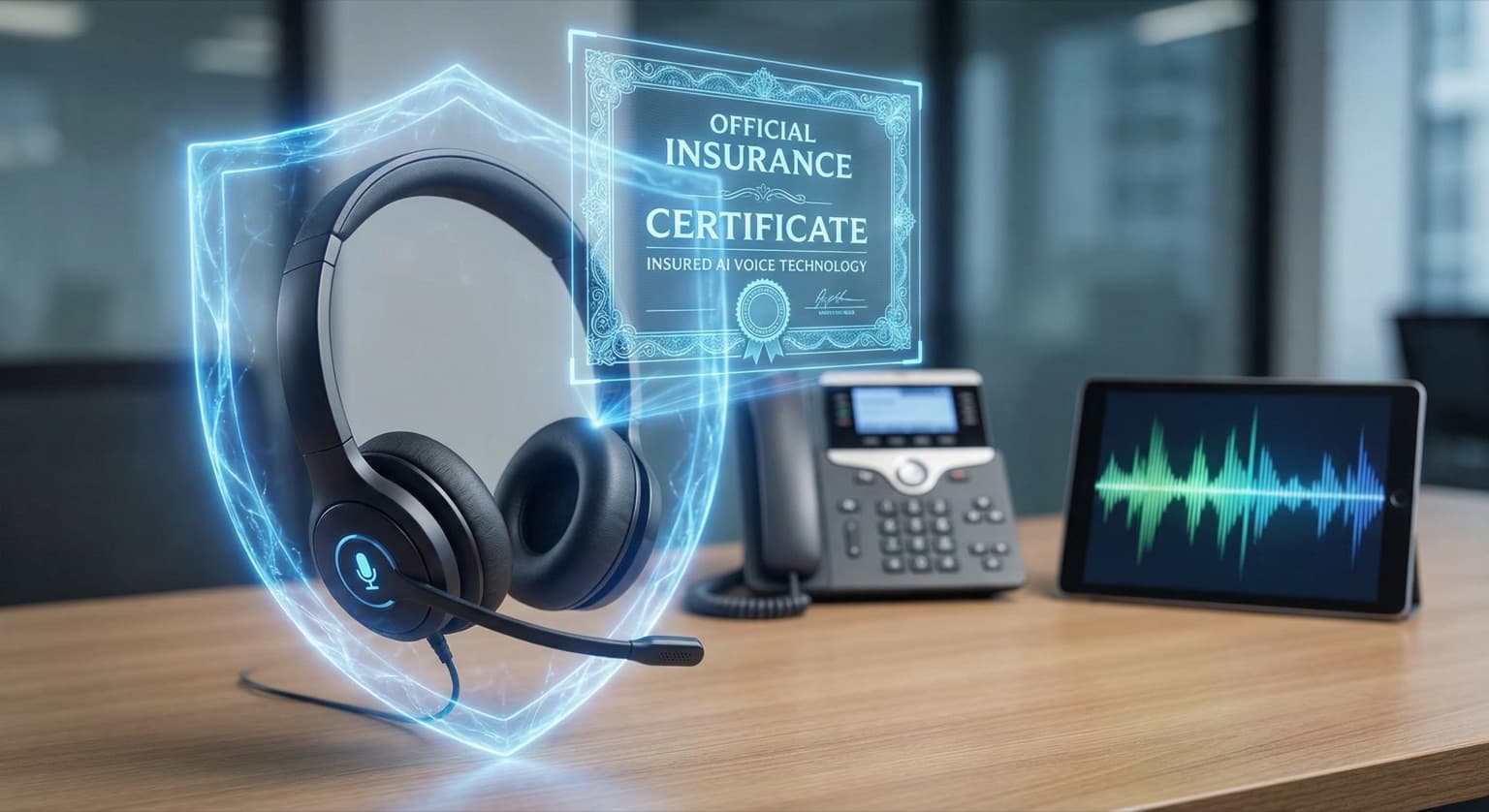
ElevenLabs announced the first-ever insurance policy specifically designed for AI voice agents, underwritten by the Artificial Intelligence Underwriting Company (AIUC). This is not a hypothetical framework or a white paper. It is a real insurance product that enterprises and small businesses can buy to cover the specific risks that come with deploying AI agents in customer-facing roles.
If you have been waiting for a reason to move forward with AI voice automation, this is it.
What Actually Happened
ElevenLabs has partnered with AIUC to create an insurance product that treats AI voice agents the way traditional insurance treats employees. That distinction matters. Instead of blanket technology liability policies that rarely cover AI-specific failures, this product addresses the actual risks businesses worry about:
- An agent providing incorrect information to a customer
- Data leaks during voice interactions
- Unauthorized actions taken by an AI agent
The insurance is backed by a new certification standard called AIUC-1. To qualify, an AI system must pass over 5,000 adversarial simulations designed to test for security vulnerabilities, hallucinations, and prompt injection attacks. Think of it as a stress test for your AI employee before it gets coverage.
Here is the part that matters most for ElevenLabs customers: their platform is what AIUC calls "pre-hardened." If you are already building on ElevenLabs, you are roughly 75 percent of the way toward certification. The remaining validation can be completed in weeks, not months.
Why This Is a Turning Point
Insurance is boring until you need it. But the availability of insurance signals something much bigger: the industry has reached a point where AI agent risk can be quantified, measured, and underwritten. That is a maturity milestone.
Consider the parallel with professional services. Consultants, contractors, and freelancers could not take on serious enterprise clients until Errors and Omissions (E&O) insurance became standard. That insurance did not just protect against lawsuits — it unlocked an entire class of business relationships that were previously too risky for both sides.
AI voice agents are at that same inflection point. The technology has been ready. The cost has been reasonable. The missing piece was a credible answer to the liability question. Now it exists.
What This Means for Small Businesses
If you run a small business — a dental practice, a plumbing company, a real estate office, a restaurant — you have probably explored AI voice agents for appointment booking, customer service, or after-hours call handling. And you have probably hesitated.
The hesitation was rational. When your AI receptionist tells a patient the wrong dosage, or confirms an appointment that does not exist, or leaks a customer's personal information, you are the one who gets sued. Not the AI vendor. That risk calculus kept a lot of smart business owners on the sidelines.
Insurance changes that equation in three specific ways:
1. Quantified Risk Instead of Unknown Risk
Before insurance, the downside of deploying an AI voice agent was theoretically unlimited. A single hallucination in healthcare could mean a malpractice suit. A data leak could trigger regulatory fines. Without insurance, those risks were unquantifiable — and unquantifiable risk is the kind that kills projects before they start.
Now there is a price tag. You can look at the premium, weigh it against the operational savings, and make a rational business decision. That is how every other business risk works, and AI just joined the club.
2. Certification as a Quality Signal
The AIUC-1 certification process — those 5,000 adversarial simulations — does something important beyond enabling insurance. It creates a verifiable standard for AI agent quality. When you deploy a certified agent, you are not just hoping it works. You have evidence that it has been tested against prompt injection, hallucination, and security attacks.
For small businesses without in-house AI expertise, that certification is a shortcut to confidence. You do not need to run your own red team exercises. The certification process already did it.
3. Competitive Differentiation
Here is the strategic angle that most people will miss: early adopters of insured AI agents will have a competitive advantage. Imagine two competing dental practices. One has an AI receptionist that is insured and AIUC-1 certified. The other still relies on a voicemail system that loses half its messages. Which one books more patients?
Insurance does not just reduce risk. It enables you to move faster than competitors who are still stuck in analysis paralysis.
The Practical Path Forward
If you are a small business owner considering AI voice agents, here is what to do with this news:
Evaluate ElevenLabs specifically. Their pre-hardened platform means faster certification and lower insurance costs. That head start is worth something. Compare it against other voice AI platforms, but factor in the insurance advantage.
Talk to your existing insurance broker. Ask about AI liability coverage. Even if they do not carry the AIUC product yet, the conversation will reveal what your current policies do and do not cover. Most general liability policies have significant gaps around AI-generated errors.
Start small. Deploy an AI voice agent for a low-risk use case — after-hours call handling, appointment confirmations, FAQ responses. Get comfortable with the technology before expanding to higher-stakes interactions. Insurance makes this experimentation safer, not riskless.
Budget for certification. If you are serious about deploying AI in customer-facing roles, plan for the AIUC-1 certification process. On the ElevenLabs platform, that timeline is measured in weeks. On other platforms, it could take longer.
The Bigger Picture
This announcement is part of a broader pattern we have been tracking. The NIST AI agent standards initiative is formalizing how AI agents should be tested and governed. The 2026 AI Safety Report highlighted the growing need for accountability frameworks. And now the insurance industry is stepping in with financial products that put real money behind those standards.
For small businesses, the message is clear: the infrastructure for responsible AI deployment is falling into place. The tools are ready. The standards are emerging. And now the safety net exists.
The question is no longer whether AI voice agents are safe enough to deploy. The question is whether you can afford to wait while your competitors move first.
Need help evaluating AI voice agents for your business? BaristaLabs specializes in helping small businesses deploy AI solutions that are practical, affordable, and now — insurable. Get in touch to discuss your specific use case.
AI Pilot Readiness Checklist
Turn the idea into a pilot you can defend.
AI agent articles are easy to bookmark and hard to operationalize. Use the readiness questions as a shared way to decide whether a workflow is specific enough, safe enough, and measurable enough to pilot. If they surface a strong candidate, BaristaLabs can review it with you and help shape a first version that fits your systems, approval process, and risk tolerance.
Please do not submit PHI, customer records, credentials, or confidential workflow exports.
Practical AI Workflow Notes
Want more practical AI operations ideas?
Get short notes on applying AI inside real small-business workflows — from document handling and customer follow-up to internal reporting, compliance, and automation guardrails.