The End of "Please Hold": Why Small Businesses Are Switching to AI Phone Agents in 2026
Discover how AI voice agents like Bland.ai, Vapi, and Retell AI are revolutionizing small business communications by eliminating hold times and reducing costs.

Sean McLellan
Lead Architect & Founder

The sound of a ringing phone used to be the sound of opportunity. In 2026, for many small business owners, it's the sound of stress. Missed calls mean missed revenue, but staffing a phone line 24/7 is prohibitively expensive.
Enter the AI telephony revolution.
We are witnessing a massive shift in how businesses handle voice communication. The days of clunky "Press 1 for Sales" IVR trees are over. They have been replaced by conversational AI agents that sound human, understand context, and can actually get things done. If you're already exploring how AI agents can orchestrate your workflows, voice is the next frontier.

The AI Telephony Revolution: What Changed?
Just a few years ago, "voice bots" were frustratingly robotic. They struggled with accents, got confused by simple interruptions, and often left customers shouting "REPRESENTATIVE!" into their handsets.
Today, platforms like Retell AI, Vapi, and Bland.ai leverage Large Language Models (LLMs) to power voice agents that are nearly indistinguishable from humans. They can:
- Detect emotion and adjust their tone.
- Handle interruptions naturally.
- Access your company's knowledge base in real-time.
- Book appointments directly into your calendar.
This isn't just for enterprise giants anymore. The technology has democratized, making enterprise-grade phone systems accessible to the local bakery, the dental practice, and the plumbing dispatch.
Key Players: Bland.ai vs. Vapi vs. Retell AI
Navigating the landscape of AI voice providers can be overwhelming. Here is a breakdown of the top contenders for small businesses in 2026:
1. Retell AI
Best for: Enterprise-grade reliability and compliance.
Retell AI has emerged as a leader for businesses that need rock-solid reliability. With SOC 2 Type II and HIPAA compliance, it is the go-to choice for healthcare providers and legal firms. Their latency is incredibly low, making conversations feel snappy and natural.
2. Vapi
Best for: Developers and customization.
Vapi offers a robust API that allows for deep customization. If you have a specific workflow or need to integrate with a custom CRM, Vapi provides the building blocks. However, it requires a bit more technical know-how to set up effectively.
3. Bland.ai
Best for: High-volume calling and sales.
Bland.ai made waves with their hyper-realistic voices. They specialize in outbound sales and high-volume dispatch. If your goal is to automate lead qualification or follow-ups, Bland.ai is a strong contender, though some users report it can be overkill for simple inbound customer service.
4. ElevenLabs
Best for: Voice quality.
While primarily known for voice synthesis, ElevenLabs has entered the conversational agent space. Their voice clones are the industry standard for realism. If your brand voice is critical (literally), ElevenLabs offers the highest fidelity. They recently launched Expressive Mode, which detects emotion from speech patterns across 70+ languages.
How Small Businesses Are Using AI Agents
You don't need a call center to benefit from this tech. Here are three practical ways small businesses are deploying AI phone agents today:
Appointment Booking
A hair salon can replace their receptionist with an AI that answers every call, checks stylist availability, and books appointments directly into the calendar software. It never sleeps, never takes a lunch break, and never double-books.
After-Hours Support
Plumbers and HVAC technicians lose business when they don't answer the phone at 8 PM. An AI agent can screen calls, dispatch emergency services if needed, or schedule a visit for the next morning—all while the business owner enjoys dinner with their family.
Customer Service & FAQ
"What are your hours?" "Do you have gluten-free options?" "Where do I park?" An AI agent can answer these repetitive questions instantly, freeing up your human staff to handle complex issues that actually require empathy and judgment.
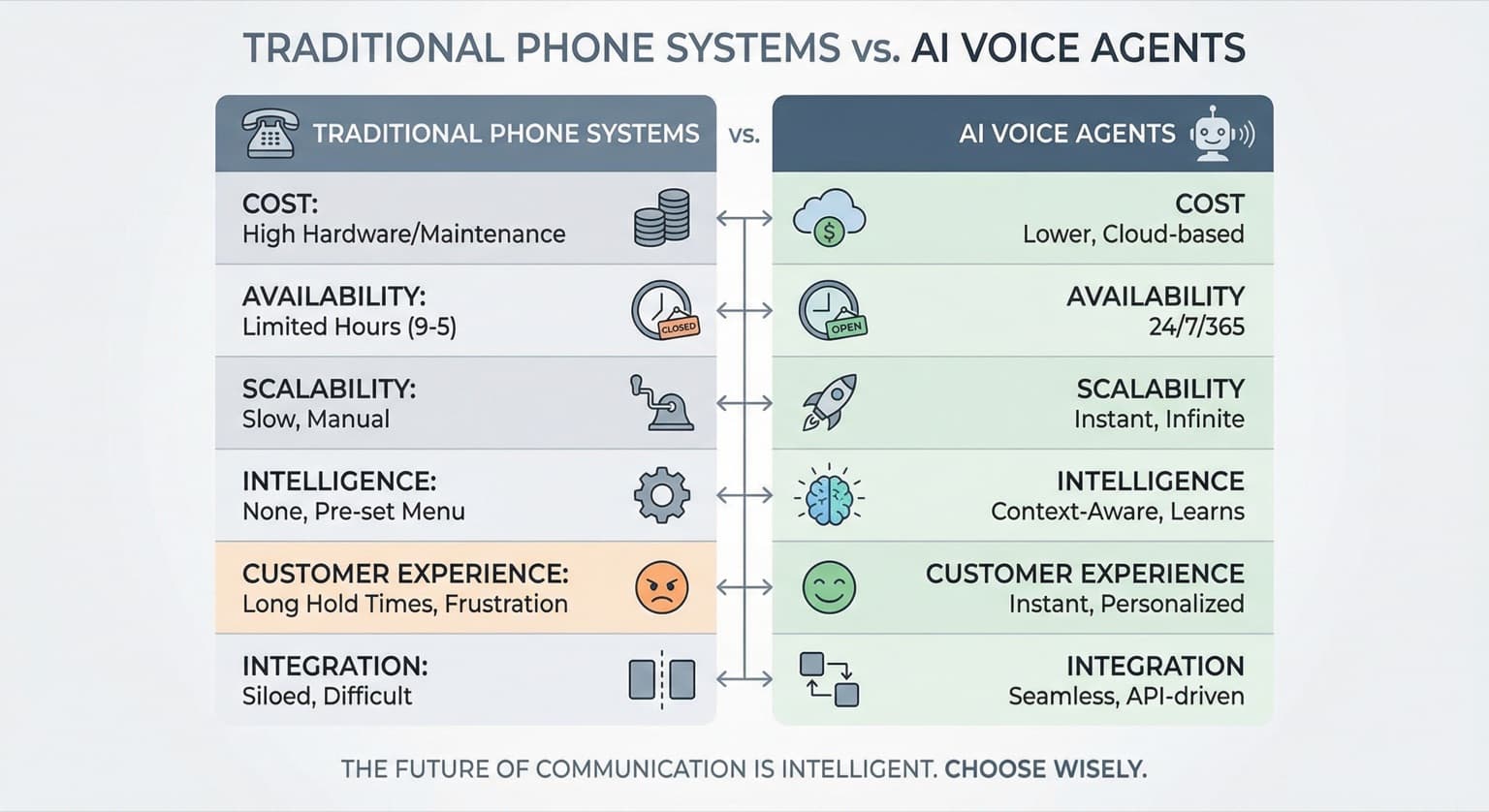
The Cost Equation: AI vs. Traditional Staffing
Let's look at the numbers.
Traditional Receptionist:
- Salary + Benefits: ~$45,000 - $60,000 / year
- Availability: 40 hours / week
- Capacity: One call at a time
AI Voice Agent:
- Cost: ~$0.10 - $0.20 per minute of conversation
- Availability: 24/7/365
- Capacity: Unlimited concurrent calls
For a small business with moderate call volume (e.g., 500 minutes/month), an AI solution might cost under $100/month. Even with heavy usage, the savings are astronomical compared to hiring full-time staff.
Getting Started: A Practical Guide
Ready to make the switch? Here is a simple roadmap:
- Audit Your Calls: What are people calling about? If 80% of calls are for appointments, start there.
- Choose a Platform: For most small businesses, Retell AI or a wrapper service built on top of it offers the best balance of ease and power. Check out their getting started guide to see how quickly you can spin one up.
- Draft Your Script: Don't write a rigid script. Write a "system prompt" that gives the AI its persona and rules. "You are a helpful assistant for Joe's Pizza. You are friendly, concise, and you want to sell pepperoni."
- Test Internal: Have your team call the bot. Try to break it. Interrupt it. Mumble. See how it handles edge cases.
- Go Live (Soft Launch): Forward your calls to the AI during off-hours first, then roll it out for peak times once you are confident.
Conclusion
The automated telephony revolution isn't about replacing human connection; it is about saving it for the moments that matter. By letting AI handle the routine logistics of appointments and FAQs, you free yourself and your team to provide genuine, high-value service to your customers.
The technology is here. The price is right. The only question is: are you still going to ask your customers to "please hold"?
If you're not sure where to start with AI for your business, check out our AI adoption roadmap or learn how agentic engineering is reshaping how businesses operate. Ready to talk? Contact us and we'll help you find the right fit.
Back-Office Automation ROI Worksheet
Choose the first automation with evidence, not vibes.
AI tools can make almost any workflow look automatable. The ROI worksheet helps you pick the one most likely to pay back quickly. If one workflow rises to the top, BaristaLabs can help decide whether a lightweight tool, integration, or custom pilot is the best next step.
Use broad workflow categories in the form; save specifics for a scoped conversation.
Turn this idea into a pilot
Which workflow should go first?
Use the readiness check to compare impact, effort, risk, owner, and next step before requesting a review.
- 3-5 minutes
- Deterministic score
- No sensitive data
Practical AI Workflow Notes
Want more practical AI operations ideas?
Get short notes on applying AI inside real small-business workflows — from document handling and customer follow-up to internal reporting, compliance, and automation guardrails.
Related Posts