AI Bot Spam Just Killed Digg's Comeback — Here's What That Means for Your Marketing
Just two months after its high-profile relaunch, Digg announced a hard reset, citing overwhelming AI bot spam. For small businesses that depend on social platforms for marketing, this is a warning sign that demands attention.

Sean McLellan
Lead Architect & Founder
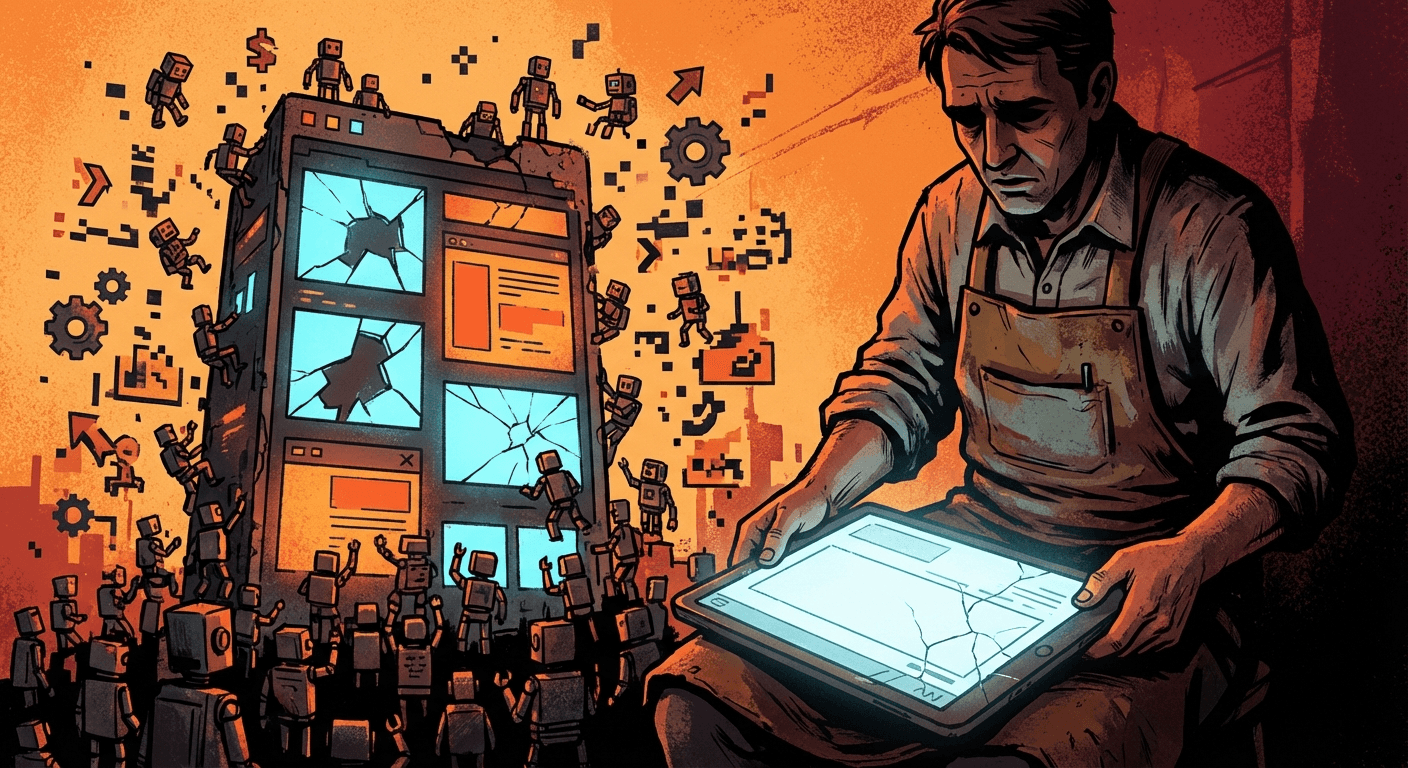
Two months. That is how long Digg's comeback lasted before AI broke it.
In January 2026, Digg relaunched with serious backing. Kevin Rose, the original founder, teamed up with Alexis Ohanian, co-founder of Reddit, to bring back the iconic link-sharing platform. The pitch was simple: a human-curated alternative to the algorithmic slop flooding every other social feed. A place where real people surfaced real content.
Today, Digg announced what it is calling a "hard reset." The platform is scaling back operations, gutting its current approach, and starting over. The reason? AI-generated bot content overwhelmed human curation at a pace the team could not match.
From the announcement on digg.com:
Example
"We are not giving up. Digg is not going away. A small but determined team is stepping up to rebuild with a completely reimagined angle of attack. Positioning Digg as simply an alternative to incumbents was not imaginative enough."
Kevin Rose is returning full-time in April to help lead the rebuild.
What Actually Happened
The original Digg, which launched in 2004, was one of the first platforms to let users vote content up or down. It was a forerunner to Reddit, Hacker News, and every social aggregation site that followed. When it relaunched in January, the bet was that people were hungry for a return to human-driven content discovery.
The problem is that in 2026, "human-driven" is nearly impossible to enforce at scale. AI bots can now generate content that is indistinguishable from human writing, create accounts that pass basic verification, and operate at volumes that dwarf what any moderation team can handle. Digg's curation model — which relied on the assumption that most participants were real people making genuine choices — collapsed under the weight of synthetic engagement.
This was not a failure of vision. It was a collision between a 2004-era trust model and a 2026-era spam engine.
Why Small Businesses Should Pay Attention
If you are a small business that relies on social platforms for marketing — and most of you do — Digg's implosion is not just a tech industry curiosity. It is a preview of what is coming to every platform you use.
1. Every Community Platform Is Vulnerable
Digg had the advantage of being small, new, and specifically designed to resist low-quality content. It still failed. Platforms like Reddit, LinkedIn, Facebook Groups, and niche industry forums face the same threat but with far more surface area to defend.
If you have been building your marketing strategy around organic engagement in online communities, the ground beneath you is shifting. The communities where your audience hangs out are increasingly polluted with AI-generated noise — fake reviews, synthetic comments, bot-driven upvotes. Your genuine content is competing with machines that can produce thousands of plausible-looking posts per hour.
2. "Human Curation" Is No Longer a Defensible Moat
Digg's entire value proposition was human curation, and it was not enough. This has direct implications for any small business strategy that depends on human-moderated spaces. Product review sites, industry forums, Slack communities, Discord servers — all of these are fighting the same battle Digg just lost.
The practical consequence: do not assume that a platform's moderation will protect the integrity of the space where you are marketing. Verify it. Ask hard questions about how the communities you invest time in are handling bot detection. If you cannot get a clear answer, factor that uncertainty into your strategy.
3. Platform Risk Just Got Worse
Small businesses have always faced platform risk — the danger that a social network changes its algorithm, shuts down, or deprioritizes your content type. AI bot spam adds a new dimension: platforms can now degrade from the inside, not just from policy changes at the top.
Digg did not change its algorithm or pivot its strategy. The platform was overwhelmed by external actors exploiting its openness. This kind of degradation is harder to predict and harder to recover from than a simple algorithm update.
4. Owned Channels Matter More Than Ever
The recurring lesson of every platform collapse — from the original Digg in 2010 to Vine in 2017 to Twitter's instability in 2023 — is the same: if you do not own the channel, you do not control your distribution.
AI bot spam accelerates this dynamic. When the signal-to-noise ratio on a platform deteriorates, everyone's reach suffers — but businesses that built their audience on rented ground suffer the most.
Your email list, your website, your direct customer relationships — these are the assets that survive platform turbulence. If Digg's two-month lifecycle does not convince you to double down on owned channels, nothing will.
What Comes Next
Digg's team says they are not done. Kevin Rose returning full-time in April signals genuine commitment to finding a new approach. But the statement itself is telling — "positioning Digg as simply an alternative to incumbents was not imaginative enough" suggests that the next version will need to be fundamentally different, not just better moderated.
The broader question is whether any platform built on open, human-driven content discovery can survive in an environment where AI can simulate human participation at scale. The answer is probably yes, but it will require technical solutions (cryptographic identity verification, proof-of-humanity protocols) that did not exist when Digg was first conceived — and that most platforms have not yet implemented.
The Bottom Line
Digg's hard reset is a case study in how fast AI bot spam can destroy trust-based systems. For small businesses, the takeaway is not to panic, but to adapt:
- Diversify your channels. Do not concentrate your marketing on any single community platform.
- Invest in owned media. Your website, email list, and direct relationships are bot-proof.
- Audit your community strategy. If you are investing time in platforms that rely on human curation, understand how they are defending against synthetic content.
- Watch for degradation signals. When the quality of engagement on a platform starts declining — more generic comments, more suspicious profiles, less genuine interaction — that is your cue to reallocate effort.
The age of "just post in the right community and the right people will see it" is ending. The businesses that recognize this shift early will be the ones that still have a marketing strategy when the next platform hits its own hard reset.
Turn this idea into a pilot
Which workflow should go first?
Use the readiness check to compare impact, effort, risk, owner, and next step before requesting a review.
- 3-5 minutes
- Deterministic score
- No sensitive data
Practical AI Workflow Notes
Want more practical AI operations ideas?
Get short notes on applying AI inside real small-business workflows — from document handling and customer follow-up to internal reporting, compliance, and automation guardrails.