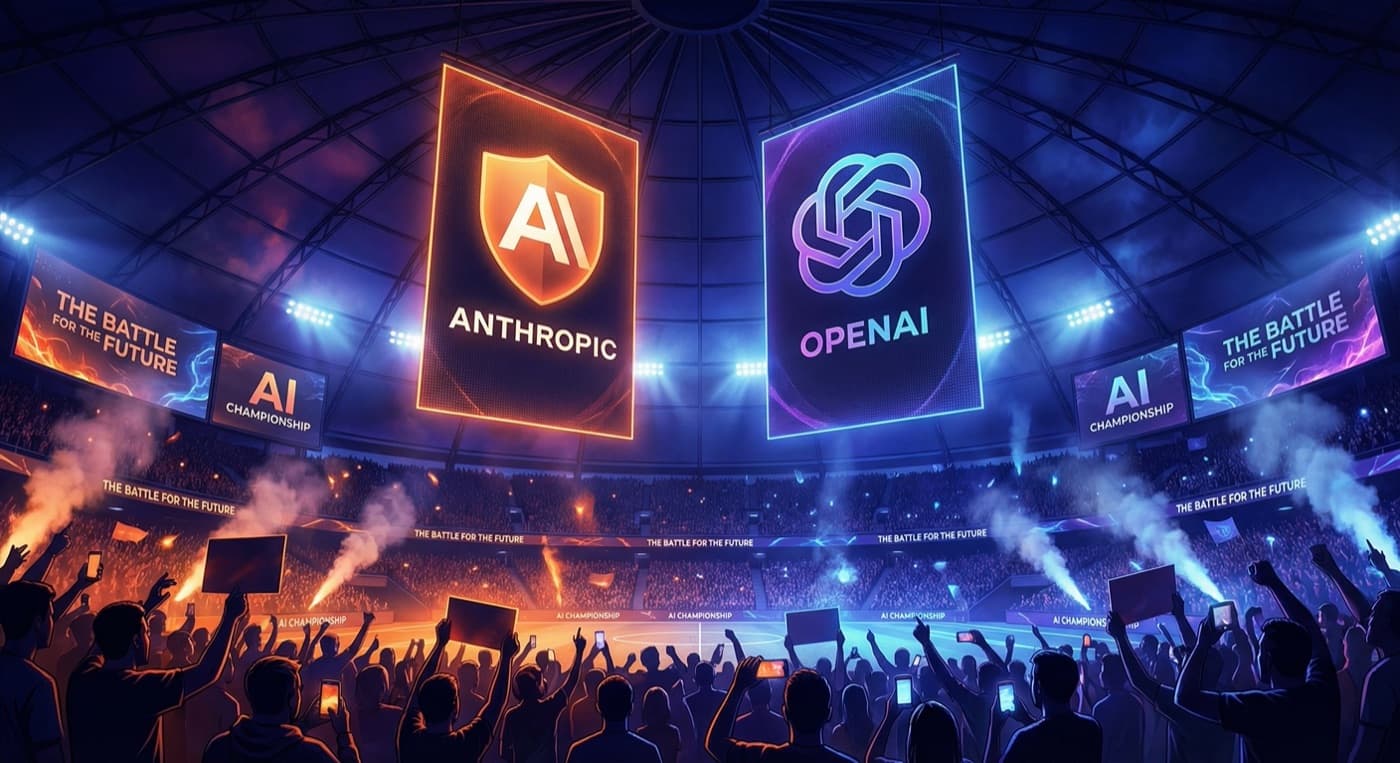

The battle for AI dominance has officially moved from the cloud to the living room. In an unprecedented move, Anthropic has dropped millions on Super Bowl LX ads (airing Sunday, Feb 9) specifically targeting OpenAI's decision to integrate advertisements into ChatGPT. The campaign, featuring titles like "Betrayal," "Deception," "Treachery," and "Violation," pulls no punches in framing OpenAI's pivot to ad revenue as a fundamental breach of trust.
This isn't just a tech spat; it's a philosophical war over the future of human-AI interaction, played out on the world's biggest advertising stage.
The Ad Campaign: "Ads are coming to AI. But not to Claude."
Anthropic's commercials depict a dystopian yet oddly familiar scenario: a user having a deep, meaningful conversation with an AI chatbot, only to be awkwardly interrupted by a targeted ad for car insurance or fast food. The tagline hits hard: "Ads are coming to AI. But not to Claude."
By focusing on the user experience—specifically the jarring nature of commercial interruption in a space meant for thought and creation—Anthropic is positioning Claude not just as a tool, but as a sanctuary. Their message is clear: when you pay for a product, you are the customer. When it's free (and ad-supported), you are the product.
The Reaction: "Dishonest" vs "Democratic"
The response from OpenAI leadership was swift and sharp. Sam Altman took to X (formerly Twitter) calling the ads "dishonest" and "deceptive," arguing that the portrayal misrepresents the actual implementation of ads in ChatGPT.
OpenAI's VP of Global Affairs, Chris Lehane, fired back with a different angle: "democratic access." Lehane framed the ad-supported model as the only way to keep cutting-edge AI technology free and accessible to billions of people, rather than gating it behind a subscription wall for the wealthy elite. In this view, ads are the price of democratization.
Business Implications: The Ad-Supported vs Subscription Model
For small businesses and enterprises navigating the AI landscape, this public feud highlights a critical decision point. The choice between Claude and ChatGPT is no longer just about benchmarks or context windows (though Claude Opus 4.6 certainly makes a strong case there). It's about data privacy and user intent.
1. Data Privacy and Trust
When a platform relies on ad revenue, the incentive structure shifts. The goal moves from "be as helpful as possible" to "maximize engagement and ad impressions." For businesses inputting sensitive strategy documents or proprietary code, the question arises: is my data being used to profile me for advertisers?
Anthropic argues that introducing ads fundamentally compromises the core principle of being "genuinely helpful." If an AI recommends a product because it's the best solution versus because an advertiser paid for the placement, the utility of the tool for business decision-making evaporates.
2. User Experience and Focus
We've seen this movie before with search engines. What started as clean, organic results eventually became cluttered with sponsored links. In a chat interface, where the value lies in precise, synthesized answers, ads are even more intrusive.
Imagine an employee using an AI to debug code or draft a legal contract, only to be side-tracked by a sponsored suggestion. The friction introduced by ads destroys the "flow state" that makes AI such a powerful productivity booster. As we discussed in our prior coverage of February's agent-model showdown, the efficiency of AI agents depends entirely on their ability to execute tasks without distraction.
3. Brand Alignment
For companies integrating AI into their own customer-facing products, the underlying model matters. Building on top of an ad-supported ecosystem introduces third-party risks. If the foundational model is incentivized to serve ads, can you guarantee those ads won't bleed into your user experience? Anthropic's "Constitutional AI" approach, which prioritizes safety and alignment over engagement metrics, offers a more predictable foundation for enterprise applications.
The Race to IPO
Looming over this philosophical debate is the financial reality. Both Anthropic and OpenAI are racing toward IPOs by the end of 2026, with collective valuations in the hundreds of billions.
OpenAI needs to justify its massive valuation by showing a path to profitability that subscriptions alone might not cover. The digital ad market is a proven trillion-dollar well. Anthropic, backed by Amazon and Google, is betting that a premium, trust-first brand can capture the high-value enterprise market that is willing to pay for privacy and focus.
What This Means for You
The Super Bowl ads are flashy, expensive, and entertaining. But for business leaders, they signal a divergence in the market.
- If you prioritize free access and broad availability: OpenAI's model aligns with scaling technology to the masses.
- If you prioritize data integrity, focus, and a distraction-free environment: Anthropic is doubling down on being the premium, professional choice.
As the AI landscape fragments into "consumer-grade ad-supported" and "professional-grade subscription," businesses will need to choose their stack carefully. The cost of "free" is often higher than a monthly subscription fee.
This feud is the most public spat we've seen between these two giants, but it clarifies the market. We now have a clear choice: the democracy of ads or the exclusivity of privacy.
At BaristaLabs, we help businesses navigate these strategic choices. Whether you're building on Claude or ChatGPT, understanding the incentives of your AI partner is crucial for long-term success.
Ready to build your AI strategy? Contact us to discuss how to leverage the right tools for your business without compromising on privacy or performance.
Sources:
Turn this idea into a pilot
Which workflow should go first?
Use the readiness check to compare impact, effort, risk, owner, and next step before booking a call.
- 3-5 minutes
- Deterministic score
- No sensitive data
Practical AI Workflow Notes
Want more practical AI operations ideas?
Get short notes on applying AI inside real small-business workflows — from document handling and customer follow-up to internal reporting, compliance, and automation guardrails.